Baby & Toddler · Roundup
Best Baby Floats (2026)
Five floats sorted by age, and why the canopy matters more than anything else on the spec sheet.
The short answer
The SwimWays Baby Spring Float with Canopy is the pick for 9-24 months: an inner spring keeps it from folding, the canopy is UPF 50+ and removable, and the mesh sides let you keep eye contact. No baby float is a safety device — the AAP tells parents to avoid relying on inflatable floats.

Product photos are the retailer’s own catalogue images, shown from the retailer’s servers and refreshed daily. Any other photo here is a licensed image that illustrates the category, not a photograph of the specific product named.
| # | Product | Best for | Age range | Price |
|---|---|---|---|---|
| 1 | 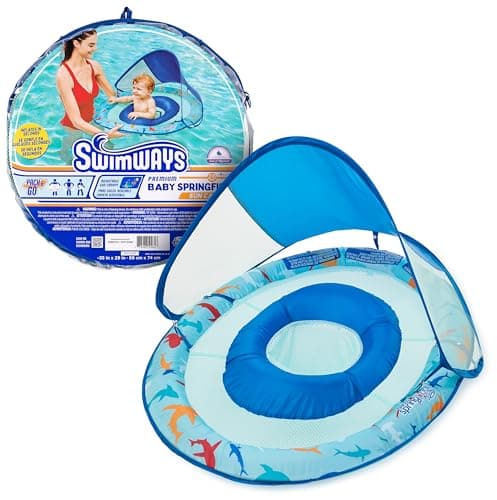 Top pick SwimWays Baby Spring Float A fabric-seated baby float with an inner spring frame and a removable sun canopy — shade is the point. | Babies, shaded floating | Approx. 9-24 months | |
| 2 | 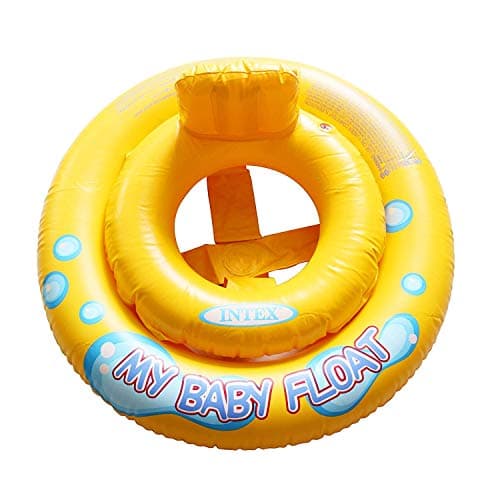 Budget pick Intex My Baby Float The bare minimum: a small vinyl ring with a seat, no canopy, and a price that makes it an impulse buy. | Cheapest option | None | |
| 3 | 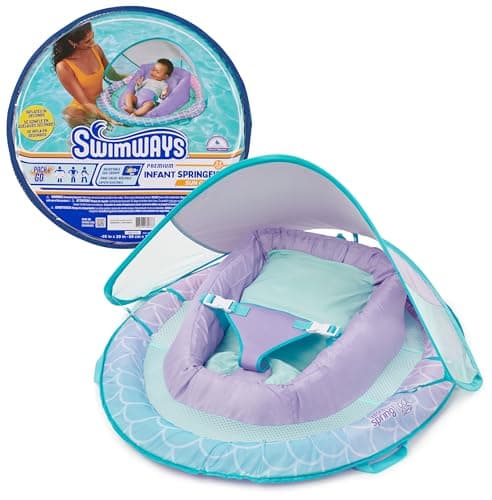 Also good SwimWays Infant Spring Float with Canopy The same design scaled down for a baby who cannot sit up unaided yet, with more back support and a smaller seat. | 3-9 months | 3-9 months | |
| 4 | 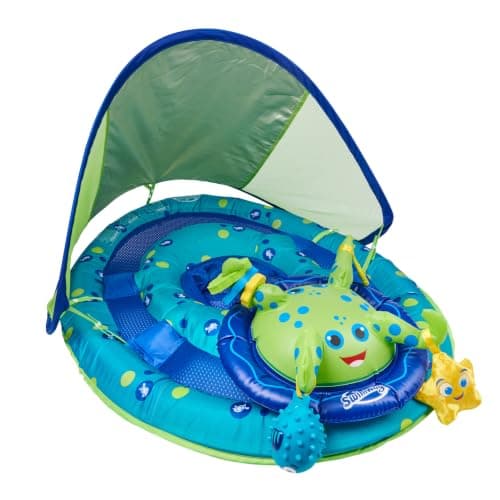 Also good SwimWays Baby Spring Float Activity Center The same hull with a splash-and-play tray in front, for the baby who objects to sitting still. | Babies who get bored | Included | |
| 5 | 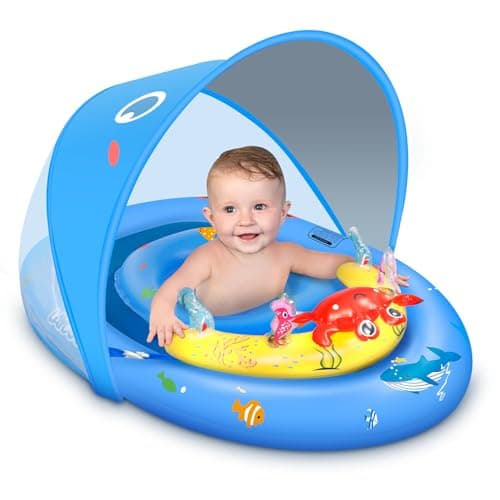 Also good LAYCOL Baby Pool Float with Canopy An adjustable canopy and an anti-tip seat design, covering a wider age span than the SwimWays floats. | Wider age range | 6-36 months |
Read this before you shop
A baby float is a shade-and-comfort toy. It is not flotation safety equipment, it is not a life jacket, and no amount of "swim training PFD" wording on the box changes that. The American Academy of Pediatrics is blunt about it: "Avoid floaties, water wings or inflatable toys. These can deflate and do not prevent drowning."
The AAP's guidance for babies and toddlers in water is to stay within arm's length, providing constant touch supervision — the same standard as bath time. A float does not relax that requirement by one inch. What it does is let a baby sit comfortably in cool water under shade for longer than an adult's arms can hold them there, which is a genuinely useful thing on a hot lake afternoon.
So this page judges floats on comfort, shade and how hard they are to tip — not on safety, because none of them offer any. If what you actually need is flotation, you need a Coast Guard approved infant or toddler life jacket, and the difference between the two product types is laid out in life jacket vs swim vest.
The four things that decide a good baby float
- A canopy, and a removable one. This is the whole purchase. A baby sitting in open water at midday is a baby in full reflected sun, and a float without shade gets used for ten minutes before you take them out. Removable matters because on a mild or overcast day the canopy just blocks the breeze. Look for a stated UPF rating — the SwimWays canopy is UPF 50+, which is the same standard explained in our UPF ratings guide.
- An inner spring or a structured outer ring. The failure mode of a plain vinyl ring is folding in half when a baby leans over the edge. SwimWays' patented inner spring exists specifically to stop that, and it is the single biggest construction difference between a bottom-of-the-market ring and a mid-tier one.
- A mesh seat rather than a vinyl one. Mesh lets the baby sit *in* the water, which keeps them cool and is most of why they stay happy. A vinyl seat holds them above it, warm, in the sun.
- See-through canopy sides. Sounds like marketing; is not. A solid canopy means you spend the whole time ducking around it to check a face. Mesh panels keep eye contact, which is what touch supervision actually looks like in practice.
SwimWays Baby Spring Float
A fabric-seated baby float with an inner spring frame and a removable sun canopy — shade is the point.
Specifications
- Age
- Approx. 9-24 months
- Seat
- Fabric, leg holes
- Canopy
- Removable, UPF-rated
- Frame
- Inner spring, folds flat
What works
- The canopy is the reason to buy it — a baby on open water needs shade more than anything else
- Fabric seat with leg holes holds a baby upright rather than letting them slump
- Spring frame folds flat into a bag, so it travels
- Wide base is stable in calm water
What doesn’t
- Not a flotation device and gives no protection if it tips — an adult stays within arm's reach, always
- Calm water only; useless in chop or wake
Who it’s for
Babies from about nine months on a calm lake edge or in a pool, with an adult in the water.
Bottom line
A shade tool, not a safety device. On a boat or in open water a baby needs a USCG-approved infant vest instead.
Intex My Baby Float
The bare minimum: a small vinyl ring with a seat, no canopy, and a price that makes it an impulse buy.
Specifications
- Canopy
- None
- Seat
- Vinyl, with leg holes
- Construction
- Inflatable vinyl ring
- Price bracket
- Bottom of the market
What works
- Cheap enough to be a holiday-week purchase rather than a considered one
- Packs down to nothing, so it lives in a beach bag all summer without taking a slot
- Simple shape means nothing to assemble and nothing to lose
- Fine for twenty minutes in shade, which is honestly what a lot of babies want
What doesn’t
- No canopy at all, so a baby in it is in full sun — on a lake at midday that is the problem, not a nice-to-have
- No inner spring, so it folds and tips far more easily than a Spring Float
- Vinyl seat rather than mesh, which means the baby sits warm and above the water instead of cooled by it
- Thin material and the same non-safety-device caveat as every float here
Who it’s for
Shaded water, short sessions, or a family that wants a float in the bag without spending real money.
Bottom line
Buy it as a backup or for shaded swims. For a sunny lake day the canopy on the SwimWays is worth the extra.
SwimWays Infant Spring Float with Canopy
The same design scaled down for a baby who cannot sit up unaided yet, with more back support and a smaller seat.
Specifications
- Age
- 3-9 months
- Canopy
- Included
- Seat
- Mesh, supported
- Design
- Inner-spring outer ring
What works
- Fills the gap the 9-24 month floats leave: a 4 month old simply does not fit those seats safely
- More back and head support than the older-baby version, which is the whole point at this age
- Same inner-spring ring and canopy approach as its bigger sibling
- Folds flat for a lake bag like the rest of the Spring Float range
What doesn’t
- An extremely short useful life — months, not summers, and then you need the 9-24 month float
- Costs about the same as the bigger float you will buy next, which makes it a hard second purchase to justify
- Still not a safety device, and a baby this age needs an adult's hands on the float, not just nearby
- SwimWays does not publish a weight limit as prominently for this model as for the 9-24 month one
Who it’s for
A 3-9 month old on a first calm-water outing, held by an adult rather than left to drift.
Bottom line
Buy it only if your baby is genuinely under 9 months this season. Otherwise skip straight to the 9-24 month float.
SwimWays Baby Spring Float Activity Center
The same hull with a splash-and-play tray in front, for the baby who objects to sitting still.
Specifications
- Canopy
- Included
- Extra
- Activity tray with toys
- Seat
- Mesh with leg holes
- Design
- Inner-spring outer ring
What works
- The toy tray buys you the extra fifteen minutes that turns a float into something the baby wants to be in
- Keeps hands busy and above water, which cuts the amount of lake water that ends up in a mouth
- Same proven spring-ring and canopy construction as the plain Baby Spring Float
- Sits a little higher at the front, which some babies prefer to a fully reclined seat
What doesn’t
- The tray makes it bulkier to pack and slower to dry than the plain version
- Small attached toys are more parts to lose at a lake, and they are not replaceable individually
- Same hard truth as the rest: an inflatable float is not flotation safety equipment
- More money for an accessory, not for more support or a better canopy
Who it’s for
A 9-24 month old who gets bored in a plain float, when the extra few dollars buys actual water time.
Bottom line
A genuine upgrade only if your baby is the kind who lasts ten minutes in a plain float. Otherwise the standard model is the better value.
LAYCOL Baby Pool Float with Canopy
An adjustable canopy and an anti-tip seat design, covering a wider age span than the SwimWays floats.
Specifications
- Age
- 6-36 months
- Canopy
- UPF 50+, 120-degree adjustable
- Seat
- Anti-tip design
- Extras
- Attached animal toys
What works
- The 6-36 month span covers both ends of the SwimWays range, so one float can last two seasons
- The canopy angle adjusts, which matters when the sun is low and a fixed canopy shades nothing
- Anti-tip seat construction is the feature parents complain is missing from cheap ring floats
- Usually sits below the SwimWays price while including the canopy
What doesn’t
- LAYCOL is a marketplace brand with no manufacturer site to check specs against, so the listing is the only source
- No published weight limit, which is the figure you actually need at the top of that 36-month range
- No inner spring, so it folds more readily than a Spring Float when a toddler leans hard
- Still an inflatable toy and still not a substitute for an arm's-length adult
Who it’s for
Parents who want one float to cover a 6-36 month span and will accept less published spec detail for it.
Bottom line
A reasonable buy for the age range and the adjustable canopy. If you want a maker you can look up, buy the SwimWays.
Buy for the age your baby is now
Float age bands are narrow and they are not marketing. A 4 month old cannot hold their own head up reliably and does not fit a seat designed for a sitting 18 month old; a 20 month old in an infant float is squeezed and will tip it.
- 3-9 months: the infant floats, with more back and head support. Short useful life — plan on part of one season.
- 9-24 months: the main category, and where the best products are. A sitting, grabbing baby who wants to splash.
- 6-36 months: the wider-span marketplace floats. One purchase instead of two, with less published spec detail.
- 2 years and up: past float territory. This is where a toddler swim vest or a proper life jacket takes over.
Check the weight limit as well as the age. The SwimWays 9-24 month float is rated to 33 lbs, and a big 20 month old can be close to that. A float loaded past its limit sits low and tips readily, which is exactly the behavior you do not want.
How much should you spend?
This is a small-money category where the extra spend is unusually well justified. The gap between the cheapest float and the best one is roughly the price of two coffees, and it buys a UPF 50+ canopy and an anti-fold inner spring — the two features that decide whether the float gets used all summer or twice.
What is not worth paying for: toy trays, unless your particular baby genuinely will not sit still without one, and licensed character prints, which cost more and fade first. The honest ranking is canopy, then spring ring, then mesh seat, then everything else — which follows the same buy-the-feature-not-the-badge logic as our family swim gear budget guide.
And budget for the thing most people forget: a float is one summer of hard use. Vinyl punctures, seams go, and a float stored damp grows mold in the seat mesh. Treat it as a consumable rather than an heirloom and the cheap-versus-good question gets easier.
Using one on a lake rather than a pool
A lake is harder on a baby float than a pool in three specific ways, and none of them appear on the box.
Wind moves it. An unanchored float with a canopy is a sail. On open water a light breeze will walk it out faster than you expect, which is one more reason the arm's-length rule is not optional. Stay upwind of the float, not downwind of it.
The bottom is not smooth. Inflate and deploy on grass or sand, not on gravel or a dock, and keep it off rocky shallows. A single sharp stone is the end of a vinyl float. Our float care and storage guide covers patching and off-season storage for the rest of the family's floats too.
Lake water goes in mouths. A seated baby splashes and then licks their hands. The CDC's healthy-swimming guidance applies to the smallest swimmers most of all, and it is worth reading alongside our swimmer's itch page before a weedy-shallows day.
What to do about sun, beyond the canopy
The canopy shades the top of the head and the shoulders. It does not shade the arms, the tops of the feet, or the face when the sun is low, and it does nothing about the glare coming back up off the water — which is the burn that surprises people.
The combination that works is a UPF 50+ rash top, a hat, shade on shore and sunscreen on the gaps, which is exactly what our baby sun protection guide sets out. Use the float for the shaded half-hour, then get the baby out and under a real umbrella.
Care, so it survives to next summer
Rinse the seat mesh in fresh water after every lake use — the mesh is where silt and weed collect, and silt is what makes a float smell. Dry it fully, open, in shade. Sun hardens vinyl and makes the next-season seams split, and a float rolled away damp grows mold in exactly the part that touches the baby.
Store it inflated or loosely folded rather than creased hard, and keep the valve plugs in. Most baby floats that die over winter die from a crease that became a split, not from use. A float is not the first decision, though: start with when can babies swim in a lake.
Before buying any of these, it is worth being clear about what a baby float is and is not — none of them is a flotation safety device: are pool floats safe for babies?
Questions
Frequently asked questions
Are baby pool floats safe?
What age can a baby use a pool float?
Do baby floats with canopies really help with sun?
Why do some baby floats cost three times more than others?
Can you use a baby float in a lake?
Do I need a baby float if my baby has a life jacket?
Sources
Read next