Floats & Towables · Guide
Are Pool Floats Safe for Babies?
They are not safety equipment. Used with that understood, they are fine.
The short answer
A baby pool float is a comfort and shade device, not a flotation safety device. It can tip, it can deflate, and it is not Coast Guard approved. Used within arm's reach in calm water for short periods, it is reasonable. Used as a reason to step away, it is dangerous.
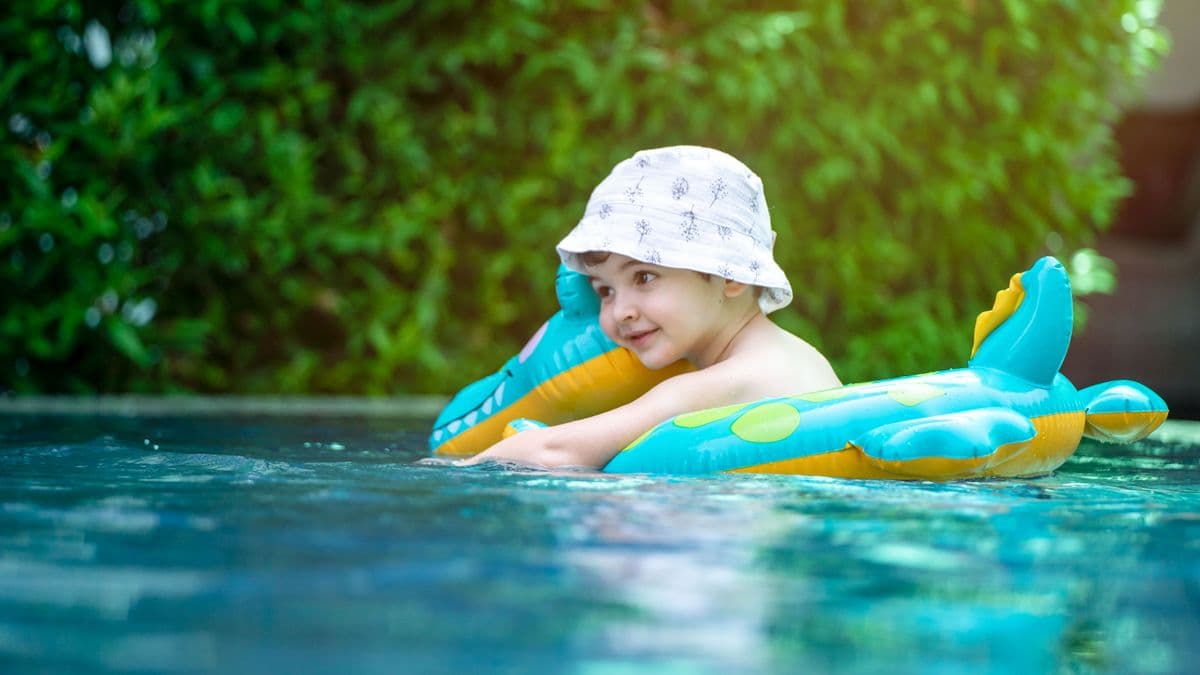
Product photos are the retailer’s own catalogue images, shown from the retailer’s servers and refreshed daily. Any other photo here is a licensed image that illustrates the category, not a photograph of the specific product named.
The honest answer
Baby floats are not safety devices and no manufacturer claims otherwise — read the box and you will find a line saying exactly that. They are not US Coast Guard approved, they are not tested as personal flotation devices, and they are not designed to keep a baby's airway clear if something goes wrong.
What they are is a comfortable, shaded place for a baby to sit in the water next to an adult, which is a genuinely useful thing. A nine-month-old in a canopied spring float will stay happy in a lake for twenty minutes in a way that the same baby held in your arms in the sun will not.
So the answer is conditional, and the condition is the only thing on this page that matters: a baby float is safe when an adult is within arm's reach, in calm shallow water, for a short period. It is dangerous the moment it becomes a reason to let go.
The four failure modes
Tipping. A baby leans, reaches for a toy, or is caught by a small wave, and the float rotates. Spring-float designs with a supported seat and a wide outer ring tip far less readily than a simple inflatable ring, but none of them is tip-proof.
Slipping through. Leg-hole seats depend on the baby being within the float's age and weight range. A baby below the range can slide through the seat; a baby above it sits too high and makes the float top-heavy.
Deflation. Inflatables lose air, and vinyl punctures on a gravel shore or a dock cleat. A float checked at the start of the day can be noticeably softer by the end of it.
Drift. This is the lake-specific one. A float with a baby in it has almost no draft and a lot of surface area, so a light breeze moves it faster than you expect. On a lake with any wind at all, a float is only ever in your hand.
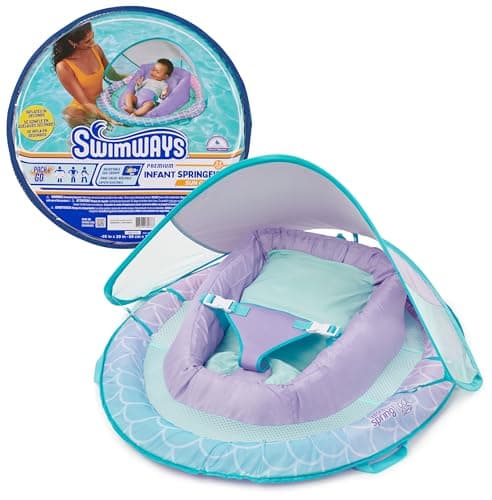
SwimWays Infant Spring Float with Canopy
The same design scaled down for a baby who cannot sit up unaided yet, with more back support and a smaller seat.
Specifications
- Age
- 3-9 months
- Canopy
- Included
- Seat
- Mesh, supported
- Design
- Inner-spring outer ring
What works
- Fills the gap the 9-24 month floats leave: a 4 month old simply does not fit those seats safely
- More back and head support than the older-baby version, which is the whole point at this age
- Same inner-spring ring and canopy approach as its bigger sibling
- Folds flat for a lake bag like the rest of the Spring Float range
What doesn’t
- An extremely short useful life — months, not summers, and then you need the 9-24 month float
- Costs about the same as the bigger float you will buy next, which makes it a hard second purchase to justify
- Still not a safety device, and a baby this age needs an adult's hands on the float, not just nearby
- SwimWays does not publish a weight limit as prominently for this model as for the 9-24 month one
Who it’s for
A 3-9 month old on a first calm-water outing, held by an adult rather than left to drift.
Bottom line
Buy it only if your baby is genuinely under 9 months this season. Otherwise skip straight to the 9-24 month float.
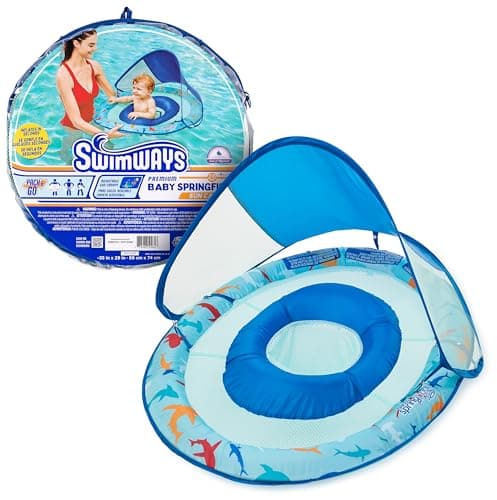
SwimWays Baby Spring Float
A fabric-seated baby float with an inner spring frame and a removable sun canopy — shade is the point.
Specifications
- Age
- Approx. 9-24 months
- Seat
- Fabric, leg holes
- Canopy
- Removable, UPF-rated
- Frame
- Inner spring, folds flat
What works
- The canopy is the reason to buy it — a baby on open water needs shade more than anything else
- Fabric seat with leg holes holds a baby upright rather than letting them slump
- Spring frame folds flat into a bag, so it travels
- Wide base is stable in calm water
What doesn’t
- Not a flotation device and gives no protection if it tips — an adult stays within arm's reach, always
- Calm water only; useless in chop or wake
Who it’s for
Babies from about nine months on a calm lake edge or in a pool, with an adult in the water.
Bottom line
A shade tool, not a safety device. On a boat or in open water a baby needs a USCG-approved infant vest instead.
Stearns Infant Classic Series Vest
An infant vest with the two features that matter at this size: a head pillow and a crotch strap.
Specifications
- USCG class
- Type II, approved
- Weight range
- Under 30 lbs
- Head support
- Flotation collar
- Closure
- Buckles plus crotch strap
What works
- The flotation collar supports an infant's head, which is the whole point at this weight
- Crotch strap stops the vest lifting off a small body in water
- Grab handle at the collar lets an adult lift the child straight out
- Type II turns most wearers face-up, which an infant cannot do for themselves
What doesn’t
- Bulky and warm, and most infants object to it initially
- A vest is never a substitute for arm's-length supervision at this age
Who it’s for
A baby or small toddler under 30 lbs on or near a boat.
Bottom line
Required kit if an infant is going on the water. Fit it dry, on land, and lift by the collar handle to check it does not slip off.
The five rules
- Touch supervision, always. One adult, within arm's reach, whose job is the baby and nothing else. Not watching from a chair, not the older sibling, not a phone in the other hand.
- Match the age and weight range exactly. A 3-9 month float and a 9-24 month float are different products for a reason, and the difference is the seat geometry.
- Calm, shallow water only. No boat wake, no wind, no current, no deep water you cannot stand up in.
- Check the inflation and the seams every time. Firm, no soft spots, no slow hiss, no split seams.
- Short sessions, with shade. Twenty minutes is plenty. A canopy covers the baby and not the water around them, so you still need shade for the rest of the trip.
None of these is unusual advice — it is the same supervision standard that pediatric water-safety guidance applies to any young child near water, with the float treated as furniture rather than as equipment.
A float is not a life jacket, and it is not swim training
This is where the real confusion lives, because the shelf next to the floats also holds swim vests, arm bands and puddle jumpers, and all of them look vaguely like the same category.
| Device | What it is for | USCG approved? |
|---|---|---|
| Baby pool float | Sitting comfortably in calm water, with shade | No |
| Swim vest / puddle jumper | Confidence and buoyancy in a pool, supervised | Usually not |
| Infant life jacket (Type II) | Keeping an unconscious infant's head up | Yes, when labeled |
On a boat, on a dock, or anywhere near deep water, the answer is an approved infant life jacket with a head-support collar and a crotch strap — not a float and not a vest. The distinction is spelled out in life jacket vs swim vest, and the sizing is in life jacket sizing by weight.
Floats also do not teach swimming. A baby in a float is in a fixed upright posture, which is the opposite of the horizontal position swimming requires, so time in a float is not practice. It is a pleasant way to be in the water, and that is worth something on its own.
What to buy, if you buy one
Look for a supported seat rather than a plain leg-hole ring, an inner-spring outer ring that holds its shape, a removable UPF-rated canopy, and a stated age range in months rather than a vague "baby" label. The products that do all four are the ones worth the money, and they are not the cheapest ones on the shelf.
Skip anything with an inflatable seat the baby straddles, anything that props a baby face-down, and anything without a published age range. The roundup with the full picks is best baby floats.
Questions
Frequently asked questions
Are baby pool floats safe?
At what age can a baby use a pool float?
Can a baby drown in a pool float?
Do babies need a life jacket instead of a float?
Are canopy floats worth it for babies?
Sources
Read next