Life Jackets & Safety · Comparison
Life Jacket vs Swim Vest
One is certified safety equipment. The other is a teaching aid. They are not interchangeable.
The short answer
A life jacket is USCG-approved safety equipment that satisfies boating law and provides head support. A swim vest is a teaching aid with no approval, designed to hold a child horizontal to practice strokes. Most families with young children need both, for different situations.
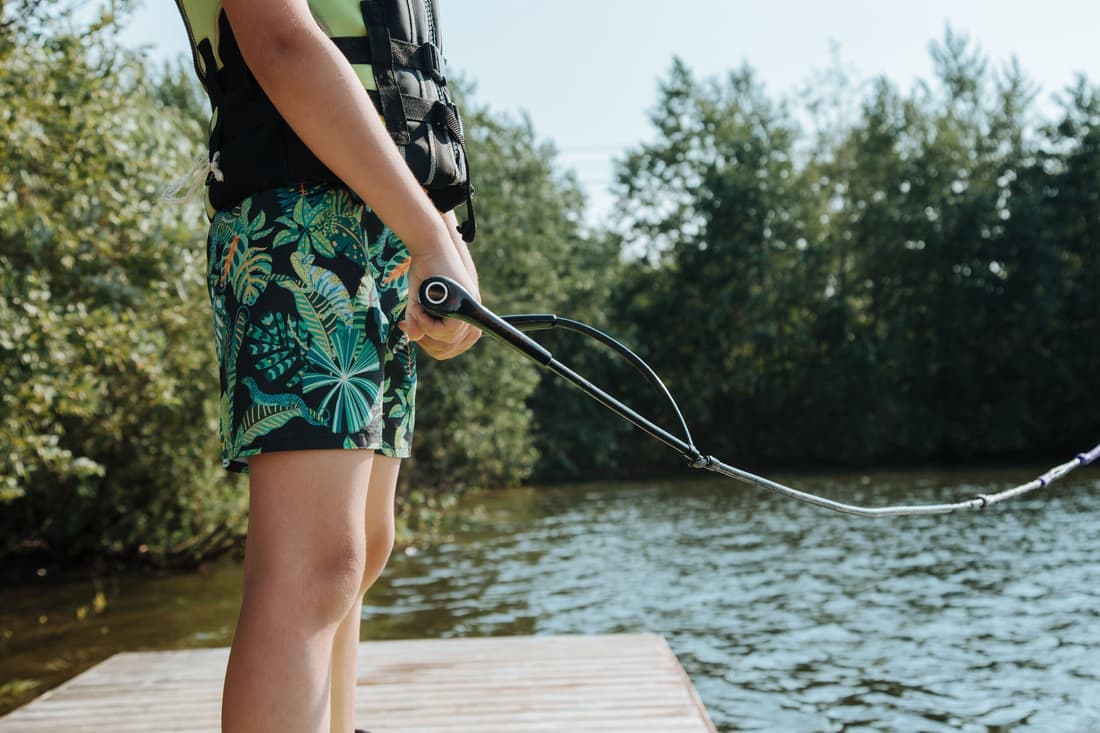
Photos on this page are licensed images that illustrate the category. They are not photographs of the specific products named, and no product image here is supplied by a manufacturer or retailer.
| Life jacket (PFD) | Swim vest / swim aid | |
|---|---|---|
| USCG approved | Yes | No |
| Satisfies boating law | Yes | No |
| Head support | Yes on infant and Type II designs | None |
| Body position | Upright, face clear | Horizontal — the stroke position |
| Flotation adjustable | No | Often yes, removable panels |
| Bulk | Higher | Low |
| Where it belongs | Boats, docks, open water, towing | Supervised pool or shallow lake edge |
| Works if the wearer is unconscious | Designed for it (varies by type) | No |
| Purpose | Keep a person afloat and face clear | Teach a stroke |
What a swim vest is actually for
A swim vest has a genuine and useful job, and it is worth being clear about it rather than dismissing the category. It holds a child horizontal — the body position that swimming actually requires — with low enough bulk that the arms and legs move freely. A life jacket cannot do that: it holds the body upright, because that is what keeps a face clear of the water.
Better swim vests also have removable flotation panels, so you reduce the support as a child improves. That progression is the whole point of a teaching aid and no life jacket offers it, because reducing a life jacket's flotation would defeat its purpose.
So a swim vest is a tool for building a stroke. It is not, and is not sold as, a device that will keep a non-swimmer's face clear of the water unattended.
Choose a life jacket if...
- There is a boat, a dock, a towable tube, or any open water away from a shallow shore.
- You need to satisfy the legal requirement for an approved wearable device per person aboard.
- The child is an infant who needs head support.
- The child is a non-swimmer and the water is deeper than they can stand in.
- You want one item that covers every situation — this is the one that does.
Choose a swim vest if...
- The child is practicing strokes in a supervised pool with an adult in the water.
- You want to reduce flotation progressively as they improve.
- A life jacket's bulk is preventing them from moving their arms properly.
- You are at a calm, shallow lake edge with an adult within arm's reach.
Why most families end up with both
A family with a four-year-old in swim lessons and a boat needs two different things, and no single product covers both. The vest comes to the pool. The approved jacket comes on the water. They cost little enough together that this is not a real financial decision.
The failure mode to avoid is using the vest because it is the one already in the car. It is low-bulk, comfortable and easy, which is exactly why it gets reached for — and it is not certified for the situation.
Our picks
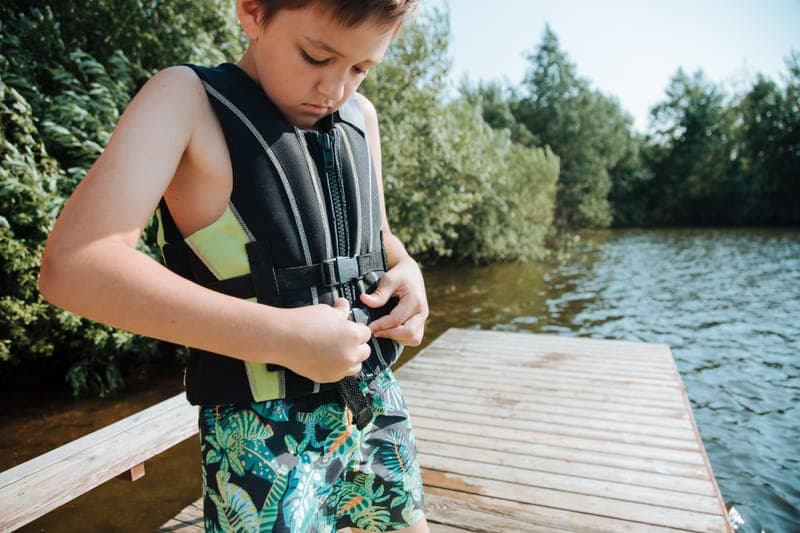
Stearns Puddle Jumper Deluxe
A USCG-approved Type III that children accept, because the arm floats leave the shoulders free.
Specifications
- USCG class
- Type III, approved
- Weight range
- 30-50 lbs
- Closure
- Single rear buckle
- Flotation
- Chest panel plus arm floats
What works
- Genuinely USCG-approved, unlike the water wings and arm bands it resembles
- The rear-only buckle is behind the child, so they cannot undo it themselves
- Children tolerate it for a whole afternoon, which is the property that actually keeps them in it
- Holds a swimmer upright and slightly forward, which suits pool and calm-lake play
What doesn’t
- Not designed to turn an unconscious wearer face-up — that is a Type I offshore jacket
- The upright-forward position teaches a vertical body posture that has to be unlearned in lessons
Who it’s for
A 30-50 lb child in a pool or on a calm lake shore, supervised at arm's length.
Bottom line
The most-worn kids' PFD in America for a reason. Check the printed USCG approval on the label, because look-alikes without it are everywhere.
Speedo Begin to Swim Kids' Swim Vest
A swim aid, not a life jacket: it holds a child horizontal to practice stroke, and is not USCG approved.
Specifications
- USCG class
- Not approved — swim aid only
- Weight range
- Approx. 33-55 lbs
- Flotation
- Removable front and back panels
- Closure
- Zip plus buckle
What works
- Removable panels let you reduce flotation as a child improves, which no life jacket does
- Holds a swimmer horizontal, which is the body position lessons are actually teaching
- Low bulk, so it does not stop arm movement
- Cheap and easy to pack
What doesn’t
- NOT USCG approved — it does not satisfy boating law and must never be used in place of a life jacket
- Provides no head support and will not keep a non-swimmer's face clear on its own
Who it’s for
A child practicing strokes in a supervised pool or a calm, shallow lake edge with an adult in the water.
Bottom line
A teaching tool. On a boat, at a dock, or in open water, it is the wrong item — use an approved Type II or III.
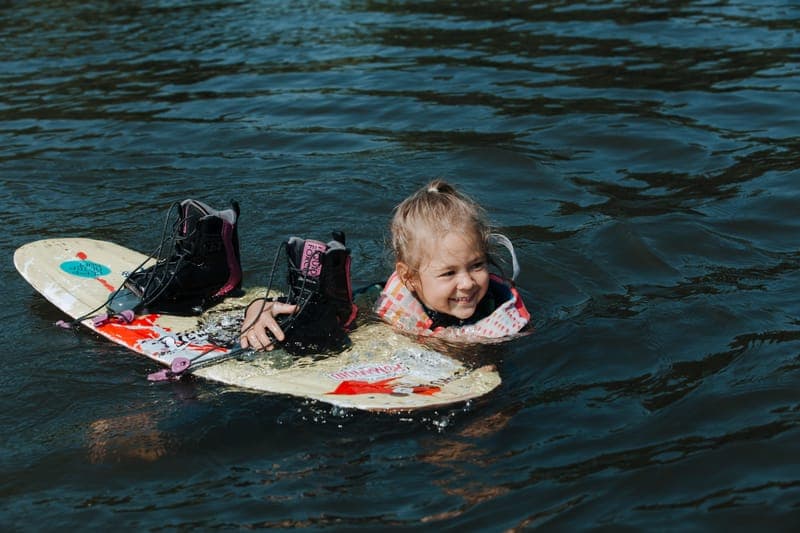
SwimWays Sea Squirts Swim Vest
A soft, low-bulk toddler swim aid that builds water confidence — again, not a life jacket.
Specifications
- USCG class
- Not approved — swim aid only
- Weight range
- Approx. 30-50 lbs
- Flotation
- Foam, soft fabric shell
- Closure
- Rear buckle
What works
- Very low bulk, so a toddler forgets they are wearing it
- Soft fabric shell does not chafe under the arms the way hard foam can
- Rear buckle is out of a toddler's reach
- Cheap enough to own alongside a real life jacket
What doesn’t
- NOT USCG approved — pool and supervised shallow water only
- Flotation is fixed, so it does not adapt as the child improves
Who it’s for
A toddler getting comfortable in a supervised pool with an adult within arm's reach.
Bottom line
Fine as a confidence aid. Anything involving a boat needs an approved infant or child vest instead.
The approved Puddle Jumper above is the one to take on the water; the two swim vests are for supervised practice. If your child is under 30 lbs, see best toddler life jackets instead — the Puddle Jumper's band starts at 30 lbs.
Questions
Frequently asked questions
Is a swim vest Coast Guard approved?
Can a swim vest be used instead of a life jacket on a boat?
Are swim vests good for learning to swim?
What is the best swim vest for toddlers?
Sources
Read next