Swim Goggles · Roundup
Best Kids' Swim Goggles (2026)
Six pairs that actually seal a child's face, sorted by age and by what goes wrong.
The short answer
For most children aged 3 to 10, the TYR Kids' Swimple is the pick: an oversized soft gasket on a one-piece frame, which is the combination that seals a small face. For a child on a swim team, step up to the Speedo Jr. Vanquisher 3.0 and its interchangeable nose bridges.
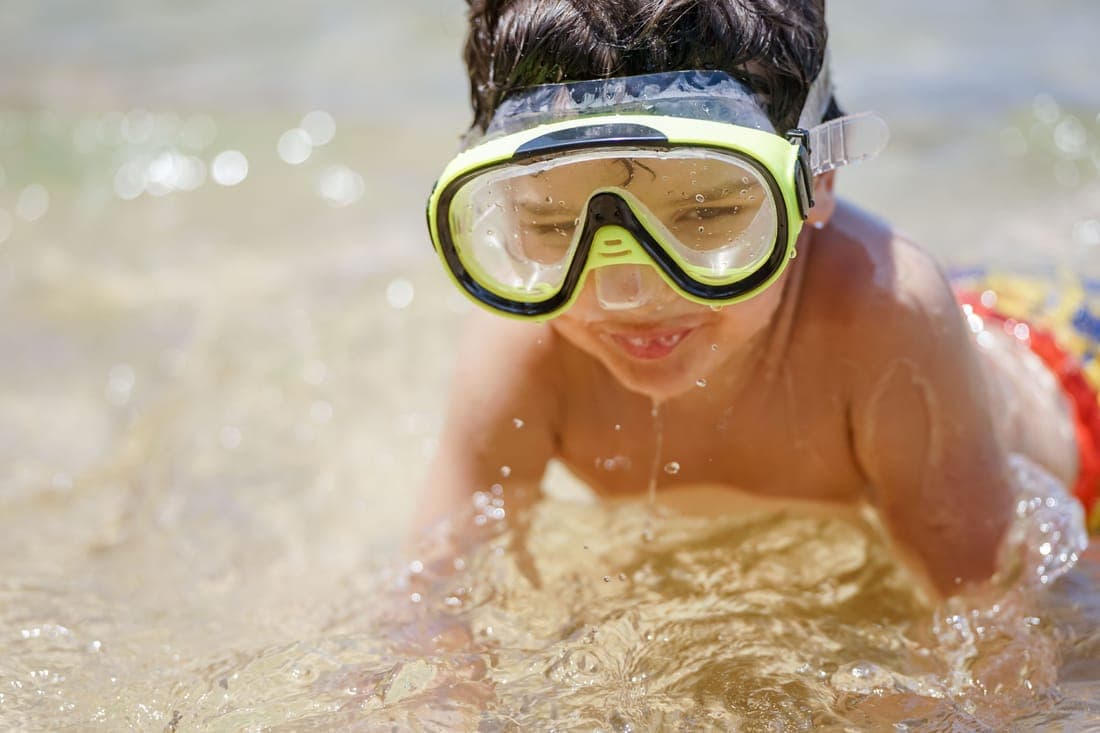
Photos on this page are licensed images that illustrate the category. They are not photographs of the specific products named, and no product image here is supplied by a manufacturer or retailer.
| # | Product | Best for | Age range | Price |
|---|---|---|---|---|
| 1 |  Top pick TYR Kids' Swimple Oversized soft gaskets on a one-piece frame, which is the combination that actually seals a small face. | Ages 3-10, first goggles | 3-10 years | |
| 2 | Budget pick Speedo Kids' Skoogles The softest, most forgiving gasket in the category — it seals even when a child pulls it on crooked. | Toddlers, nervous beginners | 3-8 years | |
| 3 | Upgrade pick Speedo Jr. Vanquisher 3.0 Adult-grade optics in a junior frame, with interchangeable nose bridges that grow with the face. | Swim team, ages 7-14 | 6-14 years | |
| 4 | Also good Aqua Sphere Kayenne Jr. A wide curved lens that gives a genuinely panoramic view — the useful choice where a child cannot see the bottom. | Open water and lakes | 6-12 years | |
| 5 | Also good Arena Tracks Jr. Built like the adult Tracks and priced close to a toy pair, which is why they survive being stepped on. | Durability, ages 6-12 | 6-12 years | |
| 6 | Also good Aqua Sphere Vista A swim mask, not goggles: it seals around the whole eye area and the nose, so nothing presses on the eye socket. | Kids who hate eye pressure | Swim mask |
How we chose these six
We researched the goggles that are actually stocked and sold for children in 2026, compared published specifications, and read public buyer feedback at volume looking for one thing: the recurring failure mode. Across thousands of parent reviews the same three complaints dominate — it leaks, it fogs, it leaves marks — and all three trace back to gasket shape rather than to price.
So the list is organized by face rather than by feature count. There are six pairs here, not nineteen. A parent buying for three children does not need a spreadsheet; they need to know which one to buy for a five-year-old and which one to buy for a ten-year-old on a team.
TYR Kids' Swimple
Oversized soft gaskets on a one-piece frame, which is the combination that actually seals a small face.
Specifications
- Age range
- 3-10 years
- Gasket
- Silicone, oversized
- Frame
- One-piece
- Lens
- Anti-fog, UV
What works
- One-piece frame has no nose-bridge adjustment to get wrong, which removes the most common source of leaks on small faces
- Soft silicone gasket sits wide of the eye socket, so it seals against cheek rather than thin skin
- Hypoallergenic silicone matters for kids who react to latex straps
- Cheap enough to replace mid-season without a conversation about it
What doesn’t
- No bridge adjustment at all, so a very narrow or very wide face has no fallback
- Strap clip is fiddly for a child to adjust alone
Who it’s for
A child between about 3 and 10 who is in the water for lessons and lake days rather than training, and who has already lost or broken a pair.
Bottom line
The default first pair. If you are buying goggles for a child under 10 and do not want to think about it, buy these.
Speedo Kids' Skoogles
The softest, most forgiving gasket in the category — it seals even when a child pulls it on crooked.
Specifications
- Age range
- 3-8 years
- Gasket
- Oversized soft silicone
- Frame
- One-piece, flexible
- Lens
- Anti-fog, UV
What works
- Very forgiving fit — the gasket is deep enough that a crooked pull-on still seals
- Wide, shallow lens avoids the pressure ring that makes small children refuse goggles
- Single-strap adjustment a four-year-old can manage
- Widely stocked, so a mid-trip replacement is realistic
What doesn’t
- Soft gasket leaves a visible mark after a long session
- Too loose on the face of a child over about 8
Who it’s for
A toddler or young child who has tried goggles once and hated them. This is the pair that usually fixes that.
Bottom line
Buy these if the problem is refusal rather than leaking. Comfort is what they optimize for and it works.
Speedo Jr. Vanquisher 3.0
Adult-grade optics in a junior frame, with interchangeable nose bridges that grow with the face.
Specifications
- Age range
- 6-14 years
- Gasket
- Silicone, low-profile
- Nose bridge
- Interchangeable, 3 sizes
- Lens
- Anti-fog, UV, mirrored options
What works
- Interchangeable bridges mean one pair covers two or three years of face growth instead of one season
- Low-profile gasket is what competitive kids actually wear, so a child on a team will not ask to swap them
- Double-strap head cradle stays put off a starting block or a dock
- Mirrored lenses are genuinely useful outdoors, not just styling
What doesn’t
- Low-profile gaskets need the correct bridge size to seal; get it wrong and they leak more than a soft-gasket pair
- Wrong shape for a child under about 6
Who it’s for
A child swimming twice a week or more, past beginner lessons or on a summer league team.
Bottom line
Worth the step up only for a regular swimmer. For a child who swims six times a summer, the Swimple does the same job for less.
Aqua Sphere Kayenne Jr.
A wide curved lens that gives a genuinely panoramic view — the useful choice where a child cannot see the bottom.
Specifications
- Age range
- 6-12 years
- Field of view
- Wide, 180-degree style
- Gasket
- Soft silicone, curved
- Lens
- Anti-fog, UV, tinted options
What works
- The wide lens is not a gimmick in murky water — peripheral vision is how a child keeps track of a parent or a dock
- Curved gasket spreads pressure across the cheekbone instead of the eye socket
- Quick-adjust buckles work with wet hands
- Tinted versions cut glare off open water, the actual complaint on bright lake days
What doesn’t
- Larger lens is more exposed and picks up scratches faster in a beach bag
- Bulkier than a low-profile pair, so a competitive swimmer will not want them
Who it’s for
A child who swims mostly in open water — a lake, a river, a bay — rather than a clear pool.
Bottom line
The lake pick. Where visibility is poor, field of view is worth more than a sleeker frame.
Arena Tracks Jr.
Built like the adult Tracks and priced close to a toy pair, which is why they survive being stepped on.
Specifications
- Age range
- 6-12 years
- Gasket
- Silicone
- Nose bridge
- Self-adjusting
- Lens
- Anti-fog, UV, polycarbonate
What works
- Self-adjusting bridge removes the sizing decision without locking you to one face width
- The frame-to-strap junction is what usually fails first, and Arena reinforces it
- Comfortable enough for an hour-long lesson
- Wide color range makes them findable in a bag of identical black goggles
What doesn’t
- A self-adjusting bridge fits most faces well and no face perfectly
- Strap is thinner than Speedo's and can pull fine hair
Who it’s for
A family that loses or breaks goggles routinely and wants a pair that survives a second summer.
Bottom line
The most durable pair at the price. Add a swim cap if your child has long hair, because the thin strap pulls.
Aqua Sphere Vista
A swim mask, not goggles: it seals around the whole eye area and the nose, so nothing presses on the eye socket.
Specifications
- Type
- Swim mask
- Seal
- Around eyes and nose
- Field of view
- Very wide
- Lens
- Anti-fog, UV
What works
- No pressure on the eye socket at all, which solves the most common reason a child refuses goggles
- Covers the nose, so water does not go up it — a real fear for beginners
- Very large field of view
- Sizing runs wide enough to cover older children as well as adults
What doesn’t
- Bulky and draggy, so it is wrong for anyone swimming laps for time
- You breathe through the mouth only, which takes some children a session to accept
Who it’s for
A child who has rejected two or three pairs of conventional goggles, or who panics about water up the nose.
Bottom line
The escape hatch when nothing else works. Not a training choice — but a child in a mask is a child in the water.
What to look for in kids' swim goggles
Gasket size beats everything. A child's eye sockets are closer together and shallower than an adult's. An oversized soft gasket sits wide, on cheekbone rather than on thin skin around the eye, and seals by area rather than by precision. A low-profile racing gasket seals by precision, which is why it needs exactly the right nose bridge and why it leaks on a face that is between bridge sizes.
One-piece frames remove a decision. On a one-piece frame there is no bridge to size, so either the frame matches the face or it does not — and you can tell in three seconds with the suction test below. For children under about eight that is usually the right trade.
Silicone, not PVC. Bargain-bin goggles use soft PVC gaskets that compress permanently within a season and then leak no matter how you adjust them. Silicone holds its shape for one to three seasons. It is also hypoallergenic, which matters for children who react to latex straps.
UV protection, and a tint if you swim outdoors. Every pair here has UV protection; many supermarket goggles do not. If most of your swimming is in open water, a tinted or mirrored lens genuinely cuts glare, and glare is the complaint parents raise most often about bright lake days.
The suction test: do this before you buy
- Take the strap off the back of the head and hold it out of the way.
- Press the goggles onto dry eye sockets with light pressure.
- Let go. Count to three.
- If they hold on suction alone, the gasket matches the face. The strap will only be holding them in position.
- If they fall straight off, the shape is wrong. No strap tension will make them watertight — it will just leave marks.
How much should you spend?
For a child who swims a handful of times a summer, the cheapest pair here is the right answer, and buying two of them is better than buying one of anything more expensive. Goggles get lost. A spare pair in the car has prevented more ruined afternoons than any feature on a spec sheet.
For a child swimming twice a week or more — lessons past the beginner stage, a summer league team — the step up to interchangeable nose bridges is worth it, for a reason that is about time rather than performance: one frame covers two or three years of face growth instead of one season.
What is never worth it for a child is a racing goggle. The minimal gasket is uncomfortable past about forty minutes, the anti-fog premium is wasted on someone who will wipe the lens with a thumb, and the frame will not fit next year. See best budget swim goggles for where the honest floor sits.
Will they last a second summer?
Two things age separately. The anti-fog coating is a microscopically thin layer on the inside of the lens, and it will not survive a season of regular use — less, if anyone wipes the inside. Assume you lose it. The gasket is what determines whether the goggles are still usable, and a silicone gasket routinely lasts two or three seasons.
The thing that ends a second summer is usually neither: it is the face growing out of the frame. A one-piece kids' frame has a fairly narrow window. An adjustable-bridge junior frame stretches it, which is the real argument for spending more on a regular swimmer and not on an occasional one.
To get the most out of whichever pair you buy: rinse in fresh water after every swim, never touch the inside of the lens, and dry them open rather than folded in a wet bag. Full routine in how to stop goggles fogging.
Questions
Frequently asked questions
What age can a child start wearing swim goggles?
Why do my child's goggles leave marks around their eyes?
Should I buy goggles that cover the nose?
How do I stop my child's goggles pulling their hair?
Are mirrored lenses worth it for kids?
Read next