Swim Goggles · Guide
Kids' Swim Goggle Fit Guide
What to measure, where the strap actually goes, and which frame size fits which age.
The short answer
Fit a child's goggles by gasket shape, not strap tension. Press them on dry eye sockets with the strap out of the way: if they hold for three seconds, the shape is right. Then position the strap high on the back of the head, above the ears, and tighten only until the goggles stop shifting.
Photos on this page are licensed images that illustrate the category. They are not photographs of the specific products named, and no product image here is supplied by a manufacturer or retailer.
Step 1 — pick the right frame size for the age
| Frame category | Typical age | Gasket style | Nose bridge |
|---|---|---|---|
| Toddler / junior soft | 3-8 | Oversized soft silicone | Fixed, one-piece |
| Kids' standard | 6-12 | Soft to medium silicone | Fixed or self-adjusting |
| Junior competitive | 7-14 | Low-profile silicone | Interchangeable, 3 sizes |
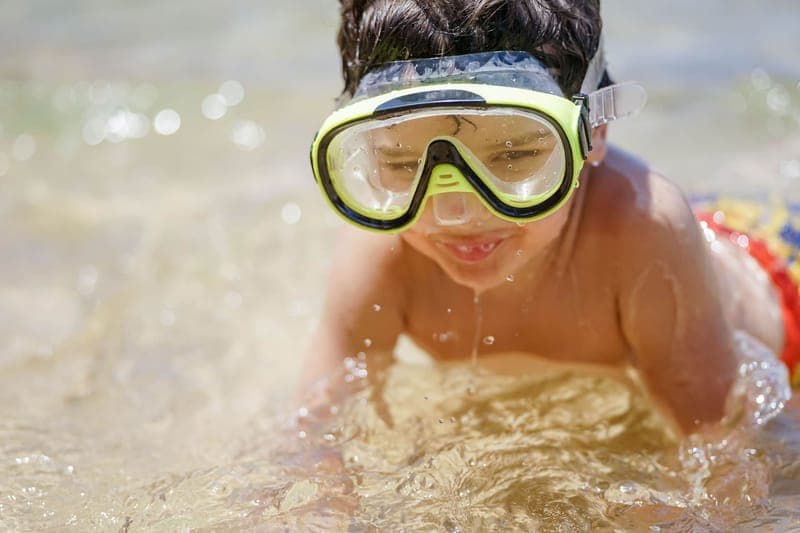
| Swim mask | 3-12 | Seals around eyes and nose | None — nose inside the seal |
| Adult | 13+ | Low profile or wide | Interchangeable, 3-4 sizes |
These bands overlap on purpose, because faces do not follow ages. A small eight-year-old is often better served by a junior soft frame than by a kids' standard, and a large ten-year-old may already need an adult frame. Use the test in step 2 to decide, not the age on the box.
Step 2 — the suction test
- Hold the strap away from the back of the head so it applies no pressure.
- Press the goggles gently onto dry eye sockets.
- Let go and count to three.
- If they stay, the gasket matches the face. If they drop, try a different nose bridge if the frame has them, or a different frame if it does not.
This is the whole fitting process in one step, and it is the one people skip. A goggle that passes it will not need a tight strap, will not leak, and will not leave deep marks. A goggle that fails it will do all three regardless of what you do next.
Step 3 — the measurement, if you are buying online
Measure the distance between the inner corners of the eyes, across the bridge of the nose, with a soft tape or a ruler held gently. That distance is what a nose bridge has to match. On most children under about eight it is small enough that adult and junior-competitive frames cannot seal at all.
Measure head circumference separately, above the ears and across the middle of the forehead, if you are choosing between single and double straps. Double straps spread load better on an active child and stay put through a dive; they also pull more hair, which is why a swim cap is worth buying at the same time.
Step 4 — strap position, which matters more than tension
The strap sits high on the back of the head, above the ears — roughly level with the top of the ear, not on the nape of the neck. A strap that has slipped down pulls the goggles up and forward, lifting the bottom edge of the gasket off the cheek, and that is a leak.
Tighten only until the goggles stop moving when your child turns their head. That is it. If they still leak at that tension, go back to step 2 — the answer is never more tension.
On a double strap, split the two bands so one sits above the ear and one just behind the crown. That is what stops the goggles sliding on a child who jumps and dives.
Teaching a child to fit their own goggles
Worth doing from about six, because a child who can adjust their own goggles stops asking an adult mid-lesson and stops swimming with a leaking pair out of resignation. Three things to teach, in this order.
- Where the strap sits. Show them it belongs above the ears, and let them feel the difference when it slips down. This is the single most useful thing they can learn, because a low strap is the commonest cause of a leak.
- Never touch the inside of the lens. Frame it as a rule with a reason — the anti-fog comes off and does not come back. Children accept that better than a bare prohibition.
- How to tip water out. Lift the bottom edge of one lens away from the cheek, let the water run, press it back. It saves them taking the whole thing off and re-fitting it badly.
When to move up a frame size
Not on a birthday. The signals are physical, and there are three:
- The strap is at or near its maximum extension. The frame has run out of head, and a maxed-out strap also pulls the goggles flat against the face in a way that marks.
- A pair that used to seal has started leaking at the nose, with no change in how it is being worn. A growing face widens across the bridge, and a fixed one-piece frame cannot follow it.
- The lenses are sitting outboard of the eyes rather than centerd over them. Look at it from the front; it is obvious once you check.
At that point a junior frame with interchangeable nose bridges buys two or three more years than another fixed frame will, which is the argument for spending slightly more once a child is swimming regularly rather than occasionally.
Common fit problems and what they mean
- Leaks at the bottom of the lens. Strap is too low, or the gasket is too wide for the cheekbone. Reposition first, then change shape.
- Leaks at the nose. Nose bridge is too wide, holding the lenses apart. Fit a smaller bridge, or move to a one-piece frame.
- Deep red marks. Over-tightened to compensate for a bad shape. See goggle marks and fit.
- Goggles ride up on the forehead. Strap too high or too tight; also common when hair is bunched under the strap.
- Works in the pool, leaks in the lake. Usually hair. Water, wind and a child pushing wet hair back under the gasket. A cap fixes it.
What we recommend
For a child under about eight, buy a one-piece soft-gasket frame and skip the sizing question entirely. For an older child who swims regularly, buy a junior frame with interchangeable bridges and spend five minutes fitting the right one — it is the difference between one season and three.
Either way, buy a swim cap with them. It stops the hair-pull, keeps hair out of the gasket, and solves the most common leak cause on children in one item. Our picks are in best kids' swim goggles.
Our picks
Matched to the fitting problems above: a one-piece frame that removes the sizing question, the most forgiving gasket for a child who has refused goggles, an adjustable-bridge frame for a regular swimmer, and a mask for a child who cannot tolerate pressure near the eyes.
TYR Kids' Swimple
Oversized soft gaskets on a one-piece frame, which is the combination that actually seals a small face.
Specifications
- Age range
- 3-10 years
- Gasket
- Silicone, oversized
- Frame
- One-piece
- Lens
- Anti-fog, UV
What works
- One-piece frame has no nose-bridge adjustment to get wrong, which removes the most common source of leaks on small faces
- Soft silicone gasket sits wide of the eye socket, so it seals against cheek rather than thin skin
- Hypoallergenic silicone matters for kids who react to latex straps
- Cheap enough to replace mid-season without a conversation about it
What doesn’t
- No bridge adjustment at all, so a very narrow or very wide face has no fallback
- Strap clip is fiddly for a child to adjust alone
Who it’s for
A child between about 3 and 10 who is in the water for lessons and lake days rather than training, and who has already lost or broken a pair.
Bottom line
The default first pair. If you are buying goggles for a child under 10 and do not want to think about it, buy these.
Speedo Kids' Skoogles
The softest, most forgiving gasket in the category — it seals even when a child pulls it on crooked.
Specifications
- Age range
- 3-8 years
- Gasket
- Oversized soft silicone
- Frame
- One-piece, flexible
- Lens
- Anti-fog, UV
What works
- Very forgiving fit — the gasket is deep enough that a crooked pull-on still seals
- Wide, shallow lens avoids the pressure ring that makes small children refuse goggles
- Single-strap adjustment a four-year-old can manage
- Widely stocked, so a mid-trip replacement is realistic
What doesn’t
- Soft gasket leaves a visible mark after a long session
- Too loose on the face of a child over about 8
Who it’s for
A toddler or young child who has tried goggles once and hated them. This is the pair that usually fixes that.
Bottom line
Buy these if the problem is refusal rather than leaking. Comfort is what they optimize for and it works.
Speedo Jr. Vanquisher 3.0
Adult-grade optics in a junior frame, with interchangeable nose bridges that grow with the face.
Specifications
- Age range
- 6-14 years
- Gasket
- Silicone, low-profile
- Nose bridge
- Interchangeable, 3 sizes
- Lens
- Anti-fog, UV, mirrored options
What works
- Interchangeable bridges mean one pair covers two or three years of face growth instead of one season
- Low-profile gasket is what competitive kids actually wear, so a child on a team will not ask to swap them
- Double-strap head cradle stays put off a starting block or a dock
- Mirrored lenses are genuinely useful outdoors, not just styling
What doesn’t
- Low-profile gaskets need the correct bridge size to seal; get it wrong and they leak more than a soft-gasket pair
- Wrong shape for a child under about 6
Who it’s for
A child swimming twice a week or more, past beginner lessons or on a summer league team.
Bottom line
Worth the step up only for a regular swimmer. For a child who swims six times a summer, the Swimple does the same job for less.
Aqua Sphere Vista
A swim mask, not goggles: it seals around the whole eye area and the nose, so nothing presses on the eye socket.
Specifications
- Type
- Swim mask
- Seal
- Around eyes and nose
- Field of view
- Very wide
- Lens
- Anti-fog, UV
What works
- No pressure on the eye socket at all, which solves the most common reason a child refuses goggles
- Covers the nose, so water does not go up it — a real fear for beginners
- Very large field of view
- Sizing runs wide enough to cover older children as well as adults
What doesn’t
- Bulky and draggy, so it is wrong for anyone swimming laps for time
- You breathe through the mouth only, which takes some children a session to accept
Who it’s for
A child who has rejected two or three pairs of conventional goggles, or who panics about water up the nose.
Bottom line
The escape hatch when nothing else works. Not a training choice — but a child in a mask is a child in the water.
Questions
Frequently asked questions
How do I stop my child's goggles falling off?
What size goggles for a 5 year old?
How tight should kids' swim goggles be?
Do kids need a swim cap with goggles?
Read next