Floats & Towables · Roundup
Best Floating Coolers (2026)
Five coolers across four designs, and why the tether point matters more than the can count.
The short answer
The Intex Mega Chill II is the pick for most families: a tethered lid, six rim cup holders and enough capacity for a group, at the price of a round of drinks. If the ice has to last all day, the hard-shell GoSports Cuddy 40QT is the only option here with a published retention figure.
Product photos are the retailer’s own catalogue images, shown from the retailer’s servers and refreshed daily. Any other photo here is a licensed image that illustrates the category, not a photograph of the specific product named.
| # | Product | Best for | Capacity | Price |
|---|---|---|---|---|
| 1 | 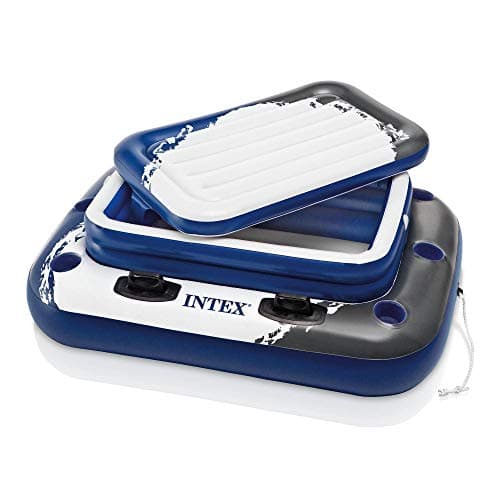 Top pick Intex Mega Chill II Floating Cooler A floating cooler with a tethered lid — the accessory that stops one person swimming back to shore every ten minutes. | Drinks and snacks | Up to 72 cans with ice | |
| 2 | 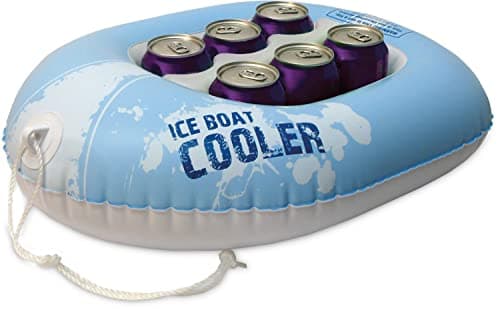 Budget pick Poolmaster Refreshment and Beverage Floating Cooler The cheapest thing in the category: a boat-shaped vinyl tub that keeps six drinks within arm's reach of a float. | A six-pack, nothing more | Approx. 18 in | |
| 3 | 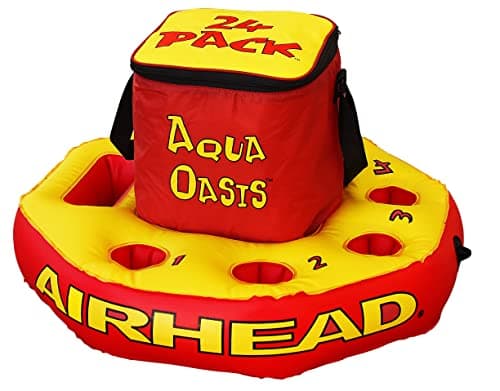 Also good Airhead Aqua Oasis Floating Beverage Cooler An insulated nylon cooler bag that lifts out of its inflatable base, so the same kit works on the water and in the car. | Cooler that comes ashore | 24 cans (maker's figure) | |
| 4 | 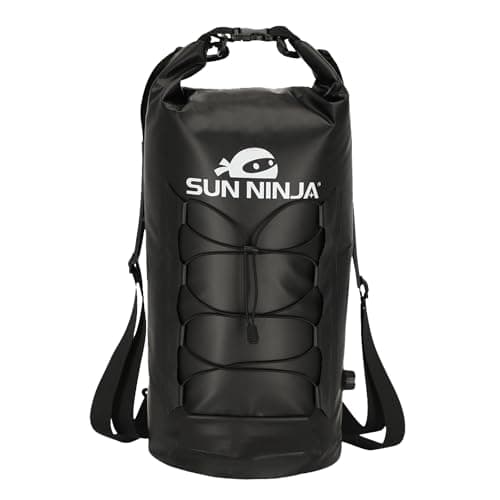 Also good SUN NINJA Floating Dry Bag Cooler, 20L A roll-top dry bag with insulation, which is the only design here you can swim with rather than push. | Swimming out with it | 20 L | |
| 5 | 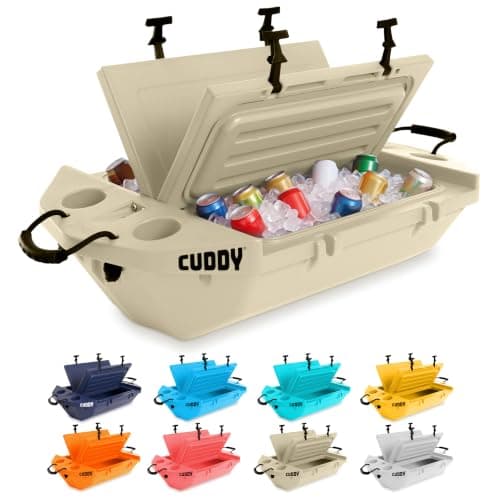 Upgrade pick GoSports Cuddy 40QT Floating Cooler A hard-shell 40-quart cooler built to float and tow, with four latches that seal it well enough to use as a dry locker. | All-day ice and dry storage | 40 qt — 30 cans + 20 lbs ice |
Four designs, four different lake days
"Floating cooler" covers products that have almost nothing in common beyond buoyancy. Pick the design first and the shortlist sorts itself out in about ten seconds.
Inflatable cooler floats are a vinyl tub with a lid and cup holders around the rim. Cheap, light, pack to nothing, and the right answer for the large majority of families. Insulation is whatever the ice and the lid give you, which is a few hours rather than a day.
Hybrid bases with a removable cooler bag put a real insulated soft cooler inside an inflatable ring. The bag lifts out, so one purchase covers the car, the shore and the water. More money, more drying.
Hard-shell floating coolers are proper rotomolded-style coolers engineered to float, latch and tow. They hold ice for a published number of hours and seal well enough to use as a dry locker. They also cost ten times an inflatable and weigh more empty than an inflatable does loaded.
Insulated dry bags are the outlier: a roll-top bag that floats, which you can actually swim with. Small capacity, nothing to set a drink on, and the only option that works when the water is a walk from the car.
The five things worth checking
- A tether point. The most common way a floating cooler is lost is drifting off while everyone is swimming. A welded rope connector or a tow strap is the difference between a cooler that stays with the group and somebody's whole afternoon spent retrieving it. The Poolmaster has no tether; the Airhead and the Cuddy both do.
- A tethered lid. Separate from the above, and the specific failure of cheap cooler floats: the lid blows off, floats away, and the ice melts in full sun for the rest of the day. Check the lid is attached, not just included.
- Cup holders on the rim. Sounds trivial. It is the feature that stops six open cans being balanced on an inflatable lounger, which is how drinks end up in the lake. Six is the usual count on the better inflatables.
- Honest capacity. Can counts assume cans packed with no ice, so halve the headline number for a real afternoon. A cooler advertised at 72 cans is a cooler for about 30 cans and a bag of ice.
- Insulation versus ice volume. Thin-walled inflatables are not insulated in any meaningful sense — the ice does the work and the volume of ice decides how long you have. Only a dual-wall hard shell changes that equation.
Intex Mega Chill II Floating Cooler
A floating cooler with a tethered lid — the accessory that stops one person swimming back to shore every ten minutes.
Specifications
- Capacity
- Up to 72 cans with ice
- Lid
- Inflatable, tethered
- Cup holders
- 6 on the rim
- Construction
- 16-gauge vinyl, 3 chambers
What works
- Tethered lid does not float away, which is the failure mode of every untethered floating cooler
- Rim cup holders mean drinks are not balanced on a float
- Ties to a dock or a raft so it stays with the group
- Cheap enough to be an impulse add-on to a float order
What doesn’t
- Insulation is minimal — ice does not survive a full hot afternoon
- Not a float; it holds nothing but cargo
Who it’s for
Any group spending several hours on the water away from a cooler on shore.
Bottom line
Not a float, but the single most-used item on a lake day. Pack more ice than you think you need.
Poolmaster Refreshment and Beverage Floating Cooler
The cheapest thing in the category: a boat-shaped vinyl tub that keeps six drinks within arm's reach of a float.
Specifications
- Length
- Approx. 18 in
- Capacity
- About 6 drinks
- Insulation
- None beyond the ice you add
- Tether point
- None
What works
- Costs less than the drinks it carries, which makes it an easy add to an existing float order
- Small enough to push along beside a single float rather than tow behind a group
- Nothing to inflate wrong and nothing to lose — one chamber, one shape
- Doubles as a dry tub for phones and keys on a dock if you keep the ice out
What doesn’t
- Six drinks is the honest ceiling; this is not a cooler for a family afternoon
- No insulation at all, so ice is gone in an hour or two in real sun
- No rope connector, so it drifts the moment nobody has a hand on it
- Thin vinyl in a shape that catches on dock boards
Who it’s for
One or two people on a short swim, or a dock day where the real cooler is ten feet away on shore.
Bottom line
Buy it as a convenience, not as a cooler. If you need ice to last, the Mega Chill II costs a little more and does much more.
Airhead Aqua Oasis Floating Beverage Cooler
An insulated nylon cooler bag that lifts out of its inflatable base, so the same kit works on the water and in the car.
Specifications
- Capacity
- 24 cans (maker's figure)
- Cooler
- Removable, insulated, leak-proof
- Drink holders
- 6, numbered
- Base
- Heavy-gauge PVC, RF-welded
What works
- The insulated leak-proof nylon cooler lifts straight out with a shoulder strap, so it is a real cooler on land too
- A molded rope connector is welded to the side for tethering to a lounge, swim platform, dock or boat
- Six numbered drink holders, which sounds silly until six people have the same can
- Heavy-gauge PVC base with RF-welded seams rather than glued ones
- A sundry pocket for sunscreen, which is the item that always ends up in the water
What doesn’t
- Roughly double the price of a plain inflatable cooler float
- The nylon cooler is soft-sided, so ice retention is hours rather than the day a hard cooler manages
- Two components means two things to dry, and nylon dries slowly
- Airhead publishes no ice-retention figure, so the 24-can number is capacity only, not performance
Who it’s for
A family that wants one cooler for the drive, the shore and the water instead of three.
Bottom line
The most useful design here if you will actually use the removable bag. If it never leaves the base, you overpaid.
SUN NINJA Floating Dry Bag Cooler, 20L
A roll-top dry bag with insulation, which is the only design here you can swim with rather than push.
Specifications
- Capacity
- 20 L
- Closure
- Leakproof roll-top
- Form
- Soft dry bag, floats
- Carry
- Shoulder-carry bag
What works
- Roll-top closure means it is genuinely leakproof, so towels and phones can share it with the ice
- Soft and light enough to swim out to a raft with, which no cooler float here can claim
- Packs flat when empty, unlike every rigid or inflated option
- Doubles as the dry bag for a canoe or paddleboard day
What doesn’t
- 20 L is a day's drinks for two or three people, not a group
- No cup holders and no lid surface — it is a bag, so drinks go back in after each pour
- SUN NINJA publishes no ice-retention figure, and a thin soft-sided bag will not match a hard cooler
- Nothing floats *on* it, so it does not double as a table the way the inflatables do
Who it’s for
Swimmers, paddlers and anyone walking a long way from the car to the water.
Bottom line
The right answer when the cooler has to travel light and stay dry inside. The wrong answer for six people and a raft.
GoSports Cuddy 40QT Floating Cooler
A hard-shell 40-quart cooler built to float and tow, with four latches that seal it well enough to use as a dry locker.
Specifications
- Capacity
- 40 qt — 30 cans + 20 lbs ice
- Ice retention
- 12-48 hrs, per GoSports
- Shell
- HDPE, dual-wall, Snow Bead insulation
- Tow
- 6 ft strap, 2 carabiners
What works
- The only pick here with a published ice-retention range — 12-48 hours depending on use and conditions
- Dual-walled HDPE with Snow Bead insulation, so it performs like a real cooler rather than a drinks tub
- Four T-latches seal it, which is what makes the dry-locker use honest rather than optimistic
- Includes a 6 ft tow strap with two carabiners for towing behind a kayak or anchoring to a fixed point
- Dual lids and four cup holders, so nobody has to climb over it
What doesn’t
- Many times the price of an inflatable cooler float — this is a several-hundred-dollar category of one
- 24.7 lbs empty before ice, so it is a two-hand carry from the car and awkward on a ladder
- Hard shell will knock a gelcoat and mark a dock, unlike the inflatables
- Overkill for a shore swim; it earns its keep on long paddles and boat days
Who it’s for
Boaters, kayakers and anyone whose lake day is all day and who needs the ice to survive it.
Bottom line
Buy it as a cooler you also float, not as a float that also cools. On that basis it is the only serious option here.
How much should you spend?
For most families, the correct spend here is small. An inflatable cooler float with a tethered lid and rim cup holders costs roughly what the drinks inside it do, and it solves the actual problem — somebody swimming back to shore every ten minutes. That is the Intex Mega Chill II, and it is the pick for the same reason most of our picks are: it is the cheapest thing that has the features that matter.
Spend up in two cases, both real. If your lake day is a boat or kayak day that runs all day, ice in an inflatable will be water by early afternoon, and a hard-shell cooler with a published retention range is the only fix. And if you walk or swim to the water, the dry-bag design is the only one that travels, regardless of price.
What is never worth paying for in this category is a bigger can count you will not fill. Capacity is the cheapest spec to advertise and the least useful one to buy. The same ranking logic we use across the site — see the family swim gear budget guide — puts tether, lid and cup holders ahead of volume every time.
Packing it so the ice actually lasts
An uninsulated floating cooler is a box of ice sitting in water that is warmer than the ice. How you pack it decides most of the outcome.
- Pre-chill everything. Warm cans put in ice spend the first hour melting it. Cans out of a fridge buy you an extra hour or two for free.
- More ice than drinks, by volume. Two-thirds ice is the rule of thumb for a thin-walled cooler. A thin layer on top does nothing.
- Block ice, or a frozen bottle, under the cubes. Cubes chill fast and die fast; a solid mass lasts much longer and doubles as cold drinking water later.
- Keep the lid on and keep it shaded. Every open is a reset. A cooler float in the shadow of a lounger or a canopy holds ice noticeably longer than one in open sun.
- Do not drain the meltwater. Cold water keeps cans cold better than air does. Drain it only when you need the space.
Tethering, and not losing it
Tie the cooler to something that is not moving — a dock cleat, an anchored raft, a boat. Tying it to an unanchored float only gives the wind two things to move instead of one, which is the point we make in the lake float vs pool float comparison about open water in general.
Keep the line short. A cooler on fifteen feet of rope swings into swimmers, wraps legs and snags on whatever the bottom is hiding. Three or four feet is plenty to reach it from a float.
And never tow one behind a moving boat alongside people in the water. A cooler is a hard, heavy object that does not track, and the rules that keep towable tubes safe exist precisely because things on ropes behind boats behave unpredictably.
Will it last a second summer?
Inflatable cooler floats are a one-to-two-season item in honest use. The seams around the cup holders are the first thing to go, because that is where the vinyl is worked hardest, and a lid hinge that has baked in the sun cracks. Hard-shell coolers are a decade item. Insulated dry bags fail at the roll-top stiffener, usually after two or three seasons.
Care is the same for all of them and matters more than price. Rinse the inside in fresh water, dry it fully open in shade rather than in direct sun, and store it loosely instead of creased. Our float care and storage guide covers patching and winter storage for the rest of the family's inflatables at the same time.
One thing worth doing before the first trip each year: fill it with water on the lawn and look for a leak. A cooler that will not hold meltwater will not hold ice either, and finding that out at the lake is the wrong time.
Questions
Frequently asked questions
Do floating coolers actually keep drinks cold?
How many cans does a floating cooler hold?
How do you stop a floating cooler drifting away?
Can you tow a floating cooler behind a boat?
Is a floating cooler worth it over a normal cooler on shore?
What is the best floating cooler for a kayak or paddleboard?
Sources
Read next