Floats & Towables · Comparison
Lake Float vs Pool Float
A lake is a harsher environment than a pool. The float needs to be built for it.
The short answer
Pool floats are thin vinyl designed for a smooth, enclosed, wind-free environment. Lake use adds punctures from rocks and docks, wind that carries floats away, and no visible bottom. For a lake, closed-cell foam or heavy-gauge construction with tether points is the right build.
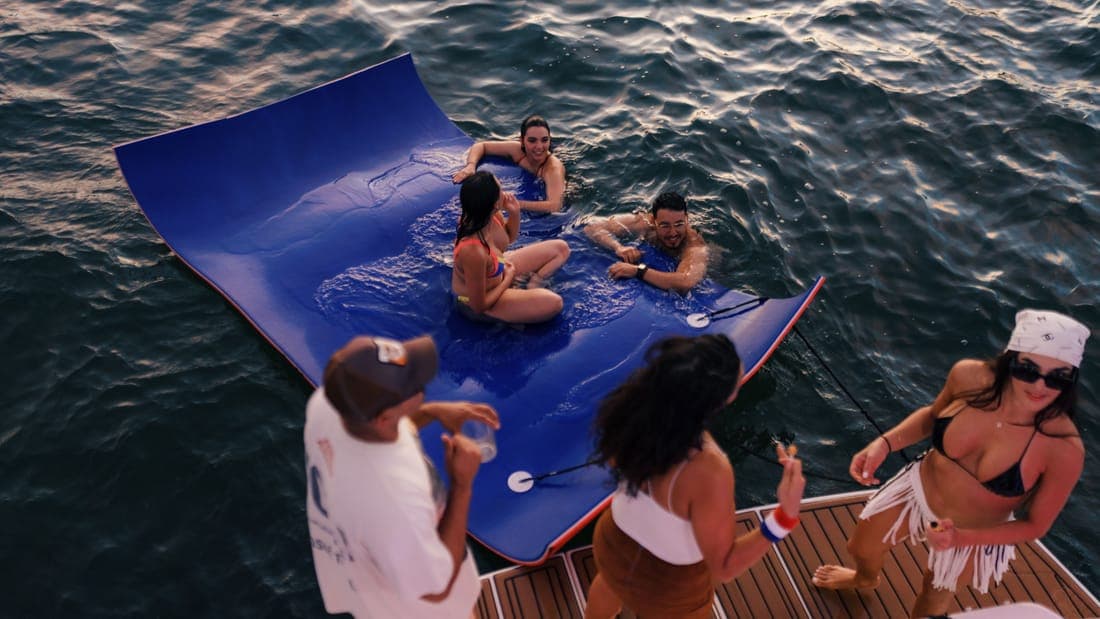
Photos on this page are licensed images that illustrate the category. They are not photographs of the specific products named, and no product image here is supplied by a manufacturer or retailer.
| Pool | Lake | |
|---|---|---|
| Surfaces the float touches | Smooth tile, coping | Rock, gravel, dock boards, weed |
| Puncture risk | Low | High |
| Wind | Usually sheltered | Open — floats travel |
| Depth visibility | Full | None |
| Distance to shore | A few feet | Can be a long way |
| Boat traffic | None | Real |
| Right construction | Standard vinyl | Foam, or heavy-gauge vinyl with tethers |
| Must-have features | None in particular | Tether point, grab handles, bright color |
The four things that change in a lake
1. Punctures. A pool is a smooth enclosed box. A lake edge is rock, gravel, weed, and a dock with exposed screw heads. Thin vinyl that lives for years in a pool fails in weeks at a lake, and this single difference is why foam mats exist as a category.
2. Wind. A float on open water moves, faster than people expect and always away from shore. A float that drifts off in a pool is a float at the other end of the pool; on a lake it is a swim. Every lake float needs a tether point, and it needs to be used.
3. No visible bottom. You cannot see what is under a lake float — a rock a foot below the surface, a submerged branch, a sudden drop-off. That matters when someone rolls off one, and it is a reason to walk the swimming area first. See lake swimming safety.
4. Boat traffic. A float is low and hard to see, and a swimmer beside one is harder still. Bright colors are a safety feature on a lake and irrelevant in a pool, and staying inside a marked swimming area matters.
Choose closed-cell foam if...
- You have somewhere to store it — a dock, a boathouse, a garage corner.
- You launch from a dock or a rocky shore where vinyl would not survive.
- You want it ready the moment you arrive, with no pump.
- You want a platform people can stand on.
- You will use it enough seasons for the cost per year to beat replacing inflatables.
Choose heavy-gauge vinyl or drop-stitch if...
- You transport your gear to the water and cannot store a foam mat.
- You want a seated lounger rather than a platform — foam mats do not do seats.
- You are buying several and cost per float matters more than lifespan.
- You want something that packs into a car boot with the rest of the day's kit.
Drop-stitch is the interesting middle: it inflates rigid enough to walk on and packs into a bag, at the cost of needing a high-pressure pump and real effort each outing.
Adapting a pool float for lake use
If you already own pool floats, you can make them work. It is mostly about handling rather than the float itself.
- Launch from water, not from land. Carry the float in and put it down floating rather than dragging it across gravel or dock boards.
- Tether everything. A short line to a dock cleat, a mooring, or another float. Wind is the thing that turns a good afternoon into a retrieval mission.
- Add grab handles if it has none. A float you cannot remount in deep water is a problem for a child.
- Carry the patch kit and learn to use it. Two minutes and a cured glue joint saves the float.
- Inflate slightly soft, not drum-tight. A firm float is more likely to split against a hard edge, and warm sun raises internal pressure through the day.
Our picks

Rubber Dockie 9x6 Floating Water Mat
The same puncture-proof foam construction at half the length — the version most families should actually buy.
Specifications
- Size
- 9 x 6 ft
- Capacity
- Approx. 3-4 adults / 750 lbs
- Construction
- Two-ply closed-cell foam, 1 3/8 in
- Shell
- Tuff-Hide membrane, Tear-Stop matrix
What works
- One adult can move and launch it, which the 18-footer does not allow
- Same foam construction, so it is equally puncture-proof
- Fits a family of four comfortably
- Stores rolled in a shed or a garage corner
What doesn’t
- Gets crowded quickly once guests arrive
- Still costs several times an inflatable mat
Who it’s for
A family of three to five with a lake spot but limited storage and no help carrying things.
Bottom line
The size to buy unless you know you regularly have eight people on the water.
Intex River Run I Sport Lounge
A seated ring with a mesh bottom, backrest and cup holders — the cheapest genuinely comfortable float.
Specifications
- Capacity
- 1 adult
- Seat
- Mesh bottom, sit-in
- Cup holders
- 2
- Extras
- Backrest, grab rope, connector
What works
- Mesh bottom keeps you cool, which is the difference between an hour and ten minutes on a hot day
- Backrest means you can actually sit and relax rather than balance
- Connectors let several link together, so a group stays in one place
- Cheap and universally stocked
What doesn’t
- Vinyl seams are the failure point; a dock screw or a rock will end it
- Hard to get out of in deep water without tipping
Who it’s for
Adults drifting on a calm lake or a slow river, especially in groups.
Bottom line
The best value float on the water. Buy two; they are cheap and they puncture.
Solstice Inflatable Water Mat
Drop-stitch construction inflates rock-hard, so it walks like a foam mat but packs like an inflatable.
Specifications
- Capacity
- 4-6 people
- Construction
- Drop-stitch, high pressure
- Feel
- Rigid when inflated
- Packed
- Rolls into a carry bag
What works
- Drop-stitch means you can stand and walk on it, which a standard inflatable does not allow
- Packs down small enough to fit in a car boot with the rest of the gear
- Far more durable than standard vinyl
- Bridges the gap between a cheap mat and a foam mat honestly
What doesn’t
- Needs a high-pressure pump — a standard float pump will not get it rigid
- Inflation takes real time and effort every single outing
Who it’s for
Families who want foam-mat performance but have to transport it to the water each time.
Bottom line
The right compromise if storage rules out foam. Factor a proper high-pressure pump into the budget.
The foam mat if you have storage, the mesh lounger if you want a seat and a low price, the drop-stitch mat if you need rigidity that packs away. Full size guidance is in best lake floating mats.
Questions
Frequently asked questions
Can you use pool floats in a lake?
What makes a float suitable for a lake?
Do lake floats need to be anchored?
Are foam mats worth the extra cost for lake use?
Read next