Floats & Towables · Roundup
Best Lake Floating Mats (2026)
Foam cannot puncture and needs storing. Inflatable packs away and needs a pump.
The short answer
The Rubber Dockie 9x6 is the mat most families should buy: closed-cell foam that cannot puncture, holds three to four adults, and is light enough for one person to launch. Choose the 18x6 only if you regularly have eight people on the water and somewhere to store it.
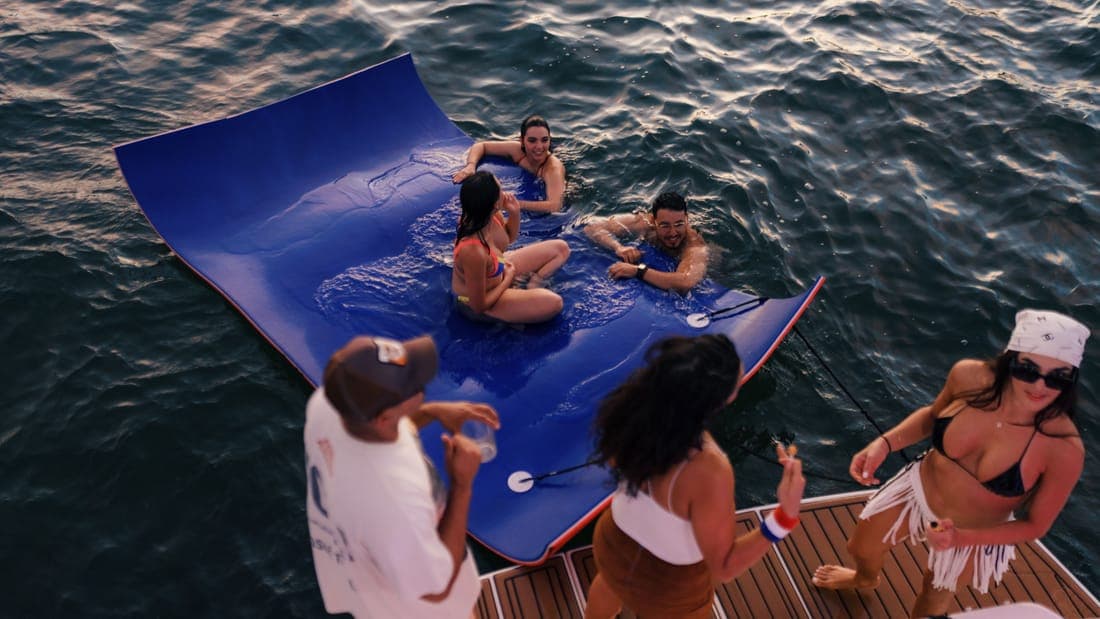
Photos on this page are licensed images that illustrate the category. They are not photographs of the specific products named, and no product image here is supplied by a manufacturer or retailer.
| # | Product | Best for | Size | Price |
|---|---|---|---|---|
| 1 |  Top pick Rubber Dockie 9x6 Floating Water Mat The same puncture-proof foam construction at half the length — the version most families should actually buy. | Smaller families, easier storage | 9 x 6 ft | |
| 2 | Budget pick Intex Giant Inflatable Floating Mat A 114 by 84 inch inflatable mat that floats a whole family for a fraction of a foam mat's price. | Cheapest big platform | 114 x 84 in | |
| 3 | Upgrade pick Rubber Dockie 18x6 Floating Water Mat Two-ply closed-cell foam with a tear-resistant membrane — no inflation, no punctures, and it holds a crowd. | Dock and cabin families | 18 x 6 ft | |
| 4 | Also good Solstice Inflatable Water Mat Drop-stitch construction inflates rock-hard, so it walks like a foam mat but packs like an inflatable. | Rigid feel, packable | 4-6 people |
Foam or inflatable: the decision is about storage
A floating mat is a platform you lie, sit and stand on, and there are two ways to build one. Closed-cell foam cannot be punctured, needs no pump, and is ready the second you arrive. Inflatable packs down into a bag you can put in a car boot, and needs inflating every single time.
Neither is better. The question is whether the mat has somewhere to live. If you have a dock, a cabin, a boathouse or a garage corner, foam is the better product by a wide margin and the extra cost buys years. If you drive to a different lake each time and carry your gear, foam is a two-person lift and a storage problem, and an inflatable is the right answer.
The middle option is drop-stitch construction, which inflates to high pressure and becomes rigid enough to walk on. It behaves like foam and packs like an inflatable, at the cost of needing a proper high-pressure pump and real effort every outing.
Rubber Dockie 9x6 Floating Water Mat
The same puncture-proof foam construction at half the length — the version most families should actually buy.
Specifications
- Size
- 9 x 6 ft
- Capacity
- Approx. 3-4 adults / 750 lbs
- Construction
- Two-ply closed-cell foam, 1 3/8 in
- Shell
- Tuff-Hide membrane, Tear-Stop matrix
What works
- One adult can move and launch it, which the 18-footer does not allow
- Same foam construction, so it is equally puncture-proof
- Fits a family of four comfortably
- Stores rolled in a shed or a garage corner
What doesn’t
- Gets crowded quickly once guests arrive
- Still costs several times an inflatable mat
Who it’s for
A family of three to five with a lake spot but limited storage and no help carrying things.
Bottom line
The size to buy unless you know you regularly have eight people on the water.
Intex Giant Inflatable Floating Mat
A 114 by 84 inch inflatable mat that floats a whole family for a fraction of a foam mat's price.
Specifications
- Size
- 114 x 84 in
- Capacity
- Several children or 2-3 adults
- Material
- Heavy-gauge vinyl
- Features
- Grab handles, tether loops
What works
- Roughly a fifth the price of a comparable foam mat
- Deflates to something you can actually store and transport in a car
- Large enough to be a genuine platform rather than a float
- Grab handles around the edge for climbing back on
What doesn’t
- It is vinyl, so it punctures — keep it away from docks, rocks and dogs
- Sits lower and gets wetter than a foam mat
Who it’s for
A family who wants a big platform occasionally and travels to the water rather than owning a dock.
Bottom line
The budget route to a floating platform. Bring the patch kit; you will need it.
Rubber Dockie 18x6 Floating Water Mat
Two-ply closed-cell foam with a tear-resistant membrane — no inflation, no punctures, and it holds a crowd.
Specifications
- Size
- 18 x 6 ft
- Capacity
- Approx. 9 adults / 1,500 lbs
- Construction
- Two-ply closed-cell foam, 1 3/8 in
- Shell
- Tuff-Hide membrane, Tear-Stop matrix
What works
- Foam cannot be punctured, so a dock screw or a rock is a scuff rather than the end of the mat
- Always ready — no pump, no fifteen-minute inflation at the start of a day
- Genuinely holds a large group, which changes how a dock gets used
- Tether points let you anchor it off the dock all season
What doesn’t
- Heavy and bulky — it rolls, but it is a two-person carry and needs real storage
- Expensive relative to any inflatable
Who it’s for
Families with a dock, a cabin, or a fixed lake spot where the mat can live all summer.
Bottom line
The best lake float money buys if you have somewhere to keep it. If you carry your gear to the water, buy the 9x6 instead.
Solstice Inflatable Water Mat
Drop-stitch construction inflates rock-hard, so it walks like a foam mat but packs like an inflatable.
Specifications
- Capacity
- 4-6 people
- Construction
- Drop-stitch, high pressure
- Feel
- Rigid when inflated
- Packed
- Rolls into a carry bag
What works
- Drop-stitch means you can stand and walk on it, which a standard inflatable does not allow
- Packs down small enough to fit in a car boot with the rest of the gear
- Far more durable than standard vinyl
- Bridges the gap between a cheap mat and a foam mat honestly
What doesn’t
- Needs a high-pressure pump — a standard float pump will not get it rigid
- Inflation takes real time and effort every single outing
Who it’s for
Families who want foam-mat performance but have to transport it to the water each time.
Bottom line
The right compromise if storage rules out foam. Factor a proper high-pressure pump into the budget.
What to look for in a floating mat
Real capacity, not marketing capacity. Foam mats publish weight limits and they are honest: roughly 750 lbs for a 9x6 and 1,500 lbs for an 18x6. Inflatable mats often publish person counts instead, which are optimistic. Work in pounds where you can.
Thickness. Foam mats around 1⅜ inches of two-ply foam sit high and dry. Thinner mats flex, and a mat that flexes underfoot is one people fall off.
A protective outer skin. The good foam mats have a tough outer membrane and a tear-resistant inner matrix, which is what stops a scrape from becoming a channel that peels open. Bare foam abrades fast against a dock.
Tether points and a bungee. A mat needs anchoring to a dock or a mooring, and it is a big enough object that wind moves it easily. Most good mats come with a tether and a stainless D-ring.
Something to climb on with. Getting back onto a mat from deep water is harder than it looks. Handles along the edge, or a bungee grab line, make it possible for children.
What size should you buy?
| Size | Capacity | Who it suits | Practical note |
|---|---|---|---|
| 6 x 3 ft | 1-2 adults | One or two people, easy transport | More of a lounger than a platform |
| 9 x 6 ft | 3-4 adults / ~750 lbs | Most families | One adult can launch and move it |
| 12 x 6 ft | 5-6 adults / ~1,000 lbs | Larger families, frequent guests | Two-person carry |
| 18 x 6 ft | ~9 adults / ~1,500 lbs | Big groups, a fixed dock | Two-person carry, real storage needed |
Most families over-buy here. A 9x6 is a genuinely large platform, and the 18-footer is a different proposition — it changes how a dock gets used, and it also has to be carried, launched and stored by two people every time. Buy the 18 only if you know you regularly have that many people on the water.
How much should you spend?
Foam mats are the most expensive single item in this category apart from a towable, and the cost is genuinely justified by lifespan if you have storage. Over five seasons a foam mat is cheaper per year than replacing an inflatable mat twice.
If the budget does not stretch, a heavy-gauge inflatable mat is roughly a fifth of the price and gives you most of the experience. Expect to patch it, keep it away from docks and rocks, and treat it as a two-or-three-season purchase rather than a decade one.
Will it last a second summer?
A foam mat will last many summers, and the failure mode is cosmetic scuffing rather than anything functional. Keep it out of prolonged direct sun when not in use — UV is what eventually degrades the outer skin — and rinse the lake water off at the end of the season.
An inflatable mat depends entirely on where it touches things. Launch it from a clean surface rather than dragging it over a dock, deflate and dry it for storage, and carry the patch kit. Under those conditions two or three seasons is realistic; dragged across boards it can fail in one.
Questions
Frequently asked questions
Are foam floating mats better than inflatable ones?
What size floating mat do I need?
Can you stand on a floating water mat?
How do you anchor a floating mat?
Read next