Life Jackets & Safety · Guide
USCG Life Jacket Types Explained
What the Type numbers mean, what replaced them, and how to read either label.
The short answer
The Coast Guard's older system classified approved devices as Types I through V by intended use and flotation. Newer labels use icons and plain-language performance descriptions instead. Both appear on shelves today, and either way the label is what tells you a device is approved and for whom.
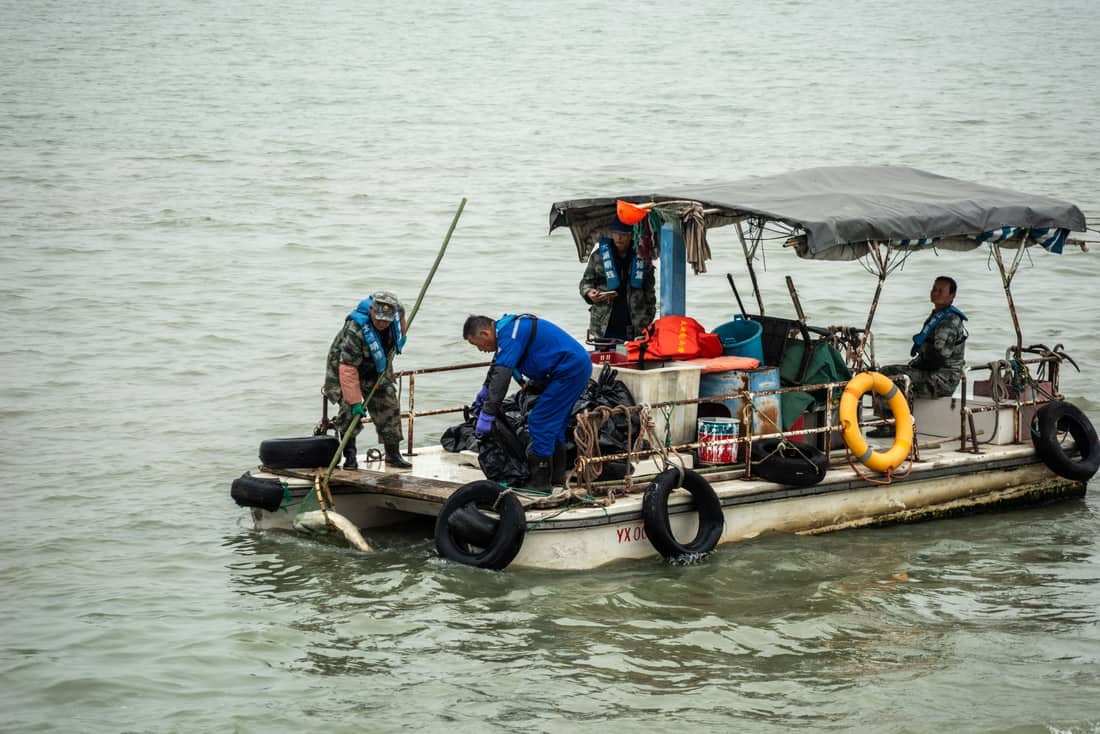
Photos on this page are licensed images that illustrate the category. They are not photographs of the specific products named, and no product image here is supplied by a manufacturer or retailer.
What approval actually means
A US Coast Guard approval is a statement that a device has been tested to a standard for buoyancy, construction and performance, and that it is intended for a stated use and a stated wearer size. It appears as printed text and an approval number on the inside label, along with the weight range.
That label is the only reliable way to tell an approved device from a swim aid. Shape, price, and how sturdy something looks tell you nothing. Water wings, swim vests, float suits and pool toys can all look substantial and carry no approval at all.
The five Types
| Type | Intended use | Turns wearer face-up? | Typical family relevance |
|---|---|---|---|
| I | Offshore, rough or remote water | Most wearers, yes | Rarely — bulky, designed for slow rescue |
| II | Near-shore, calm inland water | Many wearers, yes | Infant and toddler jackets are usually here |
| III | Flotation aid, calm water, quick rescue likely | No — wearer must position themselves | Most children's and adults' vests |
| IV | Throwable — ring buoy, seat cushion | Not worn | Carried on many boats as a second device |
| V | Special use, approved only as labeled | Varies | Some inflatables and watersport-specific vests |
Two rows deserve emphasis for families. Type IV is throwable and is not a wearable device — a seat cushion or a ring buoy does not count toward the requirement for a wearable per person. And Type V is approved only while worn as its label describes, which is a genuine catch: a Type V worn incorrectly is not an approved device at all.
What replaced the Type numbers
The Coast Guard has moved toward labels that describe performance and intended use in plain language and icons rather than a Type number — a buoyancy figure, pictograms showing suitable and unsuitable activities, and clear wearer-size information. The aim is that a buyer can tell what a device is for without memorizing a five-point scale.
In practice both label styles are on shelves right now, because existing approved stock stayed valid. That is why the old Type language still appears in product listings, including in our own picks — it is what many manufacturers still print.
Practically, nothing about buying changes. You are looking for the same three things on either label style: an approval statement, a weight range that matches the wearer, and an intended use that matches what you are going to do.
How to read a label in the shop
- Find the printed US Coast Guard approval statement and approval number. No statement, not an approved device.
- Read the weight range in pounds and check it against the actual wearer. Not their age.
- Read the intended use — either a Type number or the icons and text. Match it to where you will be: calm inland water, near-shore, offshore, or a specific watersport.
- Check for the features the use requires: a crotch or leg strap for children and towing, a flotation collar and grab handle for infants.
- If it is a Type V or a special-use device, read the conditions. It is approved only when worn as described.
Throwable devices, and why one belongs at the water's edge
A throwable — the old Type IV, a ring buoy or a square cushion — is the device you throw to someone rather than wear. Many boats are required to carry one in addition to wearable jackets, and it does not count toward the requirement for a wearable per person.
Its real value is on shore rather than on a boat, and it is underused there. Water-rescue guidance is consistently reach, throw, row — do not go: an untrained rescuer who swims to a struggling person frequently becomes a second casualty. A ring buoy sitting at the water's edge turns a swim into a throw.
If you have a regular lake spot, keeping a throwable with a line attached where the children swim is one of the cheapest safety improvements available. It needs to be somewhere you can reach in seconds, not in the car.
Inflatable and hybrid devices
Inflatable PFDs are approved and are popular with anglers and sailors because they are comfortable enough to wear all day. For a family lake context there are three limits worth knowing before buying one.
- They are not approved for children. Inflatables carry an adult minimum age and weight, so they are not an option for anyone you are supervising.
- They are not approved for towing or personal watercraft. That restriction is printed on the label and it is the most commonly missed line on it.
- They require maintenance. The CO2 cylinder and the inflator mechanism have to be inspected and rearmed after use or after an accidental inflation, and an uninspected inflatable is a jacket you are trusting without evidence.
Hybrid devices combine some inherent foam buoyancy with an inflatable chamber, which gives a baseline of flotation even uninflated. They are a reasonable middle ground for an adult, and they still carry the same age and activity restrictions on the label.
For a parent supervising children in the water, an inherently buoyant foam vest is the better tool: it works the instant it gets wet, with nothing to check and nothing to replace.
Where the label lives, and what to inspect
On a standard foam vest the approval label is stitched inside the back panel or inside the front, often under a flap. On a child's vest it is frequently on the inside of the back, where a grab handle is attached. On an inflatable it is inside the outer cover, near the bladder. If you cannot find any label at all, treat the device as unapproved.
Approval also depends on condition, not just on the original certification. A jacket check before each season takes two minutes:
- Squeeze the foam panels across their whole area, feeling for hard, stiff or crumbling spots. Degraded foam has lost buoyancy.
- Pull each strap firmly at the buckle and look at the stitching. Fraying where load concentrates is the commonest structural failure.
- Work every buckle and zip. A buckle that does not latch cleanly is a jacket that can come undone.
- Check the shell for tears that expose foam, and for UV chalking — a faded, powdery shell is a shell that has gone brittle.
- Confirm the label is still legible. An unreadable label is a compliance problem as well as an information one.
Any of those and the jacket is finished. Do not repair, pad, or modify an approved device — adding foam, shortening a strap with a knot, or removing a crotch strap that gets in the way all void the approval and change how the jacket performs.
What this means for a family lake day
For almost all family inland boating, you want Type II for infants and small toddlers — the flotation collar and face-up turning tendency matter for someone who cannot hold their own head clear — and Type III for older children and adults, which is the comfortable, wearable flotation-aid category that most vests fall into.
For towing, add the requirement for a leg or crotch strap on children, and be aware that some devices are explicitly not approved for towing or personal watercraft. That restriction is printed on the label, and it is the most commonly missed line on it.
Our picks by weight band are in best kids' life jackets, best toddler life jackets and best adult life jackets, and the sizing detail is in life jacket sizing by weight.
Our picks
One approved device per band, so the label language above maps onto something you can actually buy: a Type II infant vest with head support, an approved Type III for 30-50 lbs, a youth vest with the leg strap that towing requires, and a ventilated adult Type III.
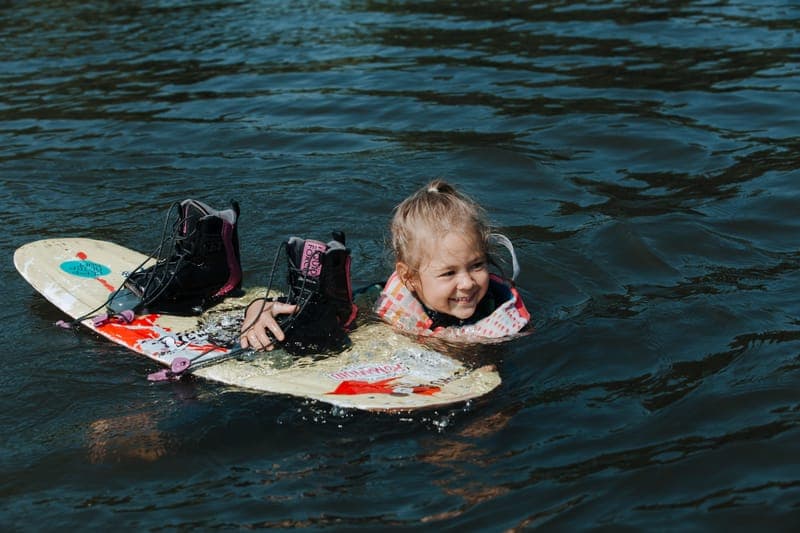
Stearns Infant Classic Series Vest
An infant vest with the two features that matter at this size: a head pillow and a crotch strap.
Specifications
- USCG class
- Type II, approved
- Weight range
- Under 30 lbs
- Head support
- Flotation collar
- Closure
- Buckles plus crotch strap
What works
- The flotation collar supports an infant's head, which is the whole point at this weight
- Crotch strap stops the vest lifting off a small body in water
- Grab handle at the collar lets an adult lift the child straight out
- Type II turns most wearers face-up, which an infant cannot do for themselves
What doesn’t
- Bulky and warm, and most infants object to it initially
- A vest is never a substitute for arm's-length supervision at this age
Who it’s for
A baby or small toddler under 30 lbs on or near a boat.
Bottom line
Required kit if an infant is going on the water. Fit it dry, on land, and lift by the collar handle to check it does not slip off.
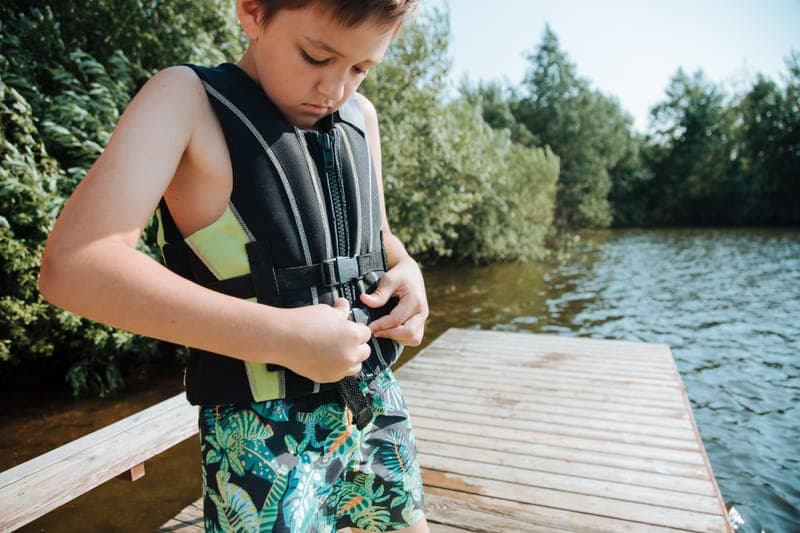
Stearns Puddle Jumper Deluxe
A USCG-approved Type III that children accept, because the arm floats leave the shoulders free.
Specifications
- USCG class
- Type III, approved
- Weight range
- 30-50 lbs
- Closure
- Single rear buckle
- Flotation
- Chest panel plus arm floats
What works
- Genuinely USCG-approved, unlike the water wings and arm bands it resembles
- The rear-only buckle is behind the child, so they cannot undo it themselves
- Children tolerate it for a whole afternoon, which is the property that actually keeps them in it
- Holds a swimmer upright and slightly forward, which suits pool and calm-lake play
What doesn’t
- Not designed to turn an unconscious wearer face-up — that is a Type I offshore jacket
- The upright-forward position teaches a vertical body posture that has to be unlearned in lessons
Who it’s for
A 30-50 lb child in a pool or on a calm lake shore, supervised at arm's length.
Bottom line
The most-worn kids' PFD in America for a reason. Check the printed USCG approval on the label, because look-alikes without it are everywhere.
Stearns Youth Classic Series Vest
The plain nylon boating vest: three buckles, a leg strap, and enough flotation to be the one you tow behind a boat in.
Specifications
- USCG class
- Type III, approved
- Weight range
- 50-90 lbs
- Shell
- Durable nylon
- Closure
- 3 buckles plus leg strap
What works
- Leg strap is what stops a vest riding up over a child's head in a hard fall — do not buy a towing vest without one
- Nylon shell survives dock boards, boat carpet and a season of sun
- Three buckles let you tighten it properly at the chest and waist separately
- Cheap enough to buy one per child rather than sharing
What doesn’t
- Bulkier and hotter than a swim-focused vest, so kids take it off between rides
- Foam panels restrict arm movement, so it is poor for actual swimming
Who it’s for
A 50-90 lb child on a boat, on a towable tube, or on a dock.
Bottom line
The right jacket for boating and towing. For swimming, a Puddle Jumper or swim vest is more wearable.

Onyx MoveVent Dynamic Paddle Vest
A ventilated paddling vest with high-cut armholes, so you can actually swim, paddle and lift children in it.
Specifications
- USCG class
- Type III, approved
- Size
- Adult S/M to XL/2XL
- Ventilation
- Mesh back panel
- Features
- High armholes, pockets, adjustable
What works
- High armholes and a mesh back make it wearable for hours in heat
- Multiple adjustment points get a real fit rather than a universal approximation
- Front pockets hold a phone in a dry bag and a set of keys
- Still a full Type III, so it satisfies the legal requirement
What doesn’t
- Costs several times a universal vest
- Mesh back offers no flotation behind the shoulders, so it sits lower in the water
Who it’s for
A parent who wears a PFD all day — paddling, supervising swimmers, getting in and out of a boat.
Bottom line
The adult vest people actually keep on. Modeling that in front of your children is worth more than the jacket costs.
Questions
Frequently asked questions
What does the Coast Guard approved symbol look like?
What is the difference between Type II and Type III life jackets?
Does a seat cushion count as a life jacket?
Are Type V life jackets safe?
Sources
Read next