Life Jackets & Safety · Guide
How to Tell if a Life Jacket Is Coast Guard Approved
One sewn-in label, five lines of print. Everything else about the jacket is marketing.
The short answer
Find the sewn-in label and read it. An approved jacket carries a printed US Coast Guard approval statement and an approval number from the 46 CFR Part 160 series, so it begins with 160. No printed approval statement means the device is not approved, whatever the box, the listing title or the shape of the jacket suggests.
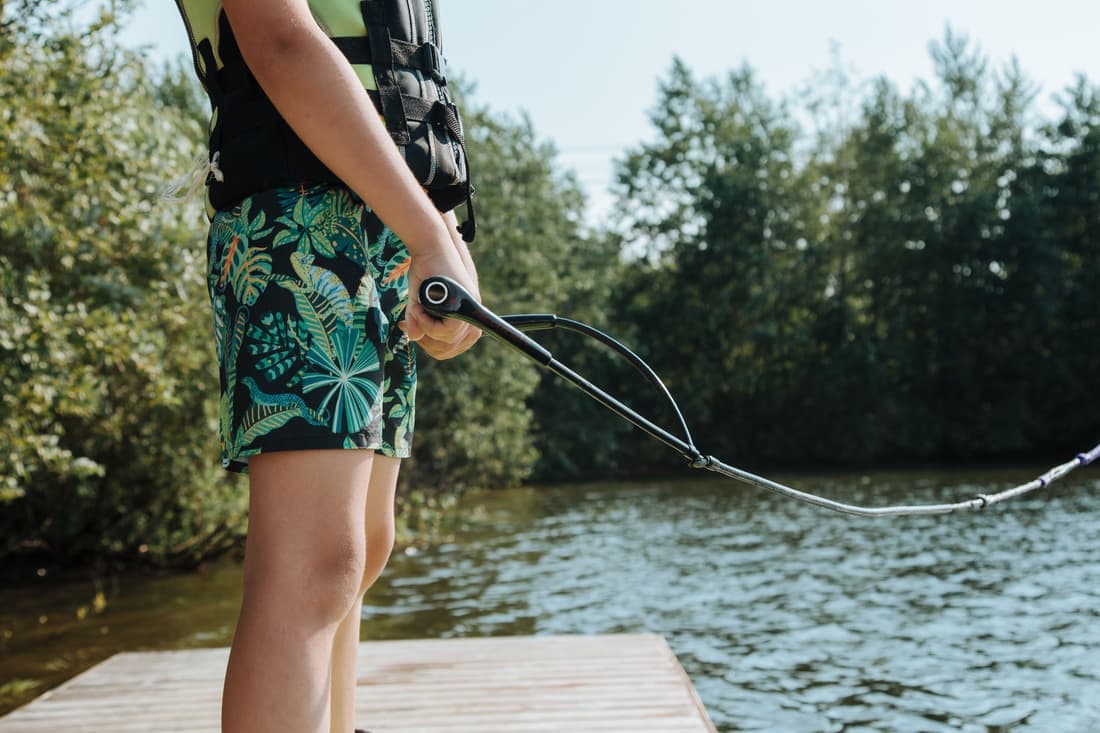
Product photos are the retailer’s own catalogue images, shown from the retailer’s servers and refreshed daily. Any other photo here is a licensed image that illustrates the category, not a photograph of the specific product named.
The label is the only evidence
A Coast Guard approval is a statement that one specific device has been tested against a federal standard for buoyancy, construction and performance, and that it is intended for a stated use and a stated wearer size. That approval exists as printed text on a sewn-in label and nowhere else.
This matters because nothing else about a jacket is diagnostic. A thick foam vest with three buckles can be unapproved. A slim, expensive, serious-looking neoprene vest can be unapproved. A cheap orange vest from a marina almost certainly is approved. Shape, price, brand recognition and how substantial something feels in your hands tell you nothing at all.
What the label says, line by line
- A US Coast Guard approval statement. The words appear in plain English on the label — a statement that the device is approved by the US Coast Guard. It is printed text, not a graphic badge, a hologram or a sticker.
- An approval number. Federally approved flotation devices carry a number from the Coast Guard's 46 CFR Part 160 series, so it begins with 160 followed by a subpart. A long model or product number that does not begin with 160 is not an approval number.
- A weight range in pounds. Not an age. 'Under 30 lbs', '30-50 lbs', '50-90 lbs', 'Adult, over 90 lbs'. If the only size information on the label is an age or a shirt size, keep looking.
- An intended use. Either a Type number from I to V or, on newer labels, icons and plain-language performance text showing which activities the device suits and which it does not.
- Restrictions. Lines excluding the device from towing, from personal watercraft, or from use by weak and non-swimmers. These are conditions of the approval, not cautious boilerplate.
Both label styles are legitimate and both are on shelves right now, because approved stock stayed valid when the labelling changed. The three things you are checking for are the same either way: an approval statement, a weight range that matches the actual wearer, and an intended use that matches what you are about to do. The full breakdown of the classes is in USCG life jacket types explained.
Where the label is sewn
| Device | Usual label location |
|---|---|
| Adult foam vest | Inside the back panel, or inside the front under a flap |
| Youth or child vest | Inside the back, often where the grab handle is stitched |
| Infant vest | Inside the back, below the flotation collar |
| Arm-float style jacket | Inside the chest panel, behind the rear buckle |
| Inflatable PFD | Inside the outer cover, next to the bladder |
| Dog life jacket | No approval exists — the Coast Guard does not approve animal PFDs |
If you cannot find a label anywhere on the device, treat it as unapproved. An approved jacket whose label has worn illegible is also a problem: it is a compliance failure during a safety check as well as an information gap, and it is a fair signal that the jacket is old enough to be replaced.
Stearns Youth Classic Series Vest
The plain nylon boating vest: three buckles, a leg strap, and enough flotation to be the one you tow behind a boat in.
Specifications
- USCG class
- Type III, approved
- Weight range
- 50-90 lbs
- Shell
- Durable nylon
- Closure
- 3 buckles plus leg strap
What works
- Leg strap is what stops a vest riding up over a child's head in a hard fall — do not buy a towing vest without one
- Nylon shell survives dock boards, boat carpet and a season of sun
- Three buckles let you tighten it properly at the chest and waist separately
- Cheap enough to buy one per child rather than sharing
What doesn’t
- Bulkier and hotter than a swim-focused vest, so kids take it off between rides
- Foam panels restrict arm movement, so it is poor for actual swimming
Who it’s for
A 50-90 lb child on a boat, on a towable tube, or on a dock.
Bottom line
The right jacket for boating and towing. For swimming, a Puddle Jumper or swim vest is more wearable.
Stearns Infant Classic Series Vest
An infant vest with the two features that matter at this size: a head pillow and a crotch strap.
Specifications
- USCG class
- Type II, approved
- Weight range
- Under 30 lbs
- Head support
- Flotation collar
- Closure
- Buckles plus crotch strap
What works
- The flotation collar supports an infant's head, which is the whole point at this weight
- Crotch strap stops the vest lifting off a small body in water
- Grab handle at the collar lets an adult lift the child straight out
- Type II turns most wearers face-up, which an infant cannot do for themselves
What doesn’t
- Bulky and warm, and most infants object to it initially
- A vest is never a substitute for arm's-length supervision at this age
Who it’s for
A baby or small toddler under 30 lbs on or near a boat.
Bottom line
Required kit if an infant is going on the water. Fit it dry, on land, and lift by the collar handle to check it does not slip off.
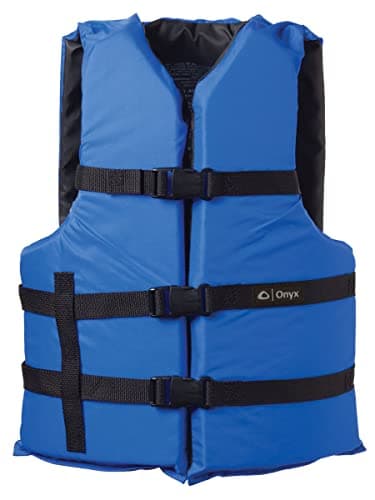
Onyx General Purpose Vest
The plain, cheap, USCG-approved adult vest you keep three of in the boat locker.
Specifications
- USCG class
- Type III, approved
- Size
- Adult universal
- Shell
- Nylon
- Closure
- Zip plus straps
What works
- Cheapest route to meeting the legal requirement of one wearable PFD per person aboard
- Universal adult sizing covers most guests without a fitting
- Stores flat and survives a locker
- Bright colors that are actually visible in the water
What doesn’t
- Basic foam construction is hot and restrictive for a full day
- Universal sizing fits nobody especially well
Who it’s for
Boat owners who need spare approved jackets for passengers.
Bottom line
Buy these as spares, not as your own jacket. Legal compliance is the job and it does it.
Stearns Puddle Jumper Deluxe
A USCG-approved Type III that children accept, because the arm floats leave the shoulders free.
Specifications
- USCG class
- Type III, approved
- Weight range
- 30-50 lbs
- Closure
- Single rear buckle
- Flotation
- Chest panel plus arm floats
What works
- Genuinely USCG-approved, unlike the water wings and arm bands it resembles
- The rear-only buckle is behind the child, so they cannot undo it themselves
- Children tolerate it for a whole afternoon, which is the property that actually keeps them in it
- Holds a swimmer upright and slightly forward, which suits pool and calm-lake play
What doesn’t
- Not designed to turn an unconscious wearer face-up — that is a Type I offshore jacket
- The upright-forward position teaches a vertical body posture that has to be unlearned in lessons
Who it’s for
A 30-50 lb child in a pool or on a calm lake shore, supervised at arm's length.
Bottom line
The most-worn kids' PFD in America for a reason. Check the printed USCG approval on the label, because look-alikes without it are everywhere.
Buying online, where you cannot read the label
This is where most mistakes happen, because an online listing can simply type the words 'Coast Guard approved' into a title. A listing title is a seller's claim; the label is the evidence. Four things separate a real listing from a hopeful one.
- An approval number in the listing text, or a photo of the label. Sellers of genuinely approved jackets publish the number, because it is the thing informed buyers check. Its absence across an entire listing is the strongest single warning sign.
- A weight range in pounds, split into bands. Approved child devices are sold in weight bands because that is how they are certified. A listing offering one size for '2-12 years' is describing a swim aid.
- A named manufacturer with a traceable range. Approval is granted to a manufacturer for a specific model. An unbranded listing, or one whose brand name changes between the title and the images, cannot be checked against anything.
- Consistency between the title and the photographs. Listings claiming approval in the title while the photos show arm bands, a swim vest or a float suit are the common pattern, and the one to walk away from.
When a listing looks plausible but you cannot confirm any of that, buy from a maker whose weight bands are published and whose approvals you can check. The picks above are all devices sold in stated weight bands with printed approvals. They are the boring answer, and boring is correct here.
Things that are definitely not approved
These are swim aids. Several are genuinely useful for teaching a child to swim, and not one of them is a life jacket or satisfies a requirement to carry one.
- Arm bands and water wings. Never approved, and they slide off.
- Swim vests and foam float suits. Useful for pool confidence, not flotation devices — see life jacket vs swim vest.
- Pool noodles, rings and inflatable floats. Toys, including the expensive ones.
- Neoprene watersports vests. Impact protection for wakeboarding, frequently with no flotation approval at all.
- A throwable cushion or ring buoy. Approved, but as a Type IV throwable — it does not count toward the requirement for a wearable device per person aboard.
One widely sold device sits in between and causes genuine confusion: the arm-float jacket, sold under the Puddle Jumper name and copied very widely. The original is an approved Type III; many look-alikes are not approved at all, and they are visually almost identical. The comparison is in puddle jumper vs life jacket.
Approved once is not approved forever
Approval also depends on condition. A jacket with crushed foam, frayed stitching at a buckle or a brittle, chalky shell has lost the performance it was certified for. A device that has been modified — padded out, knotted shorter, crotch strap cut off because it got in the way — is no longer an approved device at all.
Two minutes a season covers it: squeeze the foam across its whole area feeling for hard or crumbling spots, pull each strap firmly at the buckle and look at the stitching, work every buckle and zip, check the shell for tears that expose foam, and confirm the label is still readable. Any one of those and the jacket is finished.
Once the label checks out, the only remaining question is fit, and fit is a weight question rather than an age one — the bands and the lift test are in life jacket sizing by weight.
Questions
Frequently asked questions
How do I know if my life jacket is Coast Guard approved?
What does a Coast Guard approval number look like?
If a listing title says 'Coast Guard approved', is the jacket approved?
Are dog life jackets Coast Guard approved?
Does an old life jacket stay approved?
Sources
Read next