Life Jackets & Safety · Guide
How Long Do Life Jackets Last?
No expiry date printed on it. A condition test instead, and it takes five minutes.
The short answer
Foam life jackets have no printed expiry date — they are retired on condition, not age. Inspected and stored dry and out of the sun, a jacket commonly lasts about ten years. Replace one immediately if the foam is hard or crumbling, the fabric tears, the straps are frayed, or it no longer floats you properly.

Product photos are the retailer’s own catalogue images, shown from the retailer’s servers and refreshed daily. Any other photo here is a licensed image that illustrates the category, not a photograph of the specific product named.
Why there is no date on it
Inherently buoyant foam life jackets are not date-stamped, and that is deliberate. The foam does not degrade on a schedule; it degrades with exposure. A jacket that has spent eight summers in a dry locker is in better condition than one that spent two on a sunny dock, and a printed date would tell you nothing useful about either.
So the rule is condition, not age. In practice a well-stored foam jacket in regular family use lasts around ten years before the fabric and straps start to go, and a badly stored one can be unfit in three. Either way, the inspection is what decides.
Inflatable jackets are the exception and they do have a schedule: the CO2 cylinder and the inflator have service dates, and the whole unit needs an annual check per the manufacturer's instructions. If you own one, the manual is not optional reading.
The five-minute inspection
Do this at the start of every season, with every jacket laid out on a dock or a table. Anything that fails goes in the trash rather than back in the locker — a retired jacket that stays in the pile is a jacket somebody will grab in a hurry.
- Squeeze the foam panels all over. They should be springy and uniform. Hard spots, crunchy patches, or foam that crumbles under pressure mean the flotation is compromised. Retire it.
- Check every seam and panel for tears, abrasion and open stitching. A torn shell lets the foam move and take water.
- Pull hard on each strap and buckle. Frayed webbing, a cracked buckle, or a buckle that releases under a steady pull retires the jacket.
- Read the inside label. If the USCG approval statement is worn off entirely, you can no longer prove it is approved, which matters both legally and practically.
- Look for mildew and heavy staining. Surface mildew washes off; a jacket that smells of mildew all the way through has been wet and stored wet, which is what rots the stitching.
- Float-test it. Put it on, do it up, and get in chest-deep water. It should float you comfortably with your chin clear. If you have to work to keep your face out of the water, it is done.
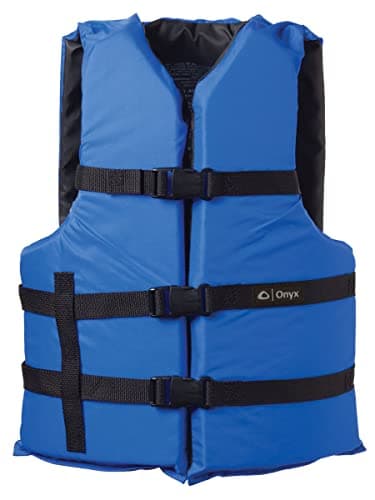
Onyx General Purpose Vest
The plain, cheap, USCG-approved adult vest you keep three of in the boat locker.
Specifications
- USCG class
- Type III, approved
- Size
- Adult universal
- Shell
- Nylon
- Closure
- Zip plus straps
What works
- Cheapest route to meeting the legal requirement of one wearable PFD per person aboard
- Universal adult sizing covers most guests without a fitting
- Stores flat and survives a locker
- Bright colors that are actually visible in the water
What doesn’t
- Basic foam construction is hot and restrictive for a full day
- Universal sizing fits nobody especially well
Who it’s for
Boat owners who need spare approved jackets for passengers.
Bottom line
Buy these as spares, not as your own jacket. Legal compliance is the job and it does it.
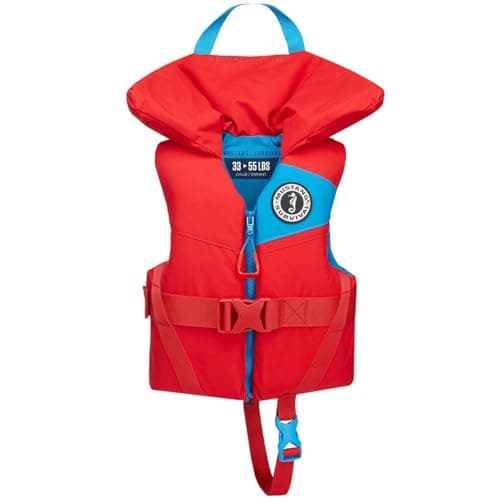
Mustang Survival Lil' Legends 70
A softer, better-shaped child vest from a marine-safety brand — noticeably more comfortable than a foam-panel jacket.
Specifications
- USCG class
- Type III, approved
- Weight range
- 30-50 lbs and 50-90 lbs options
- Shell
- Soft, segmented foam
- Closure
- Buckles plus crotch strap
What works
- Segmented foam bends with the body instead of holding a child in a rigid block
- Made by a company whose main business is commercial marine survival gear
- Crotch strap and a collar grab handle both included
- Comfortable enough for a full day out, which is what keeps it on
What doesn’t
- Two to three times the price of the basic Stearns vest
- Sizing runs slim; a stocky child may need the next band up
Who it’s for
A family that spends whole days on the water and has lost the argument about wearing the cheap vest.
Bottom line
Worth it if your child takes the vest off every twenty minutes. Otherwise the Stearns Classic is the same safety rating for far less.
Stearns Youth Classic Series Vest
The plain nylon boating vest: three buckles, a leg strap, and enough flotation to be the one you tow behind a boat in.
Specifications
- USCG class
- Type III, approved
- Weight range
- 50-90 lbs
- Shell
- Durable nylon
- Closure
- 3 buckles plus leg strap
What works
- Leg strap is what stops a vest riding up over a child's head in a hard fall — do not buy a towing vest without one
- Nylon shell survives dock boards, boat carpet and a season of sun
- Three buckles let you tighten it properly at the chest and waist separately
- Cheap enough to buy one per child rather than sharing
What doesn’t
- Bulkier and hotter than a swim-focused vest, so kids take it off between rides
- Foam panels restrict arm movement, so it is poor for actual swimming
Who it’s for
A 50-90 lb child on a boat, on a towable tube, or on a dock.
Bottom line
The right jacket for boating and towing. For swimming, a Puddle Jumper or swim vest is more wearable.
What actually kills a life jacket
| Cause | What it does | How to avoid it |
|---|---|---|
| Sunlight | Breaks down nylon shell and webbing; fades then tears | Store indoors or under cover, never on an open dock |
| Stored wet | Rots stitching, grows mildew through the foam | Hang to dry fully before it goes away |
| Compression | Permanently flattens foam, reducing buoyancy | Hang or lay flat; never use one as a boat cushion or a kneeling pad |
| Heat | Hardens foam and ages adhesives | Out of a hot car trunk and off a sun-baked deck box |
The compression one surprises people. Using a life jacket as a seat cushion, a fender or a kneeling pad crushes the closed cells that provide the flotation, and the foam does not spring back. A jacket that has lived under somebody for three seasons can look perfect and float poorly.
Children's jackets have a second clock
A child's jacket fails long before the foam does, because the child grows out of it. Life jackets for children are sized by weight band, and a jacket above the child's band rides up over the chin while a jacket below it will not float them.
That means checking the fit every season rather than assuming last year's jacket is still right. The test is the same shoulder-pull: do up every buckle including the crotch strap, lift firmly at the shoulders, and if the jacket moves up past the chin it is time for the next band. The bands are listed in life jacket sizing by weight.
Hand-me-downs are fine as long as they pass both tests — the condition inspection above and the weight band. A jacket that passes both is as good as a new one, and jackets that get handed down have usually had less sun than the one that lives on the boat.
Storage, which is most of the answer
- Rinse in fresh water after use in a lake, and especially after salt.
- Dry completely before storing, hanging rather than folded.
- Store indoors, in a dry locker or closet, out of direct sunlight.
- Hang on a broad hook or a rail rather than stacking weight on them.
- Never dry on a radiator or in a dryer. Heat is a flotation problem, not just a fabric one.
- Keep the family's jackets together so the seasonal inspection takes five minutes rather than an afternoon.
When in doubt, retire it
A life jacket is among the cheapest safety equipment a family owns and the only one whose failure is unrecoverable. If a jacket is borderline — foam slightly firm, webbing slightly frayed, label mostly illegible — the right answer is a new one, and to cut the straps off the old one so it cannot be grabbed by mistake.
What a jacket cannot do is compensate for not being worn, which is the thing that actually decides outcomes on the water. The habits that go with it are in lake swimming safety, and if you are replacing a jacket for paddling specifically, the shape matters: best life jackets for kayaking.
Questions
Frequently asked questions
Do life jackets expire?
How often should you replace a life jacket?
How can you tell if a life jacket is still good?
Can you use an old life jacket?
Does sunlight damage life jackets?
Sources
Read next