Life Jackets & Safety · Guide
Do You Need a Life Jacket on a Paddle Board?
Outside a swimming area, a paddle board is a vessel — and that changes what has to be on it.
The short answer
Yes, in most places you paddle. Once a stand-up paddle board is used beyond the narrow limits of a swimming, surfing or bathing area, the Coast Guard treats it as a vessel, so a wearable Coast Guard approved life jacket must be aboard for each person, plus a sound-producing device and a light after dark.
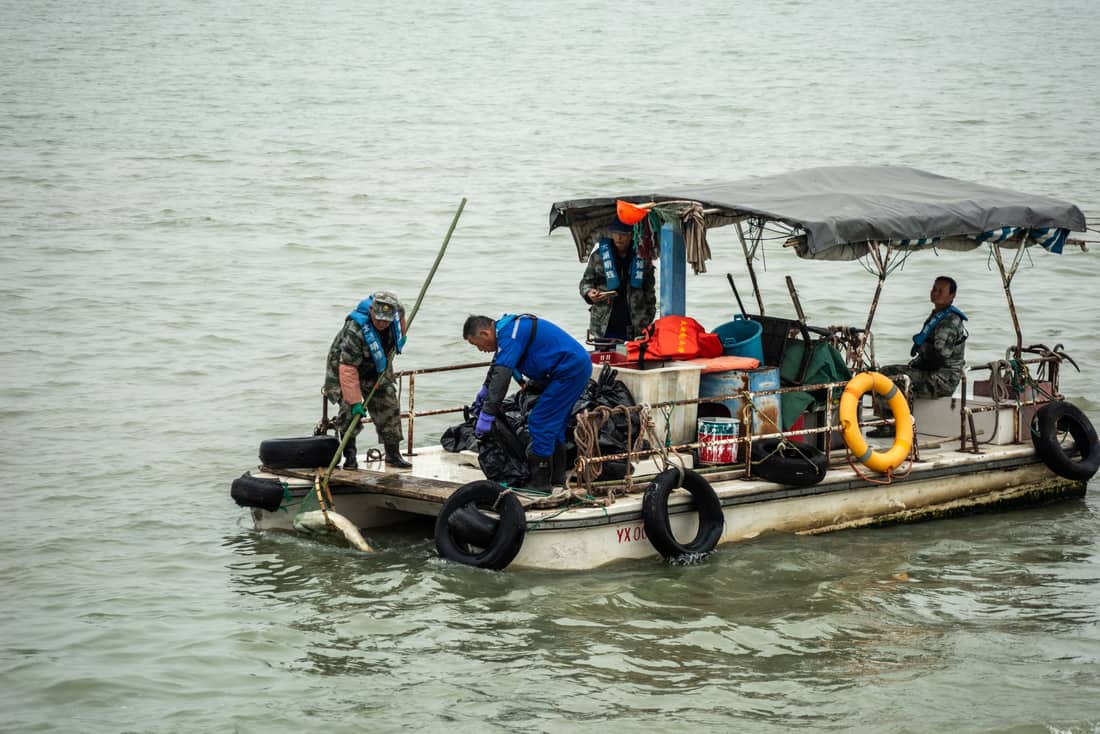
Product photos are the retailer’s own catalogue images, shown from the retailer’s servers and refreshed daily. Any other photo here is a licensed image that illustrates the category, not a photograph of the specific product named.
The rule in one paragraph
The Coast Guard's position is that a stand-up paddle board used beyond the narrow limits of a swimming, surfing or bathing area is a vessel. Inside a marked swimming or surfing area it is not. The moment you paddle past that boundary, federal recreational vessel requirements apply to you, and the first of those is a wearable, Coast Guard approved life jacket aboard for every person.
Two things follow that surprise people. First, the federal requirement for adults is to carry a life jacket, not necessarily to wear it — though deflating that distinction, most state and local rules are stricter, and drowning statistics make wearing it the obvious choice. Second, children under 13 must wear one on a recreational vessel that is under way, under federal rule, unless they are below decks or in an enclosed cabin, which a paddle board plainly does not have.
On top of that, a vessel under 39.4 feet must carry an efficient means of making a sound signal — a whistle on a lanyard is the universal answer — and a vessel operating after sunset must show a light. Both apply to a paddle board as soon as it is a vessel.
States then add their own layers, and several set a lower or higher age for the mandatory-wear rule or require the jacket to be worn at all times on paddlecraft. Check your own state's boating agency before you rely on the federal floor.
What counts as leaving a swimming area
- Paddling out past the buoy line at a lake beach — you are now a vessel.
- Crossing open water between two points, at any distance.
- Launching from your own dock into a lake with boat traffic — there is no swimming area to be inside.
- Paddling a river outside a designated swimming stretch.
- Staying inside a marked swimming or surfing area is the one case where the vessel rules do not apply.
In practice, if a boat could reasonably be where you are, you are a vessel and the rules apply. That is a more useful test than trying to read a buoy line from a hundred yards out.
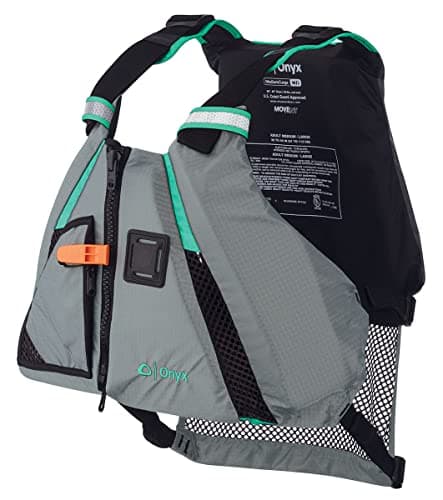
Onyx MoveVent Dynamic Paddle Vest
A ventilated paddling vest with high-cut armholes, so you can actually swim, paddle and lift children in it.
Specifications
- USCG class
- Type III, approved
- Size
- Adult S/M to XL/2XL
- Ventilation
- Mesh back panel
- Features
- High armholes, pockets, adjustable
What works
- High armholes and a mesh back make it wearable for hours in heat
- Multiple adjustment points get a real fit rather than a universal approximation
- Front pockets hold a phone in a dry bag and a set of keys
- Still a full Type III, so it satisfies the legal requirement
What doesn’t
- Costs several times a universal vest
- Mesh back offers no flotation behind the shoulders, so it sits lower in the water
Who it’s for
A parent who wears a PFD all day — paddling, supervising swimmers, getting in and out of a boat.
Bottom line
The adult vest people actually keep on. Modeling that in front of your children is worth more than the jacket costs.
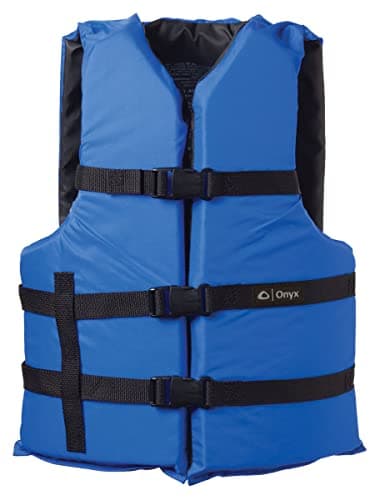
Onyx General Purpose Vest
The plain, cheap, USCG-approved adult vest you keep three of in the boat locker.
Specifications
- USCG class
- Type III, approved
- Size
- Adult universal
- Shell
- Nylon
- Closure
- Zip plus straps
What works
- Cheapest route to meeting the legal requirement of one wearable PFD per person aboard
- Universal adult sizing covers most guests without a fitting
- Stores flat and survives a locker
- Bright colors that are actually visible in the water
What doesn’t
- Basic foam construction is hot and restrictive for a full day
- Universal sizing fits nobody especially well
Who it’s for
Boat owners who need spare approved jackets for passengers.
Bottom line
Buy these as spares, not as your own jacket. Legal compliance is the job and it does it.
Stearns Youth Classic Series Vest
The plain nylon boating vest: three buckles, a leg strap, and enough flotation to be the one you tow behind a boat in.
Specifications
- USCG class
- Type III, approved
- Weight range
- 50-90 lbs
- Shell
- Durable nylon
- Closure
- 3 buckles plus leg strap
What works
- Leg strap is what stops a vest riding up over a child's head in a hard fall — do not buy a towing vest without one
- Nylon shell survives dock boards, boat carpet and a season of sun
- Three buckles let you tighten it properly at the chest and waist separately
- Cheap enough to buy one per child rather than sharing
What doesn’t
- Bulkier and hotter than a swim-focused vest, so kids take it off between rides
- Foam panels restrict arm movement, so it is poor for actual swimming
Who it’s for
A 50-90 lb child on a boat, on a towable tube, or on a dock.
Bottom line
The right jacket for boating and towing. For swimming, a Puddle Jumper or swim vest is more wearable.
What to look for in a paddle board PFD
A ventilated paddle vest. Large mesh panels at the shoulders and a high cut above the waist mean the vest does not trap heat and does not interfere with the paddle stroke or with sitting down. This is the category built for paddlecraft, and it is the one people actually keep on.
A high-cut back. Anything that sits low at the back is uncomfortable the moment you sit or kneel, which is most of the time on a paddle board. A paddle-specific vest is cut short for exactly that reason.
The approval label, read properly. A Coast Guard approval number on the label is what makes the jacket count. A foam vest sold as a swim aid is not a life jacket, however much it looks like one — the difference is covered in how to tell if a life jacket is Coast Guard approved.
Inflatables: read the age and use restrictions. Inflatable belt packs and vests are popular with paddlers because they are nearly invisible to wear, but approval conditions restrict them — commonly to users 16 and older, and they must be worn to count. The restriction is printed on the label.
For children, a proper fit rather than a size label. The lift test is the only check that matters: lift the child by the shoulders of the jacket and the jacket should not ride up past the chin or the ears. Weight-range sizing is set out in life jacket sizing by weight.
What has to be on the board
| Item | Requirement | Notes |
|---|---|---|
| Wearable life jacket | One approved jacket per person aboard | Children under 13 must wear it |
| Sound signal | An efficient means of making a sound | A whistle on a lanyard; a voice does not count |
| Light after sunset | A light to show other vessels | A white light is the usual answer |
| Leash | Not a federal requirement | Still the most useful safety item you own |
| Throwable cushion | Not required on a SUP | That rule applies to vessels 16 ft and over |
| State rules | Vary, often stricter | Check your state boating agency |
The leash argument
No federal rule requires a leash, and it is still the item most experienced paddlers would refuse to go out without. A board blows downwind far faster than a person can swim, so a separated paddler is a swimmer with no flotation and nothing to be seen from.
Leash type matters by water. A straight ankle leash is standard on flat water. In moving water, a quick-release waist leash is the only acceptable version, because an ankle leash in current can anchor a paddler to a snag. If you paddle rivers, this is not an optional detail.
A life jacket, a leash and a whistle together cost less than a cheap paddle and cover the three ways a paddle board day goes wrong: separation from the board, not being able to float, and not being able to signal.
Cold water changes the calculation
Spring and autumn paddling on a lake means warm air over cold water, and cold water shock is what turns a fall into an emergency. A life jacket carried in a dry bag is useless in the first minute of immersion, which is the minute that matters.
That is the strongest practical argument for wearing rather than carrying, and it is why a ventilated vest you forget you have on is worth paying for over a cheap one you take off. The wider set of family rules for open water is in lake swimming safety tips for families.
Questions
Frequently asked questions
Do you need a life jacket on a paddle board?
Do you have to wear the life jacket or just carry it?
Does a paddle board count as a vessel?
What kind of life jacket is best for paddle boarding?
Do you need a whistle on a paddle board?
Sources
Read next