Floats & Towables · Roundup
Best Towable Tubes for Pontoon Boats (2026)
Five picks matched to how a pontoon actually tows — and the one part most pontoon owners are missing.
The short answer
The SportsStuff Big Mable is the pick for a pontoon: a padded cockpit tube that rides well at the slower, steadier speeds a pontoon holds. The part most pontoon owners are missing is a tow harness, which spreads the pull across both transom eyes and keeps the rope clear of the outboard.
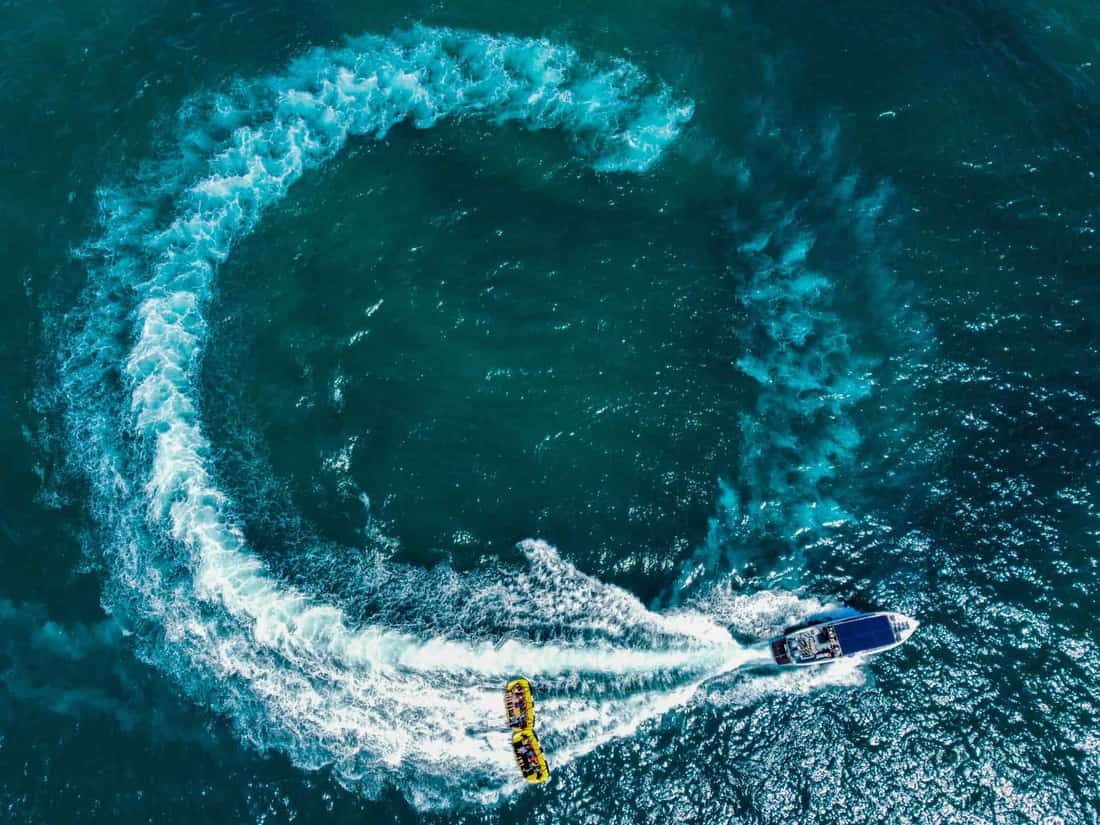
Product photos are the retailer’s own catalogue images, shown from the retailer’s servers and refreshed daily. Any other photo here is a licensed image that illustrates the category, not a photograph of the specific product named.
| # | Product | Best for | Riders | Price |
|---|---|---|---|---|
| 1 | 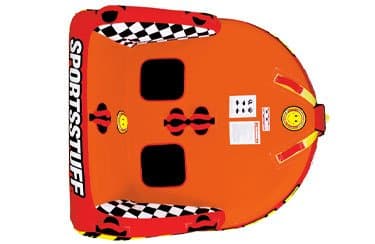 Top pick SportsStuff Big Mable A padded, high-backed cockpit tube for two — the most secure-feeling seat in the category. | Nervous first-timers | 2 | |
| 2 | Budget pick WOW Sports Super Thriller A simple one-to-three rider deck tube at the bottom of the durable price band. | Cheapest durable tube | 1-3 | |
| 3 | 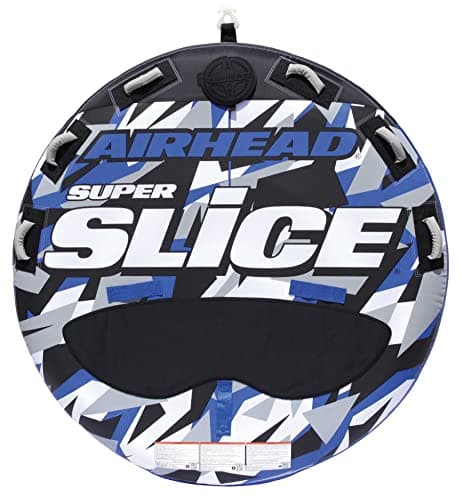 Also good Airhead Super Slice A three-rider deck tube, which is the cheapest way to stop the sibling rotation argument. | 3 riders | 3 | |
| 4 | 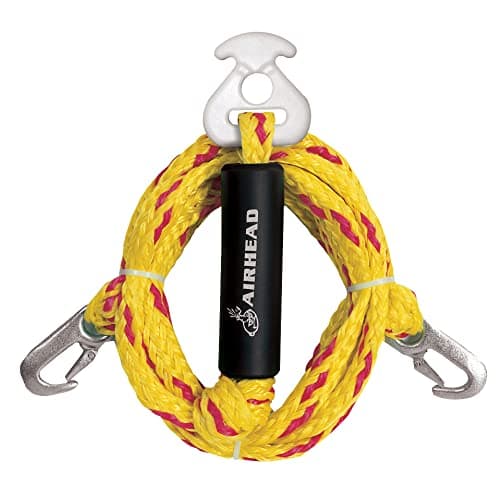 Also good Airhead Heavy Duty Tow Harness, 12 ft Not a rope - the bridle that spreads the load across both transom eyes and keeps the rope off your motor. | Boats without a tow pylon | 12 ft (16 ft version also sold) | |
| 5 | 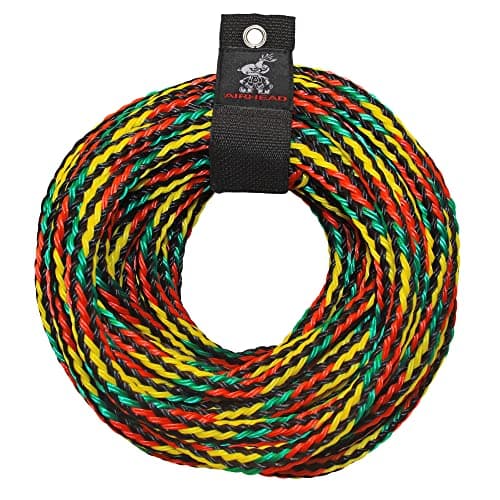 Also good Airhead 1-4 Person Tow Rope The rope you move up to the day you buy a bigger tube, and the one most families should have bought first. | 3 and 4 person tubes | 1-4 |
A pontoon changes which tube is right
A pontoon is a displacement-style platform with a wide beam and, on most family boats, a modest outboard. It tows perfectly well, but it tows steadily rather than explosively: it takes longer to come up to speed, it holds a cruise comfortably, and it does not throw the sharp wake that a V-hull runabout does.
That changes the shopping list. A low, hard-carving deck tube built to whip outside a runabout's wake is wasted behind a pontoon — there is less wake to whip across and less acceleration to load it. A cockpit tube that rides high and cruises comfortably uses what a pontoon is good at, which is holding a steady speed on flat water for a long time.
The second difference is where the rope attaches. Most pontoons have no ski pylon. The rope has to come off the transom, and on a single eye it both loads one corner of the boat and lies across the path of the outboard. That is the problem a tow harness exists to solve, and it is the single most commonly missing piece of a pontoon tubing setup.
Third: sightlines. A pontoon's fence and bimini block more of the view aft than a runabout's open stern does, which makes the spotter's job non-optional rather than nice to have. Many states require one; all of them benefit from one.
SportsStuff Big Mable
A padded, high-backed cockpit tube for two — the most secure-feeling seat in the category.
Specifications
- Riders
- 2
- Shape
- Cockpit with backrest
- Seating
- Padded, sit-in
- Cover
- Nylon
What works
- Backrest and deep seat mean a child is held in rather than hanging on, which converts refusals into rides
- Padded seating is comfortable enough for long, slow cruising
- Sits high, so riders stay noticeably drier than on a deck tube
- Also works as a lake lounger when it is not being towed
What doesn’t
- High profile catches wind and skips at speed, so it wants a slower tow
- Bulky to inflate, store and transport
Who it’s for
Children who are anxious about towing, or adults who want a comfortable cruise rather than airtime.
Bottom line
The confidence pick. If you want the ride to be gentle and the child to say yes, start here.
WOW Sports Super Thriller
A simple one-to-three rider deck tube at the bottom of the durable price band.
Specifications
- Riders
- 1-3
- Shape
- Deck
- Cover
- Nylon, full
- Valve
- Speed safety valve
What works
- Cheapest tube here that still has a full nylon cover rather than bare PVC
- Flexible rider count, so it suits a changing family
- Speed valve makes inflation and deflation genuinely quick at a boat ramp
- Light enough for one adult to carry inflated
What doesn’t
- Thinner material than the premium tubes and it shows after two hard seasons
- Handles are less padded, so knuckles take more punishment
Who it’s for
A family buying their first towable who are not sure how much they will use it.
Bottom line
The budget pick. If it survives two summers of heavy use, you were right to start cheap.
Airhead Super Slice
A three-rider deck tube, which is the cheapest way to stop the sibling rotation argument.
Specifications
- Riders
- 3
- Shape
- Wing deck
- Cover
- 840-denier nylon
- Handles
- 6, with knuckle guards
What works
- Three riders means all your children go at once instead of taking turns
- 840-denier nylon is the durability tier that survives repeated seasons
- Wing shape is stable and slow to flip, which matters with three kids aboard
- Six padded handles, so nobody is holding the wrong thing
What doesn’t
- Needs a boat with real pulling power to plane with three riders
- Large enough that storage is a genuine problem in a small garage
Who it’s for
Families with three children, towed behind a boat with adequate power.
Bottom line
Buy on rider count. Three-up on one tube is more fun and less negotiation than two-up plus a waiting list.
Airhead Heavy Duty Tow Harness, 12 ft
Not a rope - the bridle that spreads the load across both transom eyes and keeps the rope off your motor.
Specifications
- Length
- 12 ft (16 ft version also sold)
- Riders
- 1-4 rider towables
- Break strength
- 4,100 lb
- Float
- 6 in float keeps the connector up
- Connection
- Kwik-Connect system
What works
- Solves the actual problem on most family boats: no ski pylon, so the rope has to come off two transom eyes without sawing across the outboard
- The 6 in float keeps the Kwik-Connect at the surface instead of dangling toward the prop
- Kwik-Connect makes swapping between tube rope, ski rope and wakeboard rope a two-second job with no knots
- The 4,100 lb rating covers everything up to a 4 rider towable
What doesn’t
- It is an extra 12 ft behind the boat, so your effective tow length grows and needs accounting for in tight water
- Does nothing for a boat that already has a proper tow pylon or a rated ski eye
- Rated to 1-4 rider towables, so it is not the harness for a six-seat deck tube
- One more piece of hardware to rinse, dry and inspect
Who it’s for
Pontoons, runabouts and outboards with two transom eyes and no pylon.
Bottom line
If your rope currently rubs the engine or loads one eye, this is the missing part. Buy it with the rope, not after the first scare.
Airhead 1-4 Person Tow Rope
The rope you move up to the day you buy a bigger tube, and the one most families should have bought first.
Specifications
- Riders
- 1-4
- Length
- 60 ft
- Break strength
- 4,100 lb (Airhead's site lists 4,150 lb)
- Rope
- 16-strand, pre-stretched, UV-resistant
- Storage
- Rope keeper included
What works
- Correctly rated for the 3 and 4 rider deck tubes families actually end up buying
- Costs only a few dollars more than the 1-2 rider rope, which makes it the better buy if a bigger tube is anywhere in your future
- Same pre-stretched UV-resistant 16-strand construction as Airhead's smaller rope
- One continuous 60 ft length means one connection to inspect instead of two
What doesn’t
- The Amazon listing says 4,100 lb and Airhead's own product page says 4,150 lb for the same rope - a small gap, but it is the maker's own numbers disagreeing
- No 50 ft option, so in tight water you are towing at full length or not at all
- No float at the connector and no reflective strand
- Heavier and bulkier to coil than a 1-2 rider line
Who it’s for
Anyone towing a 3 or 4 rider tube, and families who expect the tube to get bigger.
Bottom line
If you are buying one rope for the next five summers, buy this rating. The money difference is trivial; the strength difference is not.
What to look for in a pontoon tube
A cockpit or high-back shape. Riders sit in rather than lie on, stay drier, and can hold a conversation at cruising speed. It is the shape that suits a boat towing at 15 to 20 mph rather than 25 to 30, and it converts nervous children into willing ones.
A rider count that matches your tow rating, not your seating. A pontoon seats ten and that tempts people into a six-rider deck tube. The rope, the harness and the motor all have to carry it. Match the tube to the rope rating and the engine, then to the family.
A full nylon cover over the bladder. Bare PVC tubes split where they rub the deck and the rail. A nylon cover is what separates a tube that lasts several seasons from one that is a consumable, and it is worth the difference on a boat you will tube from every weekend.
Knuckle-guarded handles. On a wide pontoon wake the ride is smoother but longer, and hands are what give out first. Padded handles with knuckle guards are the difference between a ten-minute ride and a three-minute one.
A quick-inflate valve. You are inflating at a dock or a ramp with a 12-volt pump, often with people waiting. A speed valve turns a tedious job into a short one and makes deflation for storage far less miserable.
Rope and harness: the part people skip
Federal and state rules aside, the physics are simple. A tow rope must be rated above the combined weight it will be asked to pull, and the standard breaks down by rider count. A one-to-two rider rope is not a four-rider rope with optimism applied, and a rope that has been shock-loaded once should be retired rather than inspected hopefully.
On a pontoon without a pylon, a tow harness is the bridge between the rope and the boat. It is a bridle: two legs onto the two transom eyes, a float to keep the connector at the surface and away from the prop, and a single connection point for the rope. It spreads the pull instead of loading one eye, and it keeps the rope from sawing across the outboard's lower unit.
Add the harness length to your rope length when you plan your turns — a 60-foot rope plus a 12-foot harness means the tube is 72 feet behind you, which matters in a narrow channel or near a dock. More on rope ratings in best tow ropes for tubing.
Matching tube to boat
| Your setup | Tube to buy | Why |
|---|---|---|
| Pontoon, modest outboard, young kids | 2-rider cockpit tube | Rides high and cruises; low refusal rate |
| Pontoon, bigger outboard, teens | Low-profile deck tube | Carves on what wake there is |
| Mixed ages, one tube only | 3-rider wing deck | Two adults or three kids, flexible |
| First season, unsure of use | Budget nylon-covered deck tube | Low commitment, still durable |
| No ski pylon (most pontoons) | Add a tow harness | Spreads load, keeps rope off the motor |
| Rope older than two seasons | Replace it | UV and shock loading are cumulative |
Driving a pontoon with a tube behind it
- Come up to speed gradually. A pontoon loads the rope smoothly if you let it; stabbing the throttle shock-loads the rope and pulls riders off the back.
- Pick a speed by rider age, not by tube rating. Around 10 to 15 mph suits young children, and the tube rating is a ceiling rather than a target.
- Turn wide and early. With a harness added to the rope, the tube's arc is far wider than the boat's, and the tube finishes the turn faster than you do.
- Keep a dedicated spotter facing aft. A pontoon fence and bimini block more of the view than you think from the helm.
- Shut the engine off before anyone is in the water near the stern, every time, without exception.
Safety gear that goes with it
Everyone on a towable wears a properly fitted, Coast Guard approved life jacket — not a swim vest, not a puddle jumper look-alike. The difference between the two categories is explained in life jacket vs swim vest, and the approval label is covered in how to tell if a life jacket is Coast Guard approved.
The wider set of risks specific to towing — speed, rope slack, the wake line and where not to ride — is in towable tube safety. Read it once before the first outing of the season rather than after an incident.
Questions
Frequently asked questions
What is the best towable tube for a pontoon boat?
Can a pontoon boat pull a tube?
Do I need a tow harness for a pontoon?
How fast should you pull a tube behind a pontoon?
Where does the tow rope attach on a pontoon?
Read next