Floats & Towables · Roundup
Best Tow Ropes for Tubing (2026)
The rope is rated for the tube, not for your family. Get that one thing right and the rest is detail.
The short answer
For a 1 or 2 rider tube, the Airhead 1-2 Person 2-Section rope is the pick: a stated 2,375 lb break strength and a 50 ft or 60 ft option in one rope. Tow a 3 or 4 rider tube and you need the 1-4 Person rope instead. Rope rating follows the tube's rider count, never the number of people in your family.
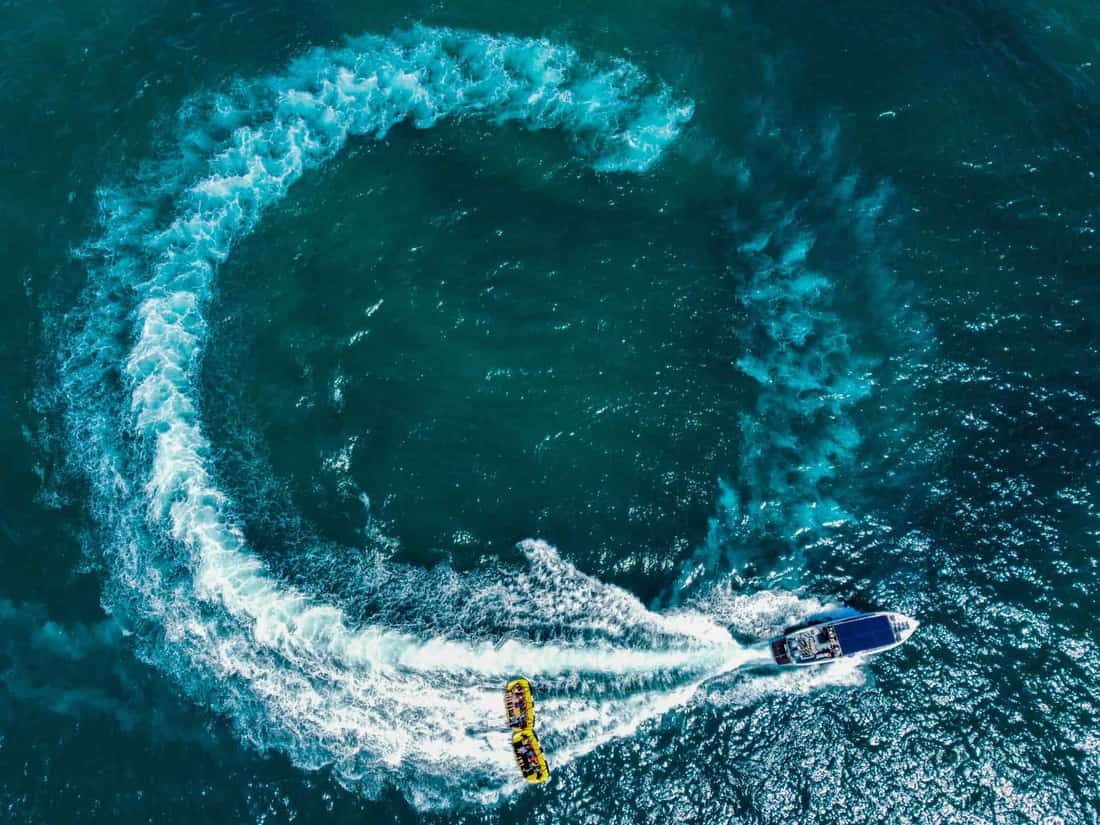
Product photos are the retailer’s own catalogue images, shown from the retailer’s servers and refreshed daily. Any other photo here is a licensed image that illustrates the category, not a photograph of the specific product named.
| # | Product | Best for | Break strength | Price |
|---|---|---|---|---|
| 1 | 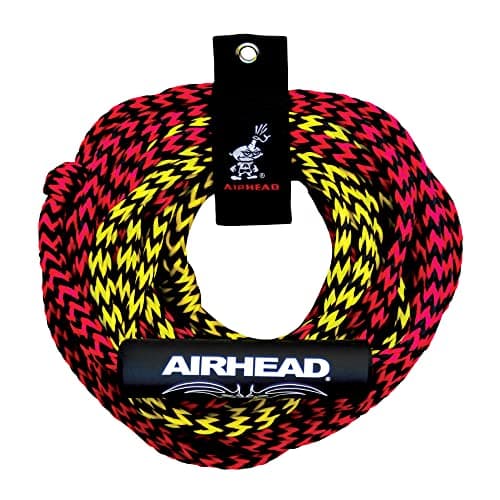 Top pick Airhead 1-2 Person 2-Section Tow Rope The rope rating most families actually need, with two sections so the same rope tows at 50 ft or 60 ft. | Most family tubes | 1-2 | |
| 2 | 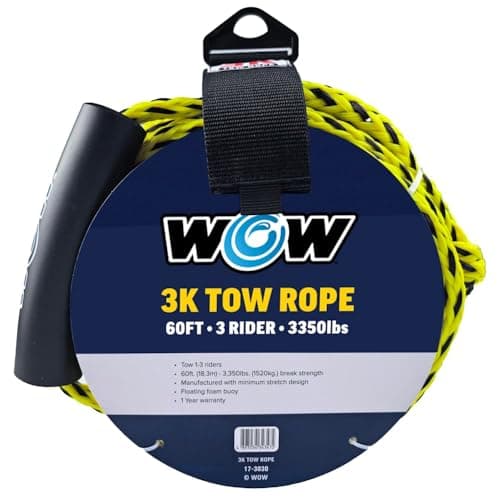 Budget pick WOW Sports 2K Tow Rope A plain 60 ft braided rope for a 1-2 rider tube, at the lowest price worth considering. | Cheapest workable rope | 1-2 (WOW's 2K line) | |
| 3 | 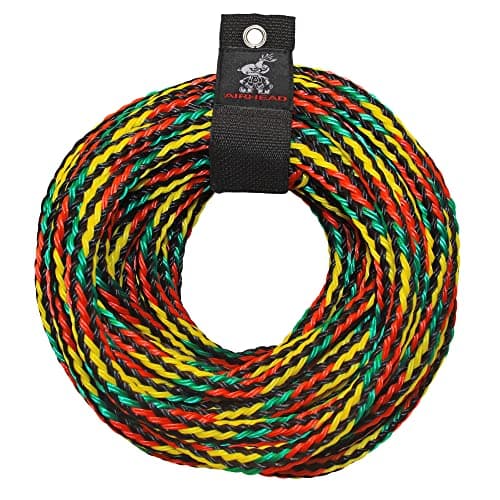 Upgrade pick Airhead 1-4 Person Tow Rope The rope you move up to the day you buy a bigger tube, and the one most families should have bought first. | 3 and 4 person tubes | 1-4 | |
| 4 | 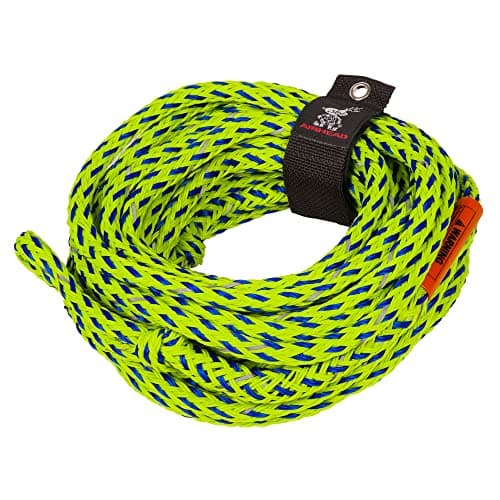 Also good Airhead Reflective Tow Rope, 1-4 Person The same 1-4 rider rating with a reflective strand and an EVA foam core, which keeps the line visible and on the surface. | Visibility and float | 1-4 | |
| 5 | 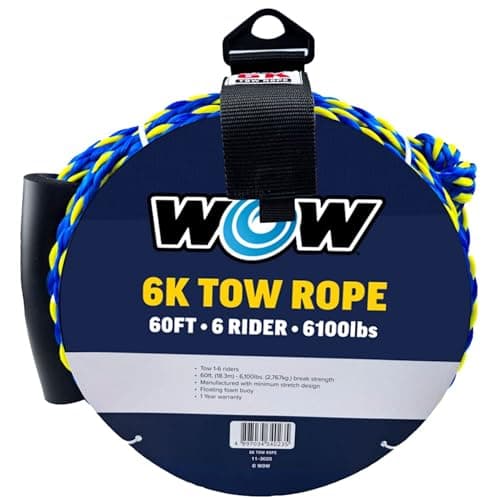 Also good WOW Sports 6K Tow Rope A published 6,100 lb line for the big six-seat deck tubes nothing else here is rated to pull. | 5-6 rider deck tubes | 1-6 | |
| 6 | 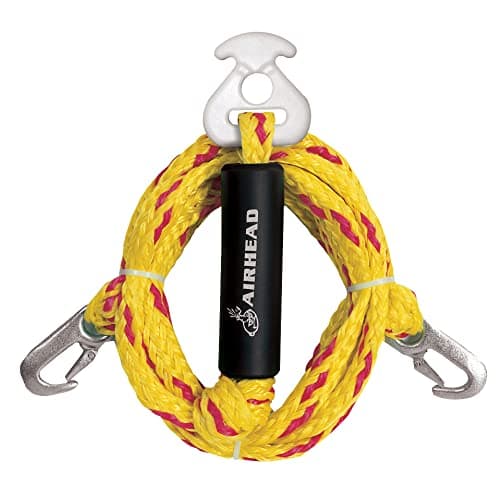 Also good Airhead Heavy Duty Tow Harness, 12 ft Not a rope - the bridle that spreads the load across both transom eyes and keeps the rope off your motor. | Boats without a tow pylon | 12 ft (16 ft version also sold) |
Rope rating follows the tube, not the family
A tow rope is the only part of a tubing setup with a single correct answer, and almost everyone gets it wrong the same way: they buy the rope that matches how many people are in the boat instead of the rope that matches the tube's rider rating printed on the tube.
Rope makers rate tube ropes by rider count because the load a tube puts into a rope scales with how many people are sitting in it. Airhead states on its own product page that its 1-2 rider rope exceeds the 2,375 lb break strength the Water Sports Industry Association specifies for 2-rider tubes. Step up to its 1-4 rider rope and the figure is 4,100 lb on the Amazon listing and 4,150 lb on Airhead's own page. WOW's 6K line publishes 6,100 lb for tubes up to six riders.
So the shopping rule is boring and absolute. Read the rider rating on the tube, buy the rope rated for at least that many riders, and ignore every other spec until that one matches. A 2,375 lb rope behind a loaded four-person deck tube is the weakest link in a system that also contains a boat, and ropes that part under load snap back toward people.
The six things worth checking before you buy
- Rider rating, then break strength. Match the rope to the tube's rated rider count and read the published break strength. If a listing does not state one, the model name is not a rating - that is the single honest criticism of the cheapest rope here.
- Length between 50 and 65 ft. Airhead's two-section rope gives you 50 ft or 60 ft from one purchase, which is the useful range for tubing. Too short and the tube rides in prop wash and exhaust; too long and the tube swings wider on every turn, which is how riders get whipped into waves they did not choose.
- It has to float. Polypropylene floats and nylon does not, which is why every rope on this page is polypropylene. A rope that sinks when the tube is unloaded is a rope that finds your prop. The reflective rope goes further with an EVA foam core that holds the line visibly on the surface.
- No knots, ever. Use the rope's spliced loops, a rated connector or a harness. A knot is a deliberate weak point in the middle of the one component whose whole job is not failing, and it is also the thing that jams when you need to drop the tube in a hurry.
- A tow point rated for tubing. Transom ski eyes, a pylon, a tow bar - check the boat's manual. If your boat has two transom eyes and no pylon, a bridle-style harness is the correct way to connect, which is why one is on this list.
- Visibility, and then storage. A reflective strand earns its money at the end of a long afternoon. A rope keeper or caddy earns its money every single time, because the rope you can deploy in ten seconds is the rope you inspect instead of untangling.
Airhead 1-2 Person 2-Section Tow Rope
The rope rating most families actually need, with two sections so the same rope tows at 50 ft or 60 ft.
Specifications
- Riders
- 1-2
- Length
- 50 or 60 ft (2 sections)
- Break strength
- 2,375 lb
- Rope
- 16-strand, pre-stretched, UV-resistant
- Storage
- Rope keeper included
What works
- Airhead states it exceeds the 2,375 lb break strength the Water Sports Industry Association specifies for 2-rider tubes, so it is correctly rated rather than optimistically rated
- Two sections mean you can shorten to 50 ft in a crowded cove and run 60 ft in open water without owning two ropes
- Pre-stretched rope does not keep growing over a season, so the tow distance you set is the tow distance you get
- Polypropylene floats, which is the single most important safety property of a tow rope
- The included rope keeper is the difference between a coiled rope and a knotted ball in the locker
What doesn’t
- Rated for 1-2 riders only - put it behind a 3 or 4 person tube and it is the weakest part of the system
- No float at the connector end, so the hardware hangs below the surface at rest
- Plain rope with no reflective strand, which matters if you tube close to dusk
- The two-section design adds a second connection point to inspect each time you rig
Who it’s for
A family towing a 1 or 2 rider tube behind a runabout or pontoon.
Bottom line
Buy the rope that matches the tube's rider rating. For most families that is this one, and spending more buys capacity you will not use.
WOW Sports 2K Tow Rope
A plain 60 ft braided rope for a 1-2 rider tube, at the lowest price worth considering.
Specifications
- Riders
- 1-2 (WOW's 2K line)
- Length
- 60 ft
- Rope
- 16-strand braided polypropylene
- Break strength
- Not published in the listing
- Sections
- One
What works
- Cheapest rope here that is still a 16-strand braided line rather than a hardware-store twist
- 60 ft out of the bag with nothing to assemble
- Braided polypropylene floats, so a dropped rope stays on the surface
- Useful as the spare rope that lives in the boat for the day somebody's main line frays
What doesn’t
- WOW does not publish a break strength for the 2K in this listing, so the model name is doing the work a spec sheet should - the Airhead ropes print theirs
- Single section, so there is no 50 ft option
- No rope keeper or caddy in the box
- A 1-2 rider line only; WOW's own 4K and 6K exist precisely because this one is not enough rope for a big tube
Who it’s for
A budget rig with a small tube, or anyone who wants a backup rope in the boat.
Bottom line
Fine as a cheap 1-2 rider line or a spare. If the rope is the only thing between a loaded tube and your transom, pay the extra few dollars for a published rating.
Airhead 1-4 Person Tow Rope
The rope you move up to the day you buy a bigger tube, and the one most families should have bought first.
Specifications
- Riders
- 1-4
- Length
- 60 ft
- Break strength
- 4,100 lb (Airhead's site lists 4,150 lb)
- Rope
- 16-strand, pre-stretched, UV-resistant
- Storage
- Rope keeper included
What works
- Correctly rated for the 3 and 4 rider deck tubes families actually end up buying
- Costs only a few dollars more than the 1-2 rider rope, which makes it the better buy if a bigger tube is anywhere in your future
- Same pre-stretched UV-resistant 16-strand construction as Airhead's smaller rope
- One continuous 60 ft length means one connection to inspect instead of two
What doesn’t
- The Amazon listing says 4,100 lb and Airhead's own product page says 4,150 lb for the same rope - a small gap, but it is the maker's own numbers disagreeing
- No 50 ft option, so in tight water you are towing at full length or not at all
- No float at the connector and no reflective strand
- Heavier and bulkier to coil than a 1-2 rider line
Who it’s for
Anyone towing a 3 or 4 rider tube, and families who expect the tube to get bigger.
Bottom line
If you are buying one rope for the next five summers, buy this rating. The money difference is trivial; the strength difference is not.
Airhead Reflective Tow Rope, 1-4 Person
The same 1-4 rider rating with a reflective strand and an EVA foam core, which keeps the line visible and on the surface.
Specifications
- Riders
- 1-4
- Length
- 60 ft
- Break strength
- 4,100 lb
- Rope
- 16-strand polypropylene, EVA foam core
- Visibility
- Reflective strand
What works
- The EVA foam core is the feature: a rope that sits high on the surface is a rope another boat can see and a swimmer can avoid
- Reflective strand makes the line far easier to spot in low light at the end of the day
- Same 1-4 rider, 4,100 lb rating as Airhead's standard heavy rope
- A floating, visible slack rope is the one that does not get wrapped around a prop
What doesn’t
- Around 50 percent more than the plain 1-4 rider rope for no extra strength
- The foam core makes it bulkier to coil and slower to dry
- Reflectivity only helps when something is shining light at it - it is not a substitute for ending the session before dark
- No 50 ft section option
Who it’s for
Busy lakes, late-afternoon sessions, and anyone who has already had a rope under the boat.
Bottom line
The upgrade worth paying for in this category is visibility, not strength. This is that upgrade.
WOW Sports 6K Tow Rope
A published 6,100 lb line for the big six-seat deck tubes nothing else here is rated to pull.
Specifications
- Riders
- 1-6
- Length
- 60 ft
- Break strength
- 6,100 lb
- Rope
- 16-strand braided
- Sections
- One
What works
- WOW publishes the 6,100 lb figure in the listing, so the rating is stated rather than implied
- The only rope here correctly rated for the 5 and 6 person deck tubes that have become common
- Costs about the same as a 4-rider rope, so the extra margin is nearly free
- 16-strand braided line handles the shock loading a heavy loaded tube puts into a rope
What doesn’t
- Overkill behind a 1 or 2 rider tube, where a heavier line just adds weight and spray
- Single 60 ft section with no shorter option
- No reflective strand and no float at the hardware
- A rope this strong will not be the thing that fails, which puts the load on your boat's tow point instead - check that it is rated for the tube you are pulling
Who it’s for
Families who have graduated to a five or six seat deck tube.
Bottom line
Match the rope to the tube. If the tube seats five or six, this is the rating you need and the cheapest honest way to get it.
Airhead Heavy Duty Tow Harness, 12 ft
Not a rope - the bridle that spreads the load across both transom eyes and keeps the rope off your motor.
Specifications
- Length
- 12 ft (16 ft version also sold)
- Riders
- 1-4 rider towables
- Break strength
- 4,100 lb
- Float
- 6 in float keeps the connector up
- Connection
- Kwik-Connect system
What works
- Solves the actual problem on most family boats: no ski pylon, so the rope has to come off two transom eyes without sawing across the outboard
- The 6 in float keeps the Kwik-Connect at the surface instead of dangling toward the prop
- Kwik-Connect makes swapping between tube rope, ski rope and wakeboard rope a two-second job with no knots
- The 4,100 lb rating covers everything up to a 4 rider towable
What doesn’t
- It is an extra 12 ft behind the boat, so your effective tow length grows and needs accounting for in tight water
- Does nothing for a boat that already has a proper tow pylon or a rated ski eye
- Rated to 1-4 rider towables, so it is not the harness for a six-seat deck tube
- One more piece of hardware to rinse, dry and inspect
Who it’s for
Pontoons, runabouts and outboards with two transom eyes and no pylon.
Bottom line
If your rope currently rubs the engine or loads one eye, this is the missing part. Buy it with the rope, not after the first scare.
How much should you spend?
Less than you think, and in a very specific direction. Tube ropes are cheap: the whole field here sits inside a narrow band, and the gap between the cheapest workable rope and the strongest rope on the page is roughly the price of a tank of gas for the boat that pulls it.
That changes the usual budget logic. On most gear we tell families to buy the cheapest thing that has the features that matter - the approach we lay out in the family swim gear budget guide. Here the cheapest thing that has the features that matter is almost always the rope one rating above what you own today, because the rope outlives the tube and the tube always gets bigger.
What is genuinely not worth paying for is a heavier rope than your tube is rated for in the hope it is safer. It is not safer. A 6,100 lb rope behind a one-person tube only guarantees that if something does let go, the something will be the boat's tow eye or the tube's own tow harness rather than the rope. Strength has to be matched, not maximized.
The two upgrades that do pay for themselves are visibility and connection hardware - a reflective, foam-cored line, and a bridle so the rope is not sawing across your outboard. Both are a few dollars and both address a failure we actually see on family boats.
Rigging it so nothing goes under the boat
Most tubing incidents on a family lake day are not dramatic. They are a rope in the prop, a rope under a swimmer, or a tube that swung into a dock because it was towed too long in a tight cove. Rigging fixes all three.
- Connect at a rated point. Pylon, ski eye, or a harness across both transom eyes. Never a cleat, a ladder or a stern rail - those are not load-rated for a tube and a cleat in particular can tear out.
- Keep the slack out of the water when you idle. Coil it onto the tube or into the boat. A floating rope lying loose in the water is still a rope that can wrap a leg or a prop.
- Shift to neutral before anyone is in the water near the line. Riders in the water plus a rope in the water plus an engine in gear is the combination worth engineering out of your day.
- Shorten to 50 ft in traffic. A shorter rope means a tighter swing, more time to react, and a tube that stays inside the water you can see.
- Run a spotter, every time. The driver cannot watch the tube and the water ahead at once. The US Coast Guard's own water sports guidance treats a dedicated observer as basic practice, and most states write it into law.
Life jackets are not optional and not negotiable on a tube: every rider wears a properly fitted, USCG-approved jacket, and children wear one with a crotch strap so it cannot ride up. We cover the fit test in life jacket sizing by weight, the oversize adult options in best plus size life jackets, and the full tubing rulebook - speed, spotters, seating, hand signals - in towable tube safety.
When to retire a rope
Polypropylene is a UV-damaged material from the day you buy it. The rope that lived on the bow of a pontoon all summer is weaker than the rope that lived in a locker, and neither one tells you so until it matters.
- Fuzz and chalk. A surface that has gone fuzzy or pale and dusty has lost fiber. Fuzz on a long section, not just at the loops, means replace.
- Stiffness. A pre-stretched rope that has gone board-stiff and will not coil has been cooked. Flexible rope absorbs shock loading; stiff rope transmits it.
- Glazing or melted patches. Shiny, hard spots mean the rope ran across something under load - usually the engine or a rub rail. That section is done.
- Damaged loops or hardware. The spliced loops and the connector take the whole load. Any deformed hook, cracked plastic or pulled splice retires the rope, not just the part.
- A rope that has been knotted under load. Once a knot has taken a hard pull, treat that section as suspect.
Rinse the rope in fresh water at the end of the day, let it dry out of direct sun, and store it coiled in its keeper rather than knotted in the bottom of a locker. That is the whole maintenance routine, and it costs a minute. The same end-of-season logic applies to the rest of the family's inflatables - see float care and storage for patching and winter storage.
One more habit worth building: write the purchase year on the rope keeper with a marker. Nobody remembers whether a rope is two seasons or six seasons old, and a five-dollar guess on a hundred-dollar tube carrying your children is the wrong place to economize. If you are still choosing the tube itself, start with how to choose a towable tube.
If your boat has no ski pylon, the rope is only half the system — a harness off both transom eyes is the other half. That setup is covered in best towable tubes for pontoon boats.
Questions
Frequently asked questions
How long should a tow rope for tubing be?
What break strength do I need for a 4 person tube?
Can I use any rope to pull a towable tube?
Should a tow rope float?
Can you tie a knot in a tow rope?
Do I need a tow harness for tubing?
Sources
Read next