Floats & Towables · Roundup
Safest Towable Tubes (2026)
Shape and seating decide the injuries. Price does not.
The short answer
The SportsStuff Big Mable is the safest towable tube for a family: a padded sit-in cockpit with a high backrest keeps riders low and centered, which is what prevents the two common tubing injuries — being thrown and being whipped. For two mixed-age riders who want a bit more excitement, the O'Brien Super Screamer is the safer deck tube.
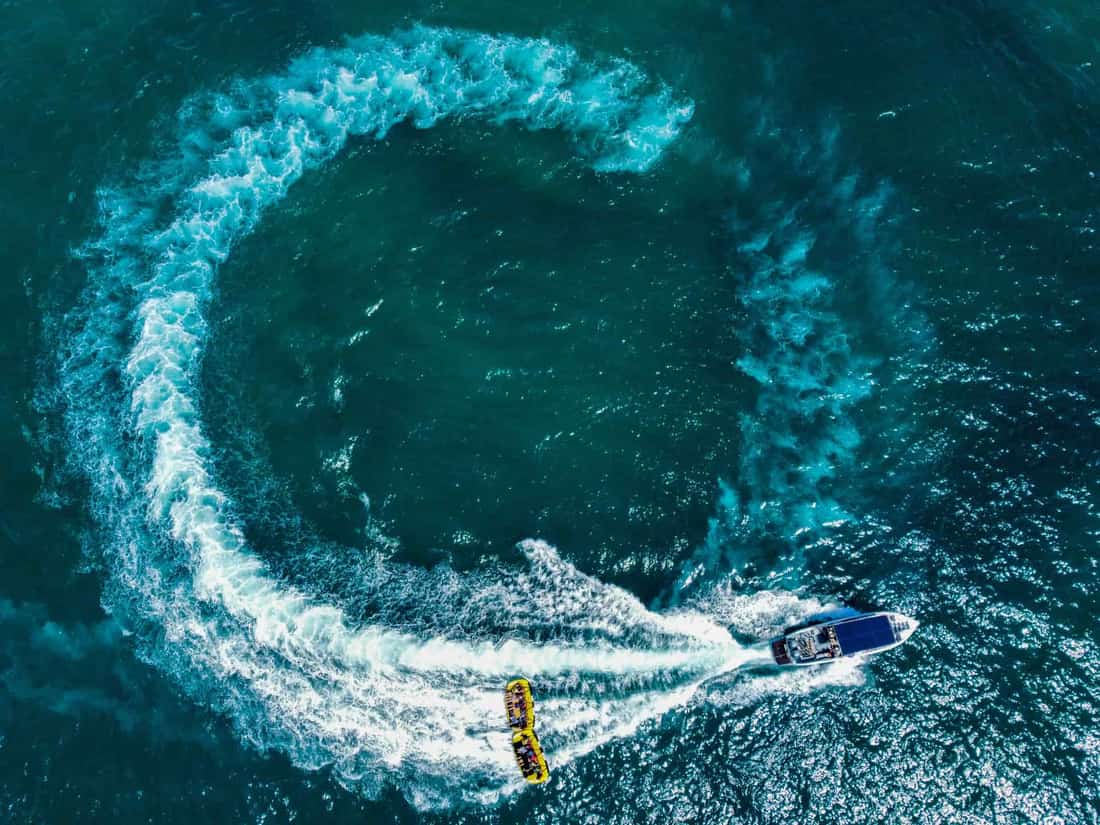
Product photos are the retailer’s own catalogue images, shown from the retailer’s servers and refreshed daily. Any other photo here is a licensed image that illustrates the category, not a photograph of the specific product named.
| # | Product | Best for | Shape | Price |
|---|---|---|---|---|
| 1 | 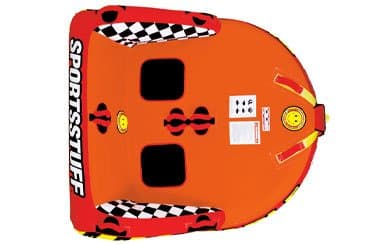 Top pick SportsStuff Big Mable A padded, high-backed cockpit tube for two — the most secure-feeling seat in the category. | Nervous first-timers | 2 | |
| 2 | 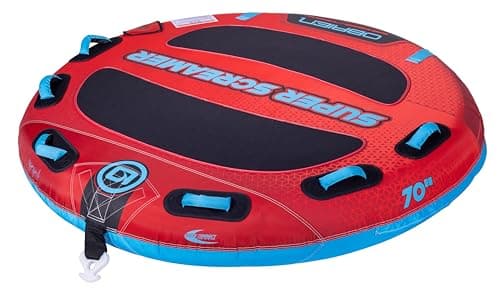 Also good O'Brien Super Screamer A deck tube that sits between approachable and exciting, which is exactly what a family with kids needs. | 2 riders, mixed ages | 2 | |
| 3 | Budget pick WOW Sports Super Thriller A simple one-to-three rider deck tube at the bottom of the durable price band. | Cheapest durable tube | 1-3 | |
| 4 | 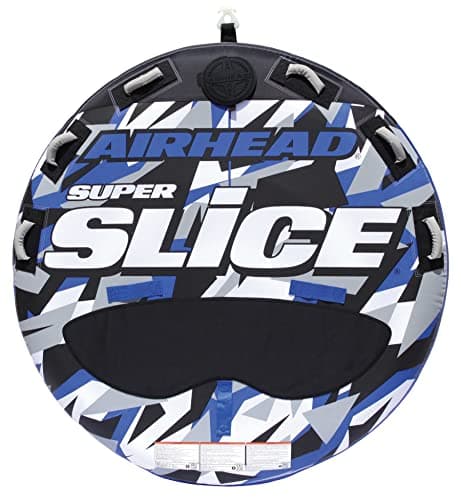 Also good Airhead Super Slice A three-rider deck tube, which is the cheapest way to stop the sibling rotation argument. | 3 riders | 3 | |
| 5 | Upgrade pick RAVE Sports Warrior A faster, more aggressive deck tube for riders who have outgrown being towed gently. | Older kids and teens | 1-2 |
Safety in this category is a shape question
Towable tubes do not fail the way most gear fails. The tube itself very rarely lets go. What hurts people is how the tube behaves when the boat turns, and that is decided by the shape and the seating position — two things you choose at the point of purchase and cannot change afterwards.
Two mechanisms account for most tubing injuries. The first is being thrown off at speed and hitting the water hard. The second is the whip: when the boat turns, the tube swings wide outside the wake and briefly travels much faster than the boat, which is where riders get launched, collide with each other, or strike the tube.
A sit-in cockpit tube with a backrest reduces both. The rider's center of gravity is low and inside the tube rather than lying on top of it, the backrest stops a rearward tumble, and the deeper seat means a rider who loses one handle still has a body position to recover from. A flat deck tube is more fun and gives you less of all three.
SportsStuff Big Mable
A padded, high-backed cockpit tube for two — the most secure-feeling seat in the category.
Specifications
- Riders
- 2
- Shape
- Cockpit with backrest
- Seating
- Padded, sit-in
- Cover
- Nylon
What works
- Backrest and deep seat mean a child is held in rather than hanging on, which converts refusals into rides
- Padded seating is comfortable enough for long, slow cruising
- Sits high, so riders stay noticeably drier than on a deck tube
- Also works as a lake lounger when it is not being towed
What doesn’t
- High profile catches wind and skips at speed, so it wants a slower tow
- Bulky to inflate, store and transport
Who it’s for
Children who are anxious about towing, or adults who want a comfortable cruise rather than airtime.
Bottom line
The confidence pick. If you want the ride to be gentle and the child to say yes, start here.
O'Brien Super Screamer
A deck tube that sits between approachable and exciting, which is exactly what a family with kids needs.
Specifications
- Riders
- 2
- Shape
- Deck (lie-down)
- Cover
- Nylon over bladder
- Valve
- Quick-inflate
What works
- Deck shape keeps riders low and flat, which is far less frightening for a first-timer than a cockpit tube
- EVA knuckle guards on the handles prevent the scraped knuckles that end rides early
- Nylon cover over the bladder is what makes a tube last more than one season
- Fits one adult and one child, so a nervous kid can ride with a parent
What doesn’t
- Deck riding position means you get hit by more spray than in a cockpit tube
- Two-rider capacity is limiting once you have three children
Who it’s for
A family towing children for the first time, or one child plus a parent.
Bottom line
The best first towable for a family. Every rider wears a properly fitted USCG-approved life jacket, and speed stays at 10-15 mph with kids aboard.
WOW Sports Super Thriller
A simple one-to-three rider deck tube at the bottom of the durable price band.
Specifications
- Riders
- 1-3
- Shape
- Deck
- Cover
- Nylon, full
- Valve
- Speed safety valve
What works
- Cheapest tube here that still has a full nylon cover rather than bare PVC
- Flexible rider count, so it suits a changing family
- Speed valve makes inflation and deflation genuinely quick at a boat ramp
- Light enough for one adult to carry inflated
What doesn’t
- Thinner material than the premium tubes and it shows after two hard seasons
- Handles are less padded, so knuckles take more punishment
Who it’s for
A family buying their first towable who are not sure how much they will use it.
Bottom line
The budget pick. If it survives two summers of heavy use, you were right to start cheap.
Airhead Super Slice
A three-rider deck tube, which is the cheapest way to stop the sibling rotation argument.
Specifications
- Riders
- 3
- Shape
- Wing deck
- Cover
- 840-denier nylon
- Handles
- 6, with knuckle guards
What works
- Three riders means all your children go at once instead of taking turns
- 840-denier nylon is the durability tier that survives repeated seasons
- Wing shape is stable and slow to flip, which matters with three kids aboard
- Six padded handles, so nobody is holding the wrong thing
What doesn’t
- Needs a boat with real pulling power to plane with three riders
- Large enough that storage is a genuine problem in a small garage
Who it’s for
Families with three children, towed behind a boat with adequate power.
Bottom line
Buy on rider count. Three-up on one tube is more fun and less negotiation than two-up plus a waiting list.
RAVE Sports Warrior
A faster, more aggressive deck tube for riders who have outgrown being towed gently.
Specifications
- Riders
- 1-2
- Shape
- Low-profile deck
- Cover
- Nylon with neoprene chest pad
- Ride
- Fast, carves hard
What works
- Low profile and hard-carving shape are what a bored teenager is actually asking for
- Neoprene chest pad makes a long ride tolerable rather than raw
- Narrow enough to whip outside the wake without dragging
- Holds air well across a full day
What doesn’t
- Too aggressive for younger children — it is easy to lose grip
- One or two riders only
Who it’s for
Confident older children and teenagers who want speed, on a boat with a driver who will manage it.
Bottom line
The upgrade for teens. Wrong tube for a first-timer or anyone under about ten.
What to look for in a safer towable
A sit-in seat with a backrest, for anyone nervous or young. This is the single biggest difference available. It keeps riders low, inside the tube, and facing forward.
Handles with knuckle guards, and enough of them. Count the handles and match them to riders. Knuckle guards matter because the injury nobody anticipates is a hand crushed between a handle and the water or another rider.
A full nylon cover over the bladder. The cover is what stops a seam splitting under load and what protects riders from the bladder itself. Uncovered vinyl tubes are cheaper and are a different, worse product.
A rider rating that matches your actual passengers, not your hopes. A three-rider tube with two riders is fine; a two-rider tube with three is a tube where someone is holding on to another person instead of a handle.
A rope rated for the tube. Tow rope strength is specified by rider count, and the rope is the component people reuse carelessly between tubes. A rope rated for one rider on a three-rider tube is the weakest part of the whole setup.
A quick-connect tow point you can inspect. You want to be able to see the harness, the stitching and the connector without unpacking anything.
How the shapes compare on risk
| Shape | Riding position | Whip behaviour | Suits |
|---|---|---|---|
| Cockpit with backrest | Sit-in, low, supported | Mildest — tracks behind the wake | Young or nervous riders |
| Deck tube (lie-down) | Prone, chest on the deck | Moderate — carves when driven hard | Mixed ages, confident kids |
| Wing deck, 3 riders | Prone, side by side | Moderate, plus rider collisions | Three siblings, adequate boat power |
| Low-profile fast deck | Prone and forward | Aggressive — carves hard by design | Teens, with a disciplined driver |
| Open ring / river tube | Sitting in a hole | Not rated for towing at all | Drifting only, never behind a boat |
That last row is worth stating plainly because it is a real and common mistake: a river-run style lounge or a vinyl swim ring is not a towable. It has no tow harness, no rated cover and no rider rating. Towing one is the kind of improvisation that produces an accident report. Our drifting picks are in best lake floats for adults.
Speed, and the number that matters
Speed is the variable that converts a safe tube into an unsafe one. With children aboard, 10 to 15 mph is the working range, and the top of that is plenty. Adults on a deck tube can take more, and the point at which a tube starts carving unpredictably arrives a long way below what the boat is capable of.
The turn matters more than the straight line. A wide, gentle arc keeps the tube inside or near the wake. A tight turn sends it out across flat water at a multiple of the boat's speed, and that is the moment riders come off. If you are towing children, drive straight lines and long curves.
Everyone aboard the tube wears a correctly fitted, Coast Guard approved life jacket, every time — and for towing that means one rated for the activity, which some devices explicitly are not. The full set of rules, signals and spotter duties is in towable tube safety.
How much should you spend?
Safety does not scale with price here, which is unusual. The budget deck tube and the expensive deck tube behave similarly; the thing that changes the risk is picking a cockpit shape instead of a deck shape, and cockpit tubes sit in the middle of the price range rather than the top.
So the value answer is clear. Buy the cockpit tube if your riders are young or nervous, buy a mid-price covered deck tube if they are not, and do not buy the fast low-profile tube until someone in the family has outgrown being towed gently. Spend what you save on a correctly rated rope and a second life jacket.
What does wear out is the cover and the bladder. A full nylon cover, rinsed after use and stored dry, is the difference between three summers and one — the routine is in float care and storage.
Questions
Frequently asked questions
What is the safest type of towable tube?
How fast should you pull a tube with kids on it?
Can you tow a regular pool float or river tube behind a boat?
Do riders have to wear life jackets on a towable tube?
Does a more expensive towable tube mean a safer one?
Sources
Read next