Swim Goggles · Guide
Do Babies Need Swim Goggles?
No for a baby, usually yes by about three — and the reason is what the water is, not the eyes.
The short answer
Babies do not need swim goggles. Infant swim classes are run without them, nothing fits a face that small, and a baby's first swims are too short for water to irritate the eyes. Goggles start to earn their place around three, when a child starts opening their eyes under water and swimming for longer.
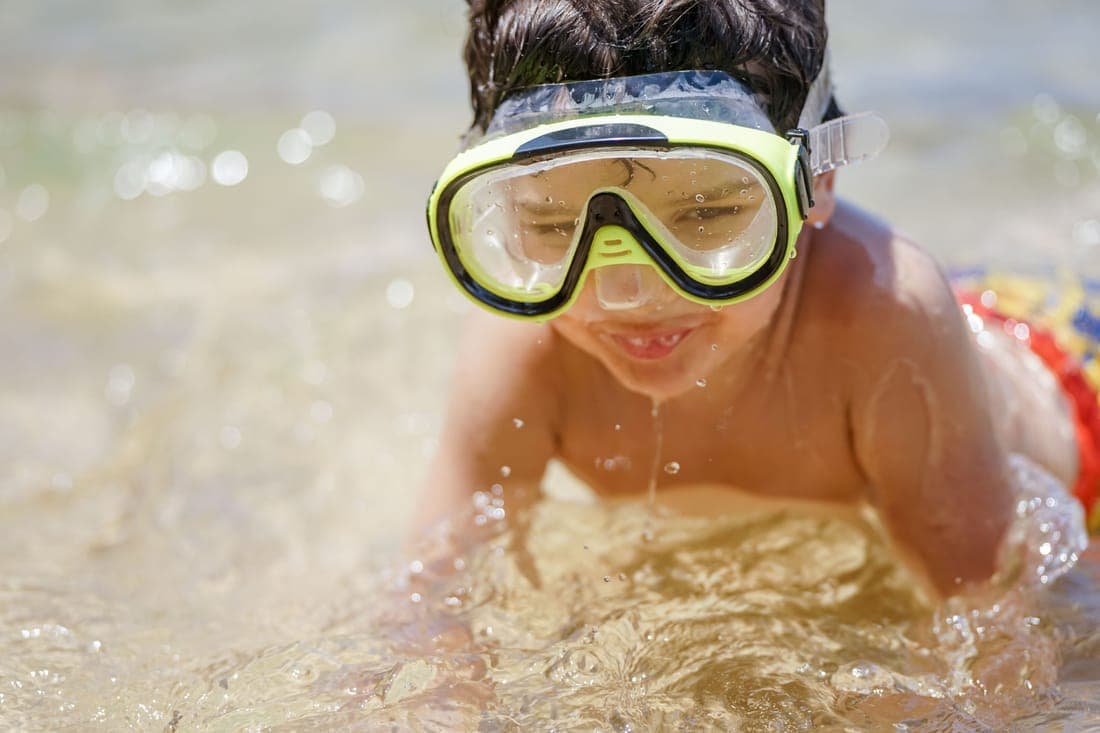
Product photos are the retailer’s own catalogue images, shown from the retailer’s servers and refreshed daily. Any other photo here is a licensed image that illustrates the category, not a photograph of the specific product named.
The short answer, and why
No. For a baby — roughly under eighteen months — goggles are unnecessary and mildly counterproductive, and there are three straightforward reasons.
Nothing fits. The smallest goggles on the market start around age three. A gasket designed for a three-year-old sits on a baby's brow and cheek in the wrong places entirely, which means it leaks, and a leaking goggle is worse than none.
The exposure is too short to matter. Infant water sessions are brief by design, and a baby is not holding their eyes open under water for minutes at a time. The irritation that goggles prevent takes longer exposure than a baby ever gets.
They get in the way of the thing that matters. A baby's first swims are about being held, making eye contact and being comfortable in the water. Something strapped to their face does not help with any of that, and most babies pull it straight off.
What to buy instead for a baby's first swims
The budget that might have gone on goggles is better spent on the three things that actually change a baby's time in the water.
- A swim diaper. Required by essentially every pool and the right call in a lake too. The comparison between reusable and disposable is in reusable vs disposable swim diapers.
- UPF 50+ cover for outdoors. Fabric beats sunscreen on the skin it covers, and a baby's skin is the thinnest it will ever be — see baby sun protection at the lake.
- Warmth. Babies lose heat fast, and cold is the usual reason a first swim goes badly. A warm pool, a short session and a towel ready beats any accessory.
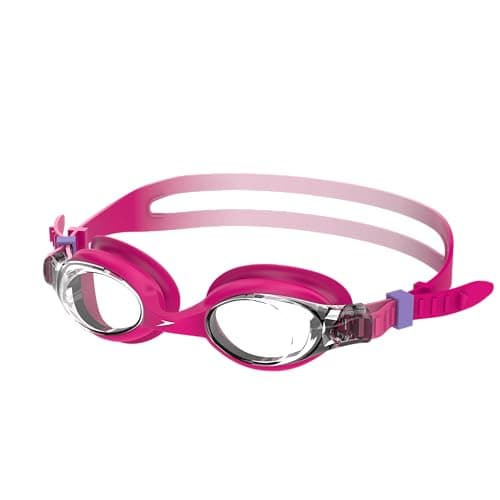
Speedo Kids' Skoogles
The softest, most forgiving gasket in the category — it seals even when a child pulls it on crooked.
Specifications
- Age range
- 3-8 years
- Gasket
- Oversized soft silicone
- Frame
- One-piece, flexible
- Lens
- Anti-fog, UV
What works
- Very forgiving fit — the gasket is deep enough that a crooked pull-on still seals
- Wide, shallow lens avoids the pressure ring that makes small children refuse goggles
- Single-strap adjustment a four-year-old can manage
- Widely stocked, so a mid-trip replacement is realistic
What doesn’t
- Soft gasket leaves a visible mark after a long session
- Too loose on the face of a child over about 8
Who it’s for
A toddler or young child who has tried goggles once and hated them. This is the pair that usually fixes that.
Bottom line
Buy these if the problem is refusal rather than leaking. Comfort is what they optimize for and it works.
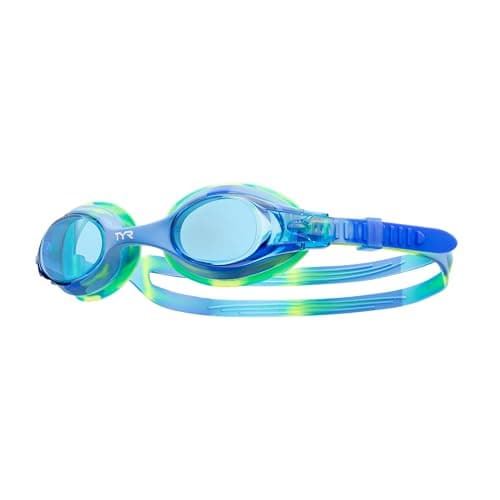
TYR Kids' Swimple
Oversized soft gaskets on a one-piece frame, which is the combination that actually seals a small face.
Specifications
- Age range
- 3-10 years
- Gasket
- Silicone, oversized
- Frame
- One-piece
- Lens
- Anti-fog, UV
What works
- One-piece frame has no nose-bridge adjustment to get wrong, which removes the most common source of leaks on small faces
- Soft silicone gasket sits wide of the eye socket, so it seals against cheek rather than thin skin
- Hypoallergenic silicone matters for kids who react to latex straps
- Cheap enough to replace mid-season without a conversation about it
What doesn’t
- No bridge adjustment at all, so a very narrow or very wide face has no fallback
- Strap clip is fiddly for a child to adjust alone
Who it’s for
A child between about 3 and 10 who is in the water for lessons and lake days rather than training, and who has already lost or broken a pair.
Bottom line
The default first pair. If you are buying goggles for a child under 10 and do not want to think about it, buy these.
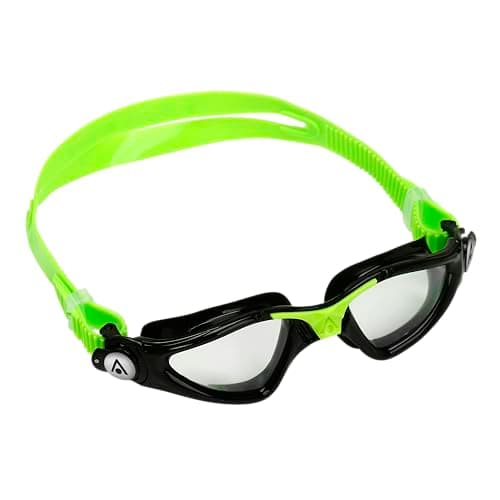
Aqua Sphere Kayenne Jr.
A wide curved lens that gives a genuinely panoramic view — the useful choice where a child cannot see the bottom.
Specifications
- Age range
- 6-12 years
- Field of view
- Wide, 180-degree style
- Gasket
- Soft silicone, curved
- Lens
- Anti-fog, UV, tinted options
What works
- The wide lens is not a gimmick in murky water — peripheral vision is how a child keeps track of a parent or a dock
- Curved gasket spreads pressure across the cheekbone instead of the eye socket
- Quick-adjust buckles work with wet hands
- Tinted versions cut glare off open water, the actual complaint on bright lake days
What doesn’t
- Larger lens is more exposed and picks up scratches faster in a beach bag
- Bulkier than a low-profile pair, so a competitive swimmer will not want them
Who it’s for
A child who swims mostly in open water — a lake, a river, a bay — rather than a clear pool.
Bottom line
The lake pick. Where visibility is poor, field of view is worth more than a sleeker frame.
When goggles start to be worth it
| Age | Goggles? | Why |
|---|---|---|
| Under 18 months | No | Nothing fits; sessions are too short to matter |
| 18 months to 3 years | Optional | Only if they are already opening their eyes under water |
| 3 to 5 years | Usually yes | Longer sessions, eyes open, lessons start in earnest |
| 5 years and up | Yes | Chlorine and lake exposure are long enough to sting |
The trigger is behaviour rather than a birthday. The moment a child starts deliberately opening their eyes under water and staying under to look at things, goggles stop being an accessory and start being the thing that makes the next hour pleasant.
In a lake there is a second trigger: wanting to see. Lake water is murky and a child who can see a foot in front of them is a child who will put their face in. Open-water goggles with a wide lens do more for that than a tighter seal does.
What stings, and what does not
It is worth knowing what goggles are protecting against, because the popular version of this is wrong. Chlorine itself is not the main irritant in a pool. What stings is the combination of chlorine with the things it reacts with — sweat, urine, sunscreen and body oils — which forms compounds that irritate eyes and skin.
That is why a busy pool on a hot day stings and a quiet one does not, and it is why the CDC's healthy-swimming guidance puts rinsing off before you get in near the top of the list. A quick shower genuinely reduces the problem for everyone in the water.
Lake water irritates for different reasons — sediment, algae and bacteria — and goggles help with the mechanical part of that. They do not make unsafe water safe, and an advisory posted at a beach is about swallowing water rather than about eyes.
Buying the first real pair
When the time comes, the first pair should be a soft oversized gasket on a one-piece frame. There is no bridge adjustment to get wrong, the gasket is deep enough that a crooked pull-on still seals, and it is cheap enough to replace mid-season without a conversation.
Fit it by pressing it onto a dry face with the strap loose: a good fit holds for a second or two on suction alone. Then tighten only until it stops moving. Over-tightening is the cause of nearly every leak and every deep ring around a child's eyes, and it is the mistake almost every parent makes first.
If your child refuses conventional goggles outright, the escape hatch is a swim mask, which seals around the whole eye area and the nose — see kids' swim goggles that cover the nose. Our picks by age are in best kids' swim goggles.
Questions
Frequently asked questions
Do babies need swim goggles?
What age can a child wear swim goggles?
Is chlorine bad for a baby's eyes?
What should I buy instead of goggles for a baby?
Do babies need goggles in a lake?
Sources
Read next