Life Jackets & Safety · Guide
How to Clean a Life Jacket
Hand wash, air dry, never the machine. The foam is what you are protecting.
The short answer
Hand wash a life jacket in cool water with a mild detergent, rinse thoroughly and air dry it out of direct sunlight. Skip the washing machine and the dryer: agitation and heat break down the closed-cell foam that provides the flotation, and a jacket that has lost buoyancy cannot be repaired.

Product photos are the retailer’s own catalogue images, shown from the retailer’s servers and refreshed daily. Any other photo here is a licensed image that illustrates the category, not a photograph of the specific product named.
What you are actually protecting
A foam life jacket floats because of closed-cell foam panels sewn inside a nylon shell. The flotation is in those cells: millions of sealed pockets of air. Nothing about the shell keeps anyone up, and nothing you can do to the shell matters nearly as much as what you do to the foam.
Three things damage closed-cell foam. Heat softens and collapses the cells, which is why a dryer, a hot car dashboard and a radiator are all bad ideas. Mechanical agitation crushes them, which is why a washing machine is the wrong tool even on a gentle cycle. Compression over time does the same slowly, which is why a jacket stored under a pile of gear all winter comes out thinner than it went in.
Foam that has lost buoyancy cannot be restored and cannot be inspected from outside. That is the whole reason the cleaning method is as conservative as it is, and why a jacket that has been through a hot wash should be retired rather than trusted.
Follow the manufacturer's care label where it differs from anything here. Some paddle vests with foam-free panels and some inflatables have their own instructions, and inflatables in particular must never be submerged with the cylinder fitted.
The method
- Rinse first, in cool fresh water, before anything else. Most of what makes a jacket smell is lake or salt residue that rinses straight out if you catch it early.
- Fill a tub with cool water and a small amount of mild detergent. No bleach, no fabric softener, no hot water.
- Work the shell with a soft brush, paying attention to the collar, the inside of the arm holes and the webbing, which are where oils and sunscreen collect.
- Rinse until the water runs clear. Detergent left in the shell attracts dirt and holds odor, which undoes the whole job.
- Squeeze gently, never wring. Wringing twists and crushes the foam panels.
- Hang it on a wide hanger or lay it flat, in shade with air moving. Direct sun degrades the nylon and the stitching; a dryer destroys the foam.
- Make sure it is completely dry before storage. A jacket stored damp is a jacket that grows mildew, which is the problem you were solving.
Getting the smell out
Smell in a life jacket is almost always mildew, and mildew is almost always the result of storage while damp. The fix is a wash followed by genuinely complete drying, which takes longer than people expect — a thick foam jacket can hold moisture inside the panels for a day or more after the shell feels dry.
For a jacket that already smells, a soak in cool water with a cup of white vinegar for an hour, followed by a full rinse and a slow shaded dry, deals with most of it. Vinegar is mild enough for the shell and effective against mildew in a way detergent alone is not.
What not to use: bleach, which weakens nylon and stitching; enzyme stain removers, which are harsh on the shell coating; and heat of any kind, which is the one thing that turns a smelly jacket into an unsafe one.
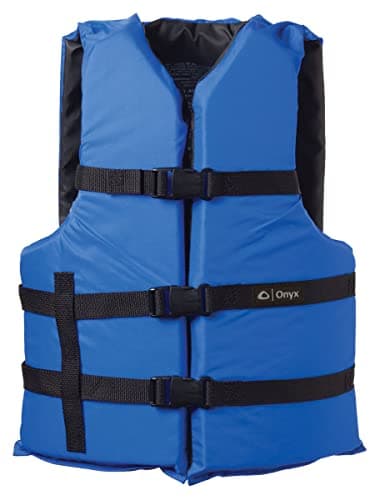
Onyx General Purpose Vest
The plain, cheap, USCG-approved adult vest you keep three of in the boat locker.
Specifications
- USCG class
- Type III, approved
- Size
- Adult universal
- Shell
- Nylon
- Closure
- Zip plus straps
What works
- Cheapest route to meeting the legal requirement of one wearable PFD per person aboard
- Universal adult sizing covers most guests without a fitting
- Stores flat and survives a locker
- Bright colors that are actually visible in the water
What doesn’t
- Basic foam construction is hot and restrictive for a full day
- Universal sizing fits nobody especially well
Who it’s for
Boat owners who need spare approved jackets for passengers.
Bottom line
Buy these as spares, not as your own jacket. Legal compliance is the job and it does it.
Stearns Youth Classic Series Vest
The plain nylon boating vest: three buckles, a leg strap, and enough flotation to be the one you tow behind a boat in.
Specifications
- USCG class
- Type III, approved
- Weight range
- 50-90 lbs
- Shell
- Durable nylon
- Closure
- 3 buckles plus leg strap
What works
- Leg strap is what stops a vest riding up over a child's head in a hard fall — do not buy a towing vest without one
- Nylon shell survives dock boards, boat carpet and a season of sun
- Three buckles let you tighten it properly at the chest and waist separately
- Cheap enough to buy one per child rather than sharing
What doesn’t
- Bulkier and hotter than a swim-focused vest, so kids take it off between rides
- Foam panels restrict arm movement, so it is poor for actual swimming
Who it’s for
A 50-90 lb child on a boat, on a towable tube, or on a dock.
Bottom line
The right jacket for boating and towing. For swimming, a Puddle Jumper or swim vest is more wearable.
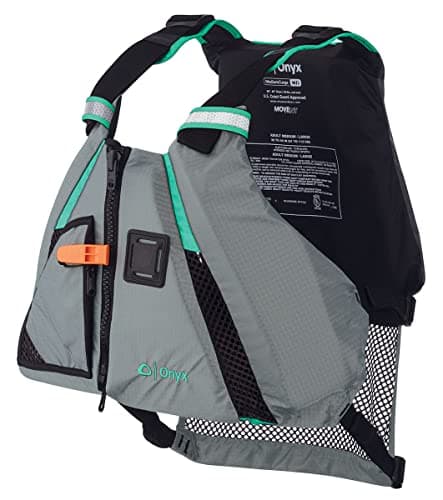
Onyx MoveVent Dynamic Paddle Vest
A ventilated paddling vest with high-cut armholes, so you can actually swim, paddle and lift children in it.
Specifications
- USCG class
- Type III, approved
- Size
- Adult S/M to XL/2XL
- Ventilation
- Mesh back panel
- Features
- High armholes, pockets, adjustable
What works
- High armholes and a mesh back make it wearable for hours in heat
- Multiple adjustment points get a real fit rather than a universal approximation
- Front pockets hold a phone in a dry bag and a set of keys
- Still a full Type III, so it satisfies the legal requirement
What doesn’t
- Costs several times a universal vest
- Mesh back offers no flotation behind the shoulders, so it sits lower in the water
Who it’s for
A parent who wears a PFD all day — paddling, supervising swimmers, getting in and out of a boat.
Bottom line
The adult vest people actually keep on. Modeling that in front of your children is worth more than the jacket costs.
What destroys a life jacket
| What people do | What it does | Verdict |
|---|---|---|
| Washing machine, gentle cycle | Agitation crushes foam cells | Never |
| Tumble dryer | Heat collapses the foam | Never |
| Bleach | Weakens nylon and stitching | Never |
| Drying in full sun | UV degrades shell and thread | Avoid |
| Using it as a boat fender or a seat cushion | Compresses foam permanently | Never |
| Storing damp in a bag | Mildew, and it will not come out easily | Avoid |
| Hand wash, shade dry | Cleans without touching the foam | Correct |
Check it while it is clean
A wash is the natural moment to inspect, because the jacket is in your hands and you can see the shell properly. Look for torn fabric, ripped seams, broken buckles, a loose or missing approval label and any hardware that no longer locks. Any of those retires the jacket.
Then do the float test, which is the only check that tells you anything about the foam. Put the jacket on, fastened properly, and get into chest-deep water. It should float you with your chin clear of the surface without effort. If you have to work at it, the foam has lost buoyancy and the jacket is done.
There is no expiry date stamped on a foam life jacket, and age alone is not the test — condition is. The fuller version of this inspection, and the signals that mean replacement, are in how long do life jackets last.
Storage, which is most of the job
- Completely dry before it goes away. Give it a day longer than you think it needs.
- Hanging, or loosely laid flat. Never at the bottom of a pile of gear all winter — compression is cumulative.
- Cool, dark and ventilated. A garage wall is better than a sealed tote; a hot attic is the worst option.
- Not in a sealed plastic bin. Any residual moisture has nowhere to go, and mildew is the result.
- Away from fuel, solvents and oil. All three attack both the shell and the foam.
Questions
Frequently asked questions
How do you clean a life jacket?
Can you put a life jacket in the washing machine?
How do you get the smell out of a life jacket?
How do you clean a moldy life jacket?
How do you dry a life jacket?
Sources
Read next