Life Jackets & Safety · Roundup
Best Inflatable Life Jackets (2026)
Three picks compared on the three numbers that decide it: buoyancy, how it inflates, and who is allowed to wear one.
The short answer
The Onyx A/M-24 is the pick: it inflates automatically on immersion, carries a 22.5 lb minimum inflated buoyancy, and is the only one of the three that works if you are knocked unconscious. The budget pick is the Onyx M-16 belt pack, which is the lightest to wear and must be pulled by hand.
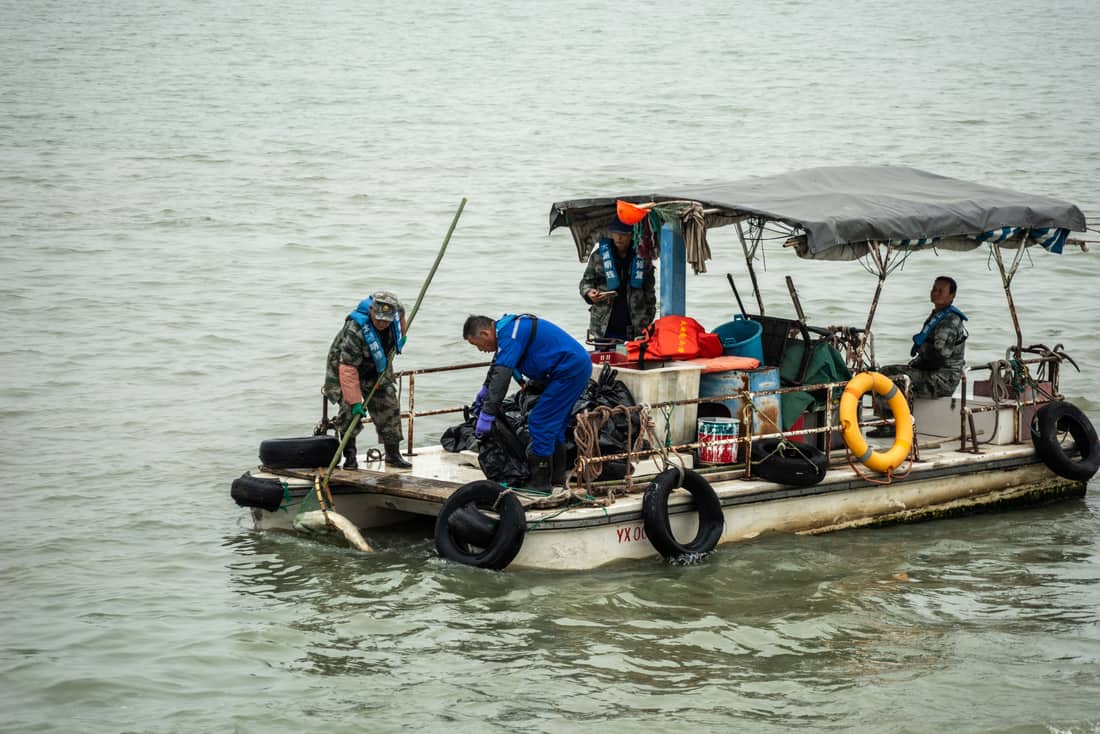
Product photos are the retailer’s own catalogue images, shown from the retailer’s servers and refreshed daily. Any other photo here is a licensed image that illustrates the category, not a photograph of the specific product named.
| # | Product | Best for | Buoyancy | Price |
|---|---|---|---|---|
| 1 | 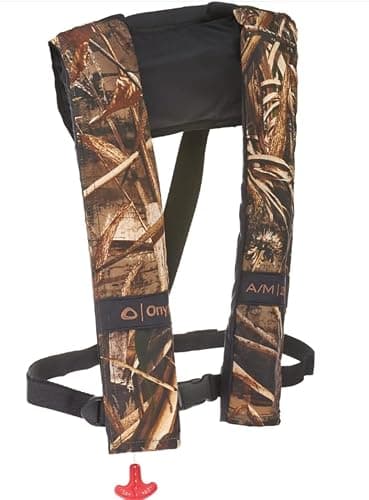 Top pick Onyx A/M-24 Inflatable Life Jacket The inflatable most adults end up buying: a slim yoke that inflates on immersion, approved only for wearers 16 and over. | Adults who won't wear foam | Type V, Type III performance | |
| 2 | 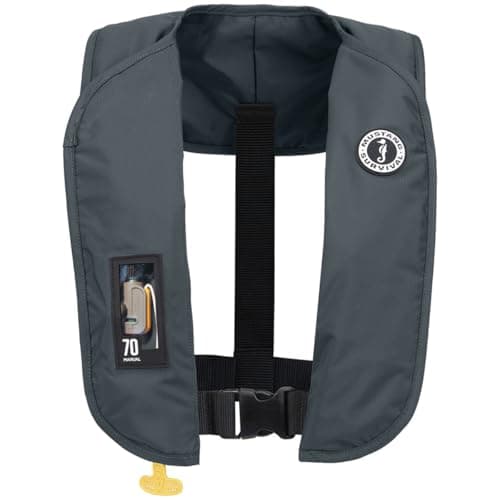 Upgrade pick Mustang Survival MIT 70 Manual Inflatable PFD The thin one: a membrane-inflatable vest that sits flatter than any other approved yoke, at a price to match. | All-day wear, slimmest fit | Harmonized Level 70 (US and Canada) | |
| 3 | 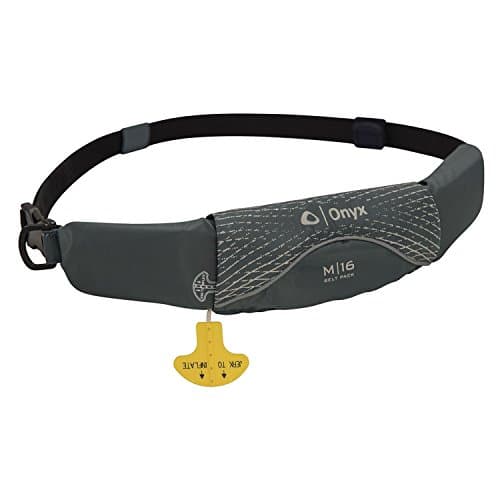 Budget pick Onyx M-16 Manual Inflatable Belt Pack A manual belt pack worn at the waist - the least intrusive approved device an adult can wear, and the one that asks the most of you. | Paddling in hot weather | Type V, Type III performance |
The jacket you wear beats the jacket you own
An inflatable PFD exists for one reason: adults take foam vests off. They are hot, they are bulky in a boat seat, they ride up when you sit down, and a jacket sitting in the bow locker has a buoyancy rating of zero. An inflatable is a slim collar or a waist belt that you genuinely keep on all day, and that trade - comfort now for a mechanism that has to work later - is the entire decision.
Before anything else, the limit that rules these out for half the family. Inflatable PFDs are approved for wearers 16 and over and above roughly 80 pounds; they are not approved for children, for non-swimmers, or for water skiing, tubing and personal watercraft, where the impact can strip them. If you are buying for a child, stop here and go to best kids' life jackets.
The second thing to understand is that an inflatable is a device with consumables. There is a CO2 cylinder, and on an automatic there is a water-sensitive bobbin or pill that fires it. Both have service lives, both are owner-replaceable, and a jacket with a spent cylinder looks exactly like a jacket with a full one. That is why every model here has an inspection window or access flap, and why checking it is a season-opening ritual rather than an optional extra.
Onyx A/M-24 Inflatable Life Jacket
The inflatable most adults end up buying: a slim yoke that inflates on immersion, approved only for wearers 16 and over.
Specifications
- USCG class
- Type V, Type III performance
- Inflation
- Automatic on immersion, or manual
- Buoyancy
- 22.5 lb minimum, inflated
- Wearer
- 16+ years, over 80 lb
- Chest
- 30-52 in
What works
- Light and open at the shoulders, which is the whole reason adults keep it on in August heat
- Inflates by itself if you go in unconscious, which no manual device and no foam vest does
- Convertible to manual-only, so you can stop it firing in spray or rain
- Oral tube as a third backup after the cylinder and the pull handle
What doesn’t
- Not approved for anyone under 16, so it is no help for the people you are supervising
- Approved only while worn - uninflated and sitting in a locker it does not count toward the one-per-person requirement
- Needs an annual inspection and a rearm kit after every firing, which is upkeep a foam vest never asks for
- Costs several times what an approved foam vest costs
Who it’s for
An adult on a boat or a dock all day who has proved they will take a foam vest off.
Bottom line
Buy it for yourself, not for the family. The comfort is real and so is the maintenance.
Mustang Survival MIT 70 Manual Inflatable PFD
The thin one: a membrane-inflatable vest that sits flatter than any other approved yoke, at a price to match.
Specifications
- Approval
- Harmonized Level 70 (US and Canada)
- Inflation
- Manual pull only
- Buoyancy
- 15.7 lb (70 N), inflated
- Weight
- About 1.1 lb
- Inspection
- Window and access flap
What works
- Membrane construction keeps it flatter and cooler than a folded-bladder yoke, which is the difference between wearing it and carrying it
- The inspection window lets you confirm the inflator is armed without unpacking the vest
- Manual pull only, so no accidental firing in rain or spray
- Harmonized Level 70 approval, so it is legal on both sides of the border
What doesn’t
- 15.7 lb of buoyancy is the lowest figure on this page - adequate, but less margin than a 22 lb inflatable or a foam vest
- Manual only, so it does nothing for an unconscious wearer
- Not approved under 16, and the Canadian listing states a minimum wearer weight near 88 lb
- The most expensive device here, and a rearm kit is an extra purchase
Who it’s for
An adult who is on the water constantly and has decided comfort is the only thing that keeps a jacket on.
Bottom line
The best-wearing inflatable here. Pay for it only if all-day comfort is genuinely the deciding factor.
Onyx M-16 Manual Inflatable Belt Pack
A manual belt pack worn at the waist - the least intrusive approved device an adult can wear, and the one that asks the most of you.
Specifications
- USCG class
- Type V, Type III performance
- Inflation
- Manual pull only
- Buoyancy
- 17 lb from the 16g cylinder
- Worn
- Belt pack at the waist
- Cover
- 200-denier nylon
What works
- Nothing crosses the shoulders, so it is the one approved device that a paddler will genuinely forget they are wearing
- Under a pound, which is why it ends up on people who would otherwise wear nothing
- Rearming is a single 16-gram cylinder, the cheapest and simplest inflator on this page to maintain
- Manual-only means it will not fire from spray, rain or a wet dog
What doesn’t
- Manual only: it does nothing at all unless a conscious person pulls the handle and then pulls the bladder over their head
- Not approved under 16, and not approved for towed sports or whitewater
- Approved only when worn as labeled, which for a belt pack means around the waist rather than slung over a shoulder
- Wrong device for anyone who might be knocked out, which on a boat is the case worth planning for
Who it’s for
A strong adult swimmer paddling or fishing in heat, who would wear nothing otherwise.
Bottom line
A real jacket for the adult who refuses one. Never the device for a weak swimmer, a child, or a tube ride.
Automatic or manual
Automatic inflates on immersion without you doing anything, which is the only version that helps if you go in unconscious or stunned. The cost is false inflations: heavy spray, a swamped cockpit or a wet locker can set one off, and each one costs a rearming kit.
Manual inflates when you pull the handle, and nothing else will set it off. It is cheaper to own, it has one less consumable to track, and it is useless if you are not conscious to pull it. Paddlers often prefer manual precisely because they expect to get wet.
Both types also have an oral inflation tube as a backup, which is worth finding and trying once in shallow water. The thing most owners have never done is inflate their own jacket; doing it once, on purpose, tells you more than any review.
The three compared
| Model | Inflation | Inflated buoyancy | Approval |
|---|---|---|---|
| Onyx A/M-24 | Automatic on immersion, or manual | 22.5 lb minimum | USCG Type V with Type III performance |
| Mustang Survival MIT 70 | Manual pull only | 15.7 lb (70 N) | Harmonized Level 70, US and Canada |
| Onyx M-16 belt pack | Manual pull only | 17 lb from the 16g cylinder | USCG Type V with Type III performance |
Those buoyancy numbers are lower than people expect, and they are not a weakness. A foam Type III adult vest provides roughly 15.5 to 22 pounds of buoyancy too - the job of a PFD is to hold a swimmer's airway clear, not to lift their whole body out of the water. What the figures do tell you is that these are not offshore devices: nothing here is designed to turn an unconscious wearer face-up the way a Type I offshore jacket is.
What to look for
An inspection window. You need to be able to see the cylinder and the status indicator without unpacking the jacket. Green means armed on most designs; red means it has fired or the cylinder is loose.
A rearming kit you can actually buy. Check the kit is a current, stocked part before you buy the jacket. An orphaned inflatable with no kit available is a one-use device.
A chest range that fits over what you wear. Published ranges are measured over a layer, and a jacket that is snug over a t-shirt in July will not close over a fleece in May.
A belt pack only if you will deploy it. A belt pack is the coolest thing to wear and the slowest to use: it has to be pulled, then pulled over your head and secured. It is a reasonable choice for a strong swimmer in warm water and a poor one for anyone else.
Care, service and storage
- Check the status indicator before every trip. It takes two seconds through the window.
- Rinse with fresh water after use in a lake or in salt, then dry fully open before packing it away.
- Replace the automatic bobbin or pill on the maker's schedule - they expire whether or not the jacket is used.
- Inflate it orally once a season and leave it overnight to check the bladder holds air.
- Store it dry and loose, not compressed in a hot locker, and never stuff it wet.
The rest of the maintenance picture, including what makes any jacket fail its own checks, is in how long do life jackets last and how to clean a life jacket.
Who should buy foam instead
Anyone under 16. Anyone who cannot swim. Anyone being towed behind a boat. Anyone on a personal watercraft. And anyone who would not reliably check a status window twice a season - a foam vest has no mechanism to fail and no consumable to forget, which is a genuine advantage.
If the problem you are solving is heat rather than bulk, a ventilated foam paddle vest is a better answer than an inflatable: it is approved for everyone, it never needs rearming, and the mesh-back designs are far cooler than a standard vest. The full case either way is in inflatable vs foam life jackets, and the cheapest approved foam options are in best life jackets under $50.
Questions
Frequently asked questions
What is the best inflatable life jacket?
Can kids wear inflatable life jackets?
Automatic or manual inflatable - which is better?
How much buoyancy does an inflatable life jacket have?
Can you wear an inflatable life jacket tubing?
Read next