Lake Swimming Guides · Roundup
Best Waterproof Phone Pouches (2026)
Six pouches, sorted by the two questions that decide the purchase: does it float, and what does its waterproof rating actually promise?
The short answer
The Pelican Marine Waterproof Phone Pouch is the pick for most people: it floats, and Pelican publishes a specific IP68 claim - 3.3 ft for 30 minutes - instead of a headline depth with no test behind it. For a family that needs four pouches in circulation, a JOTO two-pack costs about half as much for two and does the same job in shallow water.

Product photos are the retailer’s own catalogue images, shown from the retailer’s servers and refreshed daily. Any other photo here is a licensed image that illustrates the category, not a photograph of the specific product named.
| # | Product | Best for | Rating | Price |
|---|---|---|---|---|
| 1 | 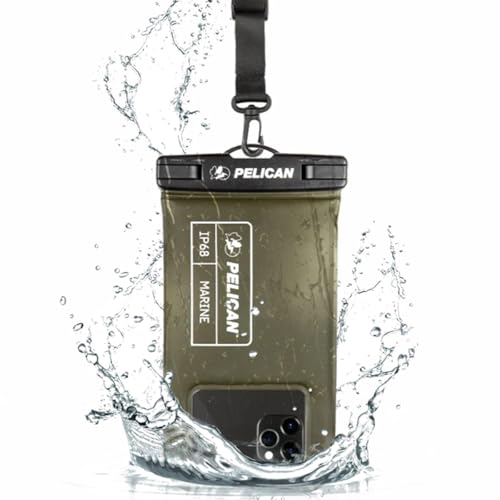 Top pick Pelican Marine Waterproof Phone Pouch The only pouch here whose maker publishes a conservative, testable depth claim and backs it with a warranty - which is exactly why it is the one to put a phone in. | The one to trust | IP68, stated to 3.3 ft (1 m) for 30 minutes | |
| 2 | 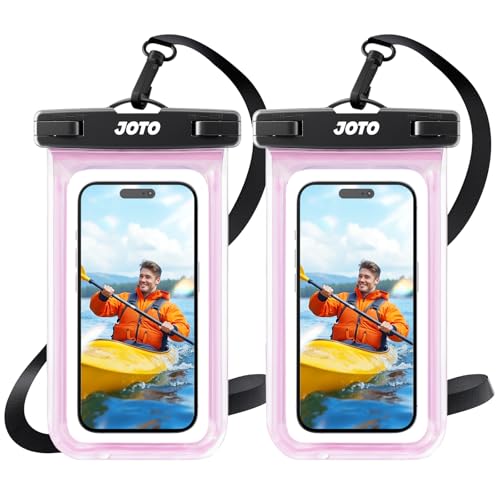 Budget pick JOTO Universal Waterproof Phone Pouch The default budget pouch: two of them cost less than a round of ice creams, and for a beach bag that is the right answer. | Cheapest sane option | IPX8, manufacturer-declared | |
| 3 | 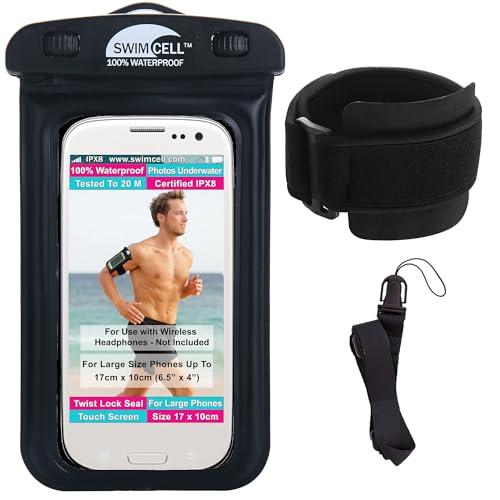 Upgrade pick SwimCell Waterproof Phone Case with Armband The one pick here designed to be worn on an arm while you actually swim, rather than hung round a neck where it swings into every stroke. | Swimming, not just boating | IPX8; retailers state 10 m or 20 m tested | |
| 4 | 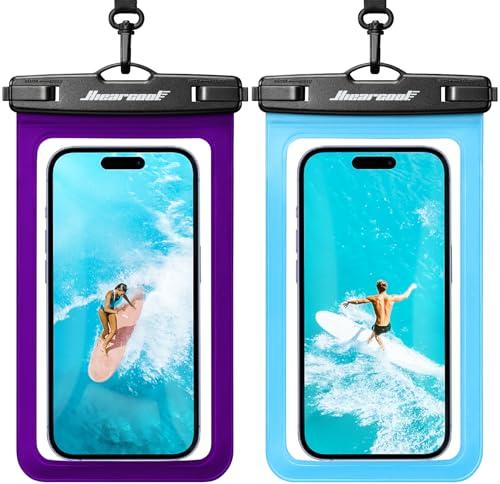 Also good Hiearcool Waterproof Phone Pouch The generic pouch that most often fits a large phone with its case left on, sold in a two-pack at a mid-range price. | Big phones in cases | IPX8, manufacturer-declared | |
| 5 | 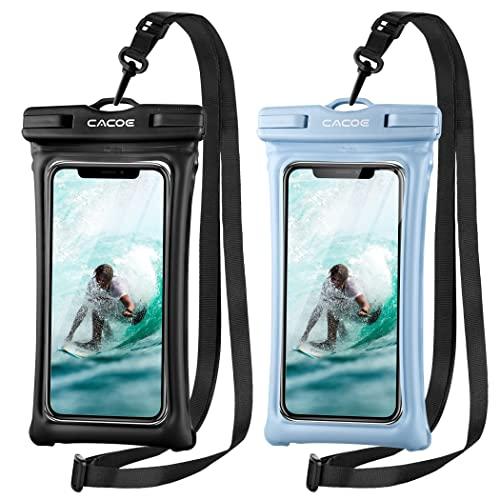 Also good CACOE Floatable Waterproof Phone Pouch A budget two-pack built with air pockets so it sits on the surface - the one feature that actually saves a phone on a lake. | Cheapest that floats | IPX8, manufacturer-declared | |
| 6 | 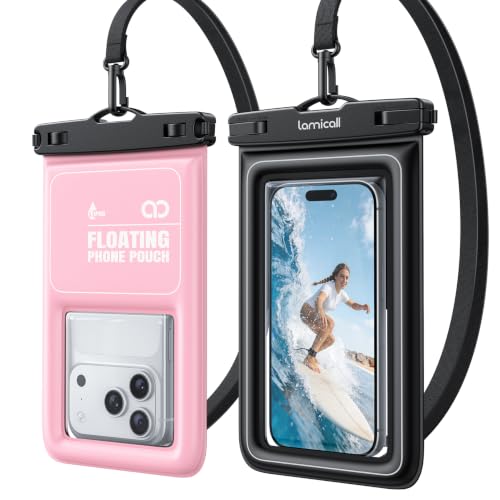 Also good Lamicall IP68 Floating Waterproof Phone Pouch A floating two-pack from an established phone-accessory brand, and a useful illustration of how far apart two IP68 depth claims can sit. | Floats, from a real brand | IP68; maker claims 100 ft |
The purchase nobody plans for until the phone is gone
A lake day has a reliable shopping list and a phone pouch is never on it. It goes on the list the first time somebody hands a phone across a tube, or sets it on a float that flips, or puts it in a dry bag that turns out to be water-resistant rather than waterproof. By then the purchase has already cost several hundred dollars more than the pouch would have.
The useful thing about this category is that it is cheap and the decision is small. Almost every pouch on the market is the same object - a clear TPU sleeve with a press-and-lock seal and a lanyard - and the ones worth buying differ on two points: whether the pouch floats, and whether the maker has published a depth claim you could actually hold them to. Everything else on the listing is noise.
IPX8 does not mean what the listing implies
This is the single most useful fact to carry into the category, and it explains why one pouch on this page claims 100 ft and another claims 3.3 ft while both carry an 8 in their rating. Under the IEC 60529 IP code, an 8 in the second digit means the enclosure is suitable for continuous immersion under conditions which shall be specified by the manufacturer. The depth and the duration are declared by the maker, not fixed by the standard. The only hard floor is that the conditions must be at least as severe as IPX7, which is about 1 meter for 30 minutes.
So a pouch rated "IPX8 to 100 ft" is making a manufacturer's claim about its own product, with no independent depth test implied by the code. Pelican, which has a warranty department and a legal department, declares 3.3 ft for 30 minutes. Other pouches on this same page, at a similar price, declare 100 ft. Both are formally IP68 or IPX8. One of those numbers is a specification and the other is a marketing figure, and you cannot tell which from the rating alone.
The practical conclusion is not that cheap pouches do not work - they do, for what a lake day asks of them. It is that you should buy on the published number rather than the biggest one, and you should treat every pouch as a splash-and-drop device rather than a diving housing. Nothing on this page is rated for free diving, and nothing on it should be taken below a few feet on purpose.
How we picked these six
We have not pressure-tested six pouches at depth and will not pretend otherwise. What we did do is check that every pouch here is currently sold and in stock as this page was written, read every published figure the maker and its retailers provide, and record where those figures contradict each other - which in this category is constantly, and is itself the most useful thing to know before buying.
That contradiction is worth seeing plainly. The Hiearcool pouch's maximum phone size is published as 7 in, 7.2 in, 8.3 in and 8.9 in on four different listings for the same product. SwimCell's own retailers state a tested depth of 10 m on one page and 20 m on another. We have put those disagreements in the spec tables and the cons rather than picking the flattering number, because the figure you need is the one on the listing you are actually buying.
The six things that decide which pouch to buy
- Does it float. This is the first question and most buyers never ask it. A plain TPU sleeve with a phone in it sinks, and a lake has no shallow end - a dropped pouch is gone. A pouch with air pockets or air cushions sits on the surface and you pick it up. Pelican, CACOE and Lamicall float by design; the plain sleeves do not.
- The published depth and duration, not the headline depth. A maker that states "1 m for 30 minutes" has told you something testable. A maker that states "100 ft" with no duration has told you nothing. Prefer the specific claim even when it is the smaller one.
- Measured fit, with the case on. Pouch listings state a screen size; your phone's problem is its thickness and its case. Measure the phone you will actually carry, in the case you will actually leave on, against the pouch's internal dimensions. This is the single commonest reason a pouch gets returned.
- How it is carried. A neck lanyard is right for a boat and wrong for swimming - it swings into your stroke within fifty yards. An armband is right for swimming and overkill for a pontoon. Buy for the activity, not for the pouch.
- The seal, and how many there are. A single press-seal strip is one chance to get the closure right. Hiearcool's three-strip design gives you three. Either way the seal is the failure point: check it before every trip and retire the pouch at the first crease, split or stiff spot.
- Whether you need one pouch or four. A household with four phones, a car key, a bank card and a hotel card does not need one premium pouch, it needs several cheap ones and one good one. Two-packs exist for exactly this reason.
Pelican Marine Waterproof Phone Pouch
The only pouch here whose maker publishes a conservative, testable depth claim and backs it with a warranty - which is exactly why it is the one to put a phone in.
Specifications
- Rating
- IP68, stated to 3.3 ft (1 m) for 30 minutes
- Floats
- Yes - built-in air cushions
- Fits
- Phones up to about 6.1 in display (Regular)
- Also sold as
- XL, 9.37 x 5.43 in external
- Carried
- Detachable lanyard
- Warranty
- 1-year limited, per Pelican
What works
- Pelican states a depth and a duration - 1 m for 30 minutes - instead of a headline number with no test behind it
- The air cushions mean a dropped pouch sits on the surface rather than going to the bottom of the lake
- The latch is a positive, two-stage closure you can feel engage, not a roll-and-clip strip
- Hi-vis yellow trim on the black version makes it findable on the floor of a boat and in shallow water
- A named brand with a warranty address, which in this category is unusual
What doesn’t
- Costs roughly double a generic two-pack, and you get one pouch rather than two
- The Regular size is tight on a big phone in a case - measure before you buy, or take the XL
- The stated 1 m / 30 min rating is honest but modest: this is a splash, drop and dunk pouch, not a diving housing
- Like every pouch, the touchscreen only works above water - capacitive screens stop responding once submerged
Who it’s for
Anyone who would rather pay once than replace a phone, and anyone taking a phone onto a boat or a paddleboard.
Bottom line
Buy this one if the phone inside it matters. The published rating is lower than the cheap pouches claim, and that is the point.
JOTO Universal Waterproof Phone Pouch
The default budget pouch: two of them cost less than a round of ice creams, and for a beach bag that is the right answer.
Specifications
- Rating
- IPX8, manufacturer-declared
- Fits
- Phones up to 7 in
- Pack
- Two pouches
- Floats
- Not stated - treat as sinking
- Carried
- Neck lanyard
- Closure
- Snap-lock press seal
What works
- Two pouches per pack, so the second one carries a car key, a bank card and cash instead of leaving them on a towel
- Clear on both faces, so the camera shoots through it and the screen stays readable above water
- Cheap enough to replace every season, which is genuinely the right maintenance plan for a TPU pouch
- The 7 in fit covers most phones without a case
What doesn’t
- There is no published float claim - assume it sinks and tie it to something
- IPX8 here is a manufacturer declaration with no stated depth or duration you can hold them to
- A phone in a thick case or with a PopSocket often will not fit
- Press-seal strips are the failure point: inspect the seal every trip and retire the pouch at the first crease or split
Who it’s for
A family that needs three or four pouches in circulation and is not taking a phone deep.
Bottom line
The budget pick, and an honest one. Buy two packs, test them empty in the sink, and do not trust any of them past one season.
SwimCell Waterproof Phone Case with Armband
The one pick here designed to be worn on an arm while you actually swim, rather than hung round a neck where it swings into every stroke.
Specifications
- Rating
- IPX8; retailers state 10 m or 20 m tested
- Case size
- 4 x 6.7 in (10.5 x 17 cm)
- Armband
- Fits 8-10 in (20-25 cm) upper arm
- Worn
- Armband; lanyard versions also sold
- Floats
- Not stated - treat as sinking
- Sizes
- Standard and Large
What works
- An armband is the only sensible way to carry a phone while swimming - a neck lanyard pouch fouls your stroke within fifty yards
- The armband range is published (8-10 in), which is the figure a larger adult or a lanky teenager actually needs
- A key-and-card version of the same case exists, so a swimmer can carry a car key without carrying a phone
- Sold in two sizes rather than one universal fit
What doesn’t
- SwimCell's own retailers publish different tested depths - 10 m on one, 20 m on another - and we could not reconcile them
- Reports of Plus and Pro Max sized phones not fitting the Large; measure the case opening against your phone, not against the model name
- Priced at the top of this list, and it is one case rather than a two-pack
- Stock is thin at any one retailer, so the listing may show a low count
Who it’s for
The adult doing real distance - lap swimming, a point-to-point lake crossing, a triathlon swim.
Bottom line
Buy it for the armband, not for the depth claim. If you are swimming rather than floating, this is the format that works.
Hiearcool Waterproof Phone Pouch
The generic pouch that most often fits a large phone with its case left on, sold in a two-pack at a mid-range price.
Specifications
- Rating
- IPX8, manufacturer-declared
- Fits
- Listings vary: 7 in to 8.9 in
- Pack
- Two pouches
- Closure
- Three-layer snap-lock seal
- Floats
- Not stated - treat as sinking
- Carried
- Neck lanyard
What works
- Routinely fits a Pro Max or Ultra class phone with the case still on, which the 7 in pouches do not
- Three sealing strips rather than one, so there are two more chances to catch a bad closure
- Two per pack, in several color pairs, so family members can tell theirs apart
- Front and back are both clear, so the rear camera works through it
What doesn’t
- The maximum phone size is stated differently on different listings for the same product (7 in, 7.2 in, 8.3 in, 8.9 in) - measure, do not trust the headline
- Listings also disagree on the material: TPU on the maker's own copy, PVC on at least one retailer sheet
- Several buyers report the window fogging in warm water, which makes the screen hard to read
- No float claim, and the depth figure is a declaration rather than a test
Who it’s for
Anyone whose phone did not fit the cheap pouch, and anyone who refuses to take their case off at the lake.
Bottom line
Buy it for fit, not for its rating. Measure your phone in its case against the listing you are actually buying.
CACOE Floatable Waterproof Phone Pouch
A budget two-pack built with air pockets so it sits on the surface - the one feature that actually saves a phone on a lake.
Specifications
- Rating
- IPX8, manufacturer-declared
- Floats
- Yes - air pockets built into the body
- Fits
- Phones up to 7.0 in
- Pack
- Two pouches
- Carried
- Neck lanyard
- Closure
- Snap-lock press seal
What works
- Floating is the feature that matters in open water, and this is the cheapest way to get it
- Two per pack at a price where losing one is annoying rather than expensive
- The air pockets double as a grip, which makes it easier to hold onto in chop than a flat sleeve
- Clear front and back for the camera
What doesn’t
- The air pockets add bulk, so it is a worse pocket pouch than a plain sleeve
- 7.0 in is a real ceiling - a big phone in a case is not going in
- Floating is only true if the pouch is actually sealed; a half-closed pouch fills and sinks like any other
- No stated test depth or duration behind the IPX8 claim
Who it’s for
Anyone handing a phone across a boat, a tube or a dock, where the realistic accident is a drop into deep water.
Bottom line
If you only take one thing from this page, take the float. On a lake it is worth more than any depth number.
Lamicall IP68 Floating Waterproof Phone Pouch
A floating two-pack from an established phone-accessory brand, and a useful illustration of how far apart two IP68 depth claims can sit.
Specifications
- Rating
- IP68; maker claims 100 ft
- Floats
- Yes, per the maker
- Pack
- Two pouches
- Carried
- Neck lanyard
- Closure
- Snap-lock press seal
- Note
- Same IP code as Pelican's 3.3 ft claim
What works
- Floats, two per pack, and from a brand with an actual product line rather than a one-listing storefront
- Sits in the upper bracket with the Pelican rather than down with the generic two-packs, and you get two pouches for it
- Clear on both faces with a reasonable window for the rear camera
- Lanyard is long enough to wear over a life jacket, which the short ones are not
What doesn’t
- The 100 ft claim carries the same IP68 code that Pelican uses for 3.3 ft - the code does not fix a depth, so the two numbers are not comparable
- No published test duration to go with the depth
- Press-seal closure, with the same inspect-every-trip caveat as every other pouch here
- Fit on the largest phones in cases is not clearly stated
Who it’s for
Someone who wants a floating pouch and a recognizable brand without paying Pelican money.
Bottom line
A sensible middle pick. Read its depth claim as marketing and its float as the real feature.
Float or sink: make this decision first
Everything else is secondary. On a lake, the realistic accident is not a slow leak at depth - it is a phone going over the side of a boat, off a float, or out of a hand on a dock. In that scenario a waterproof pouch that sinks has saved you nothing at all: the phone is dry, on the bottom, in eleven feet of silty water.
A floating pouch converts that from a loss into an inconvenience. It is achieved two ways. Pelican builds air cushions into the body of the pouch; CACOE and Lamicall build air pockets along the edges. Both work, both add a little bulk, and the bulk is the price of the feature. If you are buying a single pouch for a boat or a paddleboard, buy a floating one and accept that it does not slide into a pocket as neatly.
One caveat that matters: a pouch only floats if it is sealed. A pouch closed on one of its three strips and not the others fills, gets heavy and sinks exactly like a plain sleeve. The float is a property of a correctly closed pouch, not of the product sitting in its packaging.
Carrying a phone while you actually swim
A pouch on a neck lanyard is fine for anything that is not swimming. The moment you start a crawl stroke it becomes a problem: the lanyard shortens as the pouch drifts, the pouch slaps your chin, and the phone ends up under your armpit. If you are swimming any real distance with a phone, the format is an armband, which is why SwimCell is the pick here despite being the most expensive single item on the page.
The second honest option is not to carry it on your body at all. The adult swimming out past the swim line usually has somewhere better to put a phone: the dry compartment of a tow float. Our best open water swim buoys roundup covers those, and the two products belong together - a tow-float dry bag is water-resistant, and the maker of the most popular one explicitly recommends putting a phone in a sealed bag inside it. The pouch is the sealed bag.
For a child, the answer is simpler: no. A phone in a pouch round a child's neck is a lanyard in moving water, and that is a hazard with no upside. If the point is for a child to be reachable, the phone belongs with the adult on the shore.
Fitting, testing and closing a pouch properly
- Test it empty, in the sink, before the lake. Close the pouch with a folded paper towel inside and hold it under water for a minute. A dry towel means a good seal. This takes two minutes and it is the only test that matters.
- Close it on a flat surface, not in your hand. Press the seal strip along its whole length with a thumb, then fold and clip. The commonest leak is a corner that was never pressed closed.
- Leave some air in it. A pouch with a cushion of air inside is easier to spot, floats better if it is a floating design, and keeps the window off the screen so the touchscreen still works.
- Keep the lanyard clipped to something. A pouch clipped to a boat cleat, a life jacket D-ring or a wrist is a pouch that does not go overboard in the first place.
- Check the seal strip every trip. TPU goes stiff with sun and age and a stiff strip does not seal. A pouch that has lived in a hot car all summer is a pouch to replace, not to trust.
- Open it with dry hands. Most water that reaches a phone in a pouch got in while somebody opened the pouch with wet fingers on a wet boat deck.
What about a waterproof phone, or a hard case?
Most current flagship phones carry an IP68 rating of their own, and that is a fair question to ask before buying a pouch at all. Two reasons to buy one anyway. First, phone IP ratings are tested in fresh water in a lab on a new device, and makers are explicit that the rating degrades with age, drops and seal wear - a two-year-old phone is not the phone that was tested. Second, phone warranties routinely exclude liquid damage regardless of the IP rating, which means the rating protects the phone and not your wallet.
Hard waterproof cases are the other alternative, and they are a genuinely better answer for a phone that lives on the water - but they are phone-model-specific, cost several times a pouch, and are obsolete the moment you change phone. A universal pouch outlives three phones. For a lake season rather than a lifestyle, the pouch is the better buy.
The in-between option that works surprisingly well is a cheap pouch inside a dry bag. A floating dry bag keeps bulk items dry and a sealed pouch inside it keeps the phone dry twice. That is also the combination we would recommend for a boat, where the real risk to a phone is standing water in the bilge rather than full immersion.
What to buy alongside it
A phone pouch is one line on a bag list, and the rest of it is worth getting right in the same order. Our lake day packing list is the full version; the short version is a towel per person, a shoe per foot and flotation for anybody who needs it. If you are outfitting from nothing, family swim gear on a budget works out what to buy first and what can wait a season.
The two items that pair most directly with a pouch are a quick-dry towel - because a damp towel in the same bag is what gets a phone wet in the first place - and something to keep the bag dry on a boat. Our best quick-dry towels for swimming page covers the towels that go home damp instead of soaked. And if the phone is going on the water because somebody is swimming out of sight of shore, read lake swimming safety first: a phone in a pouch is not a safety plan.
One last pairing, and it is the other purchase nobody makes until they need it. A phone pouch is what you buy so a phone survives the water; an approved throwable is what you buy so a person does. Both cost about the same, both spend their lives doing nothing, and only one of them is required by federal law on a boat 16 feet or longer - best throwable flotation devices covers which cushion or ring to buy and where it has to be stored.
Questions
Frequently asked questions
Do waterproof phone pouches actually work?
What does IPX8 mean on a phone pouch?
Can you use a touchscreen through a waterproof pouch underwater?
Do waterproof phone pouches float?
Will a waterproof pouch fit my phone with the case on?
Should my child wear a phone pouch in the water?
Sources
- IEC 60529 IP Code - IPX8 is "continuous immersion under conditions specified by the manufacturer"
- Pelican Marine Waterproof Phone Pouch (IP68, 3.3 ft / 30 min, floating, 1-year warranty)
- Andark - SwimCell 100% Waterproof Armband Phone Case (IPX8, case and armband dimensions)
- New Wave Swim Buoy - FAQ (buoyancy, sizing by swimmer weight, dry bag)
Read next