Baby & Toddler · Guide
Are Swim Diapers Necessary?
At a public pool, yes, and it is a rule rather than a suggestion. At a lake, it is a courtesy with a real reason behind it.
The short answer
Yes, for any child not reliably toilet trained. Nearly every public pool requires one, and a regular diaper is not an alternative — it absorbs pool water, swells and falls apart. A swim diaper contains solid waste, which is the only thing that matters for water contamination.
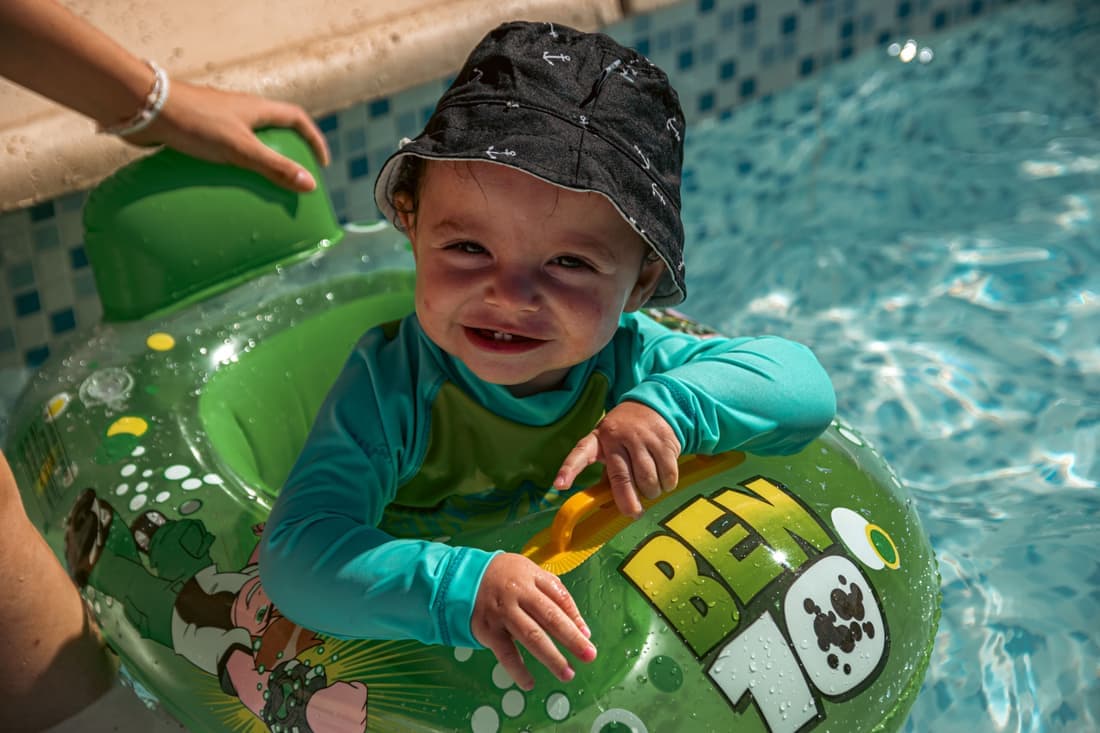
Product photos are the retailer’s own catalogue images, shown from the retailer’s servers and refreshed daily. Any other photo here is a licensed image that illustrates the category, not a photograph of the specific product named.
The rule, first
Almost every public pool, splash pad, swim school and water park in the country requires a swim diaper for children who are not reliably toilet trained, and many require a reusable one with a snug leg seal on top of a disposable. That is posted policy, not staff preference, and arriving without one usually means not swimming.
The reason is specific. Public health guidance on recreational water focuses on fecal contamination, because that is the route by which the organisms that cause recreational water illness get into a pool. A single contamination incident closes a pool for hours. A swim diaper with a snug leg elastic is the barrier that prevents it.
So the honest framing is not "does my baby need a swim diaper" but "does the water need my baby to be wearing one." The answer to the second question is yes, every time, until toilet training is genuinely reliable rather than mostly reliable.
What a swim diaper does and does not do
It contains solid waste. That is the job, and a correctly fitted one does it well. The snug leg and waist elastic is the entire mechanism — a loose swim diaper does not work, regardless of brand.
It does not absorb urine, and it is not meant to. A swim diaper that absorbed liquid would fill with pool water within a minute, swell to several times its size and sag off the child. Urine is also far less of a contamination concern in a chlorinated pool than solid waste is. The mechanics are in swim diaper vs regular diaper.
It is not a flotation device, despite the fact that several are sold with buoyant panels. Nothing worn as a diaper is approved flotation, and nothing about one changes supervision requirements.
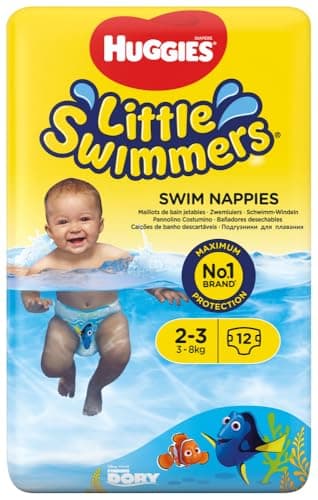
Huggies Little Swimmers
The disposable standard, with a double leak guard and a stretchy waist — and available in every supermarket.
Specifications
- Type
- Disposable
- Sizes
- Small to large (approx. 16-34+ lbs)
- Guards
- Double leak guard
- Removal
- Pull-on with tear sides on some sizes
What works
- Genuinely the most available swim diaper — you can buy them mid-trip anywhere
- Double leak guard is the best containment in the disposable tier
- No rinsing, no washing, no wet bag in the car
- Fine for a one-off pool party or a holiday week
What doesn’t
- Costs add up fast — a weekly swimmer spends well over a hundred dollars a season
- Bulks up when wet, so the waistband gaps under a swimsuit
Who it’s for
Occasional swimmers, travel, and anyone without laundry access.
Bottom line
Right for occasional use, expensive as a habit. Swimming weekly? Buy two reusables instead.
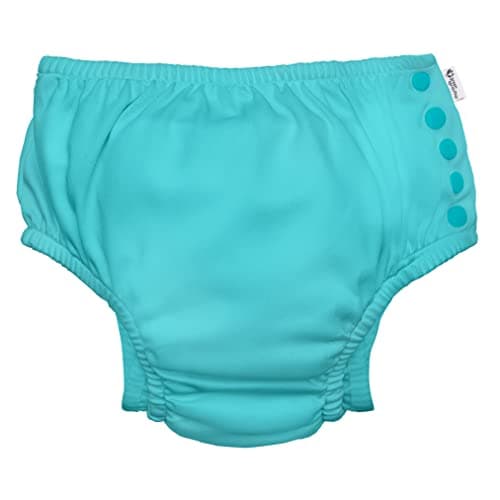
i play. by green sprouts Reusable Swim Diaper
The reusable standard: a snug three-layer diaper with a UPF 50+ outer that meets public-pool rules.
Specifications
- Type
- Reusable
- Layers
- 3, with absorbent inner
- UPF
- 50+ outer
- Sizes
- 6 months to 5T
What works
- Snug leg elastic is what public pools actually check for, and this passes
- Pays for itself in about a month of weekly swimming
- Sizes run up to 5T, well past where disposables stop being practical
- Machine washable and survives a full season
What doesn’t
- Has to be rinsed immediately after use or it smells
- Absorbs nothing meaningful, so it is containment only — it does not hold urine
Who it’s for
A baby or toddler swimming weekly or more, where disposables become a recurring cost.
Bottom line
The reusable to buy. Own two so one is always dry; a single one is not enough for back-to-back sessions.
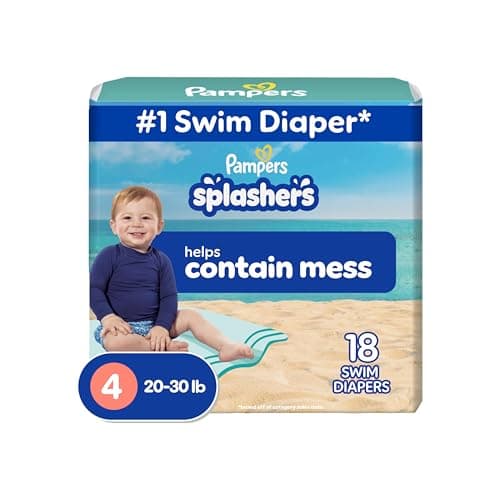
Pampers Splashers
Disposable containment comparable to Huggies, with tear-away sides that matter more than they sound.
Specifications
- Type
- Disposable
- Sizes
- Approx. 13-41+ lbs
- Sides
- Tear-away
- Guards
- Dual leak-guard barriers
What works
- Tear-away sides mean a soiled diaper comes off without going down the legs
- Containment is on par with Huggies in practice
- Slimmer fit when wet than most disposables
- Widely stocked
What doesn’t
- Same recurring cost problem as every disposable
- Tear-away sides occasionally give way early on an active toddler
Who it’s for
Toddlers likely to have an accident, where removal method genuinely matters.
Bottom line
Pick between these and Huggies on fit and price — containment is equivalent. Tear-away sides are the real differentiator.
Why a regular diaper is not an option
This is the substitution people reach for and it fails comprehensively. A disposable diaper's absorbent core is designed to pull in liquid and lock it into a gel. Submerge one and it does exactly that with pool water: within a minute it is several times its dry weight, hanging below the child, and the leg elastic that was holding the seal is now stretched away from the skin.
At that point it has stopped containing anything, it is uncomfortable, and in many pools it is also shedding gel beads into the water. Putting a regular diaper under a swim diaper is the same failure with an extra step, and it breaks the swim diaper's seal as well — the full explanation is in do swim diapers go over regular diapers.
Reusable or disposable: which is cheaper for you
| Reusable | Disposable | |
|---|---|---|
| Cost per swim, occasional use | High — the up-front cost dominates | Low |
| Cost per swim, weekly use | Very low after a few weeks | Adds up fast |
| Leg seal | Usually the better seal | Good, varies by size fit |
| Pool acceptance | Accepted everywhere; often required | Accepted, sometimes only under a reusable |
| After an accident | Rinse, wash, reuse | Tear-away sides; straight in the trash |
| Travel | Needs a wet bag | Nothing to carry home |
The break-even is roughly the point where a child swims more than once a week for a season. Weekly swim lessons: buy two reusables and never think about it again. Three trips to a lake all summer: buy a pack of disposables and spend the difference on a rash guard. The detailed version is in reusable vs disposable swim diapers.
Many families end up with both, which is not indecision: a reusable for the pool where it is required, and disposables in the car for the trips you did not plan.
Fit is the whole product
- Snug at the legs, with the elastic flat against the skin all the way around. If you can hook a finger between the elastic and the thigh and pull it away easily, it is too big.
- Snug at the waist, sitting at the natural waist rather than below the belly.
- Sized by weight, not by age, and sized to the current weight rather than up for growth.
- Changed before the swim, at the water, not at home — a swim diaper worn in the car is a swim diaper that has already been used.
- Changed immediately after, into a regular diaper. A wet swim diaper left on is a rash waiting to happen.
Do you need one at a lake?
There is rarely a posted rule at an unsupervised lake shore, so this is a judgment rather than a requirement. The contamination logic is weaker in a large body of moving water than in a pool, but it is not absent — the shallow, warm margin where a baby plays is exactly the part of a lake that does not flush, and it is where everybody else's children are too.
The practical answer: yes, wear one. It costs almost nothing, it makes the inevitable accident a non-event rather than a problem, and at a swimming beach with a lifeguard it is usually required anyway. The rest of the first-lake-trip checklist is in baby's first lake day checklist.
What to buy, in one paragraph
If your child swims weekly: two reusable swim diapers in the current size, worn alone or under a swimsuit. If your child swims occasionally: a pack of disposables with tear-away sides, which make an accident recoverable in a changing room. If a pool has told you it requires a reusable over a disposable, do both — that is a real policy at a lot of swim schools and the staff are not improvising.
The product picks across both types are in best swim diapers, and if you are buying swimwear at the same time, several baby swimsuits have the diaper built in: best baby swimwear.
Questions
Frequently asked questions
Are swim diapers required at pools?
Are swim diapers meant to hold pee?
Can my baby just wear a regular diaper in the pool?
Are swim diapers worth it for one trip?
When can a child stop wearing a swim diaper?
Sources
Read next