Baby & Toddler · Comparison
Swim Diaper vs Regular Diaper
One absorbs and fails in water. One contains and holds nothing. Neither does both.
The short answer
A regular diaper absorbs, so in water it swells with pool water, sags, and stops working. A swim diaper deliberately does not absorb — it contains solids only and holds essentially no urine. They are not interchangeable in either direction, and pools require the swim diaper.
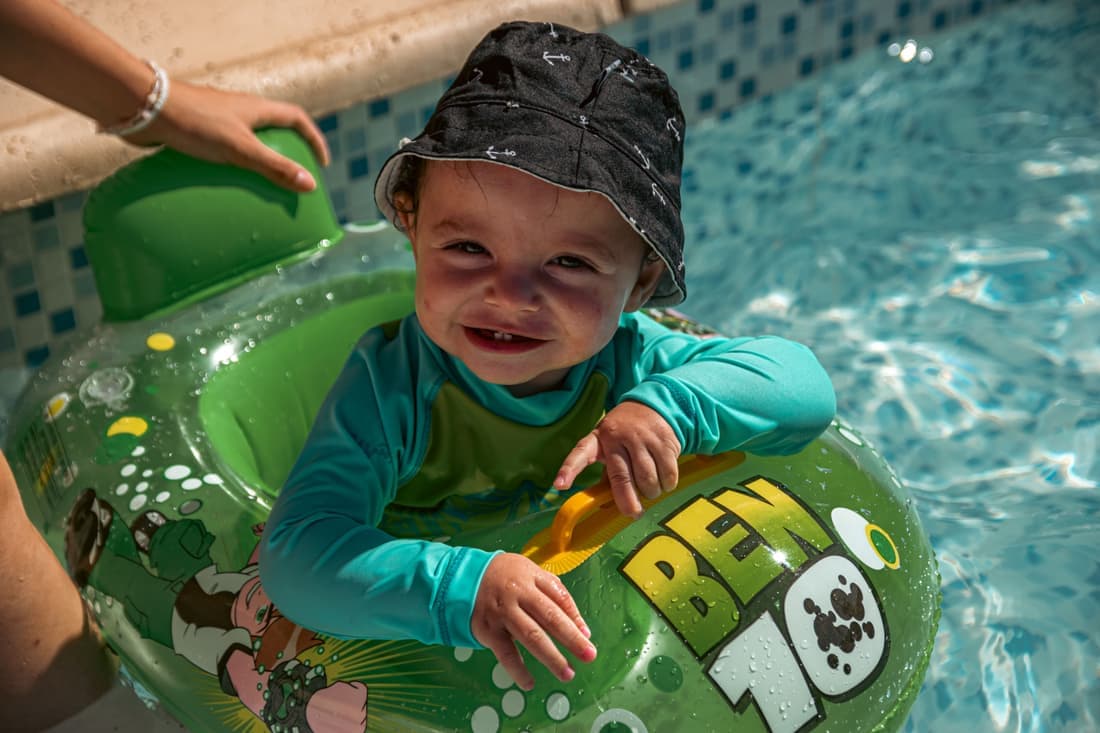
Photos on this page are licensed images that illustrate the category. They are not photographs of the specific products named, and no product image here is supplied by a manufacturer or retailer.
| Swim diaper | Regular diaper | |
|---|---|---|
| Absorbs urine | No, deliberately | Yes, that is its purpose |
| Contains solids | Yes — its only job | Yes |
| Behavior in water | Stays slim and in place | Swells, sags, can leak gel |
| Allowed in public pools | Yes, usually required | No |
| Fits under a swimsuit | Yes, slim | No — bulks badly when wet |
| Reusable options | Yes | Cloth diapers, but not for swimming |
| Needs checking every 30-60 min | Yes | Yes |
Why a regular diaper fails in water
A modern disposable diaper works by means of a superabsorbent polymer that swells into a gel as it takes up liquid. It cannot tell the difference between urine and pool water, so submerged in a pool it absorbs until it is saturated — which happens fast.
The consequences are all bad. The diaper becomes heavy and sags off the hips. It bulks to several times its dry size, so it will not sit under a swimsuit. Its capacity is used up, so it is no longer doing anything useful. And on some products the swollen gel can escape through a stressed seam, leaving little beads in the water.
That last point is why pools ban them, over and above the hygiene question. It is not an arbitrary rule.
Why a swim diaper holds nothing
This is the thing parents find genuinely surprising. A swim diaper has no absorbent core, because an absorbent core is exactly what fails in water. It is a snug-legged pant made of fabric or a thin non-absorbent liner, and its whole function is a physical barrier around the legs and waist.
So a baby in a swim diaper is, for urine purposes, effectively swimming without a diaper. That is fine — the pool's disinfection handles it, and urine is not the contamination risk that solids are. What it means practically is that you change into the swim diaper at the water and back into a regular diaper afterwards, and you do not expect the swim diaper to have kept anything dry.
What the CDC actually asks of parents
- Check diapers every 30 to 60 minutes, and check rather than wait to notice.
- Change away from the water — in a changing room, not at the poolside.
- Wash hands afterwards, yours and the child's.
- Keep anyone with diarrhea out of the water entirely, which is the single most important one on this list.
- Take children on regular bathroom breaks once they are trained.
A swim diaper reduces the consequences of an accident. None of the above becomes optional because you are using one.
Choose a swim diaper if...
- The child is going in a pool, a lake, or a splash pad and is not toilet trained. There is no alternative.
- A pool or class requires one, which nearly all do.
- You want it to fit under a swimsuit without bulking the waistband.
When a regular diaper is still the right item
- Before and after swimming, which is most of the day.
- On the drive home. A swim diaper in a car seat holds nothing, which is a problem you only discover once.
- At the poolside between swims, if the child will be out of the water for a while.
Our picks
i play. by green sprouts Reusable Swim Diaper
The reusable standard: a snug three-layer diaper with a UPF 50+ outer that meets public-pool rules.
Specifications
- Type
- Reusable
- Layers
- 3, with absorbent inner
- UPF
- 50+ outer
- Sizes
- 6 months to 5T
What works
- Snug leg elastic is what public pools actually check for, and this passes
- Pays for itself in about a month of weekly swimming
- Sizes run up to 5T, well past where disposables stop being practical
- Machine washable and survives a full season
What doesn’t
- Has to be rinsed immediately after use or it smells
- Absorbs nothing meaningful, so it is containment only — it does not hold urine
Who it’s for
A baby or toddler swimming weekly or more, where disposables become a recurring cost.
Bottom line
The reusable to buy. Own two so one is always dry; a single one is not enough for back-to-back sessions.
Huggies Little Swimmers
The disposable standard, with a double leak guard and a stretchy waist — and available in every supermarket.
Specifications
- Type
- Disposable
- Sizes
- Small to large (approx. 16-34+ lbs)
- Guards
- Double leak guard
- Removal
- Pull-on with tear sides on some sizes
What works
- Genuinely the most available swim diaper — you can buy them mid-trip anywhere
- Double leak guard is the best containment in the disposable tier
- No rinsing, no washing, no wet bag in the car
- Fine for a one-off pool party or a holiday week
What doesn’t
- Costs add up fast — a weekly swimmer spends well over a hundred dollars a season
- Bulks up when wet, so the waistband gaps under a swimsuit
Who it’s for
Occasional swimmers, travel, and anyone without laundry access.
Bottom line
Right for occasional use, expensive as a habit. Swimming weekly? Buy two reusables instead.
Pampers Splashers
Disposable containment comparable to Huggies, with tear-away sides that matter more than they sound.
Specifications
- Type
- Disposable
- Sizes
- Approx. 13-41+ lbs
- Sides
- Tear-away
- Guards
- Dual leak-guard barriers
What works
- Tear-away sides mean a soiled diaper comes off without going down the legs
- Containment is on par with Huggies in practice
- Slimmer fit when wet than most disposables
- Widely stocked
What doesn’t
- Same recurring cost problem as every disposable
- Tear-away sides occasionally give way early on an active toddler
Who it’s for
Toddlers likely to have an accident, where removal method genuinely matters.
Bottom line
Pick between these and Huggies on fit and price — containment is equivalent. Tear-away sides are the real differentiator.
Questions
Frequently asked questions
Can you use a regular diaper for swimming?
Do swim diapers hold urine?
What happens if a baby pees in a swim diaper?
Do you need a regular diaper as well as a swim diaper?
Sources
Read next