Rash Guards · Comparison
Rash Guard vs Compression Shirt
They look identical on a hanger. One is built for water, the other for land.
The short answer
A rash guard is a swim garment: chlorine- and saltwater-rated fabric, a certified UPF rating, and flatlock seams that do not chafe wet. A compression shirt is a training garment built to squeeze muscle on land, usually with no UPF rating and a fabric that degrades in chlorine.

Product photos are the retailer’s own catalogue images, shown from the retailer’s servers and refreshed daily. Any other photo here is a licensed image that illustrates the category, not a photograph of the specific product named.
The short version
| Rash guard | Compression shirt | |
|---|---|---|
| Built for | Water, sun, board sports | Land training, muscle support |
| UPF rating | Usually certified UPF 50+ | Usually none stated |
| Chlorine and salt | Rated for both | Degrades, especially elastane blends |
| Fit | Close but not compressive | Deliberately compressive |
| Seams | Flatlock, placed away from rub points | Overlock, placed for support panels |
| Wet weight and drying | Light, dries fast | Heavier, holds water longer |
| Transparency when wet | Designed to stay opaque | Often goes sheer |
| Price | Low to mid | Mid to high |
Both are close-fitting synthetic long-sleeve tops, which is why they get confused. The difference is what the fabric was engineered to survive and what the garment is trying to do to your body.
What a rash guard is for
A rash guard started as surf equipment: a thin layer between skin and a waxed board, stopping the chest rash it is named after. Modern ones do three jobs — abrasion, sun, and a small amount of warmth — and every design decision follows from being in water all day.
That means polyester-heavy fabric, which neither absorbs much water nor minds chlorine; a tested UPF rating that comes from the weave rather than a coating; and flatlock seams deliberately routed away from the armpit and the shoulder, where a wet seam under a shoulder strap will take skin off over an afternoon.
It also means staying opaque wet, which is a real engineering requirement and one that compression shirts frequently fail. The detail of what the UPF number covers, and what it does not, is in UPF ratings explained.
What a compression shirt is for
A compression shirt applies graduated pressure to muscle. The claimed benefits are around proprioception, reduced muscle oscillation and recovery; the design priority is consistent squeeze through the torso and arms, delivered with a high elastane content.
Elastane is the problem in water. Chlorine attacks it, salt and sun accelerate the damage, and the fabric goes slack and loses the very compression it was bought for. A compression shirt used as swimwear typically has a short, disappointing life.
Most compression shirts also carry no UPF rating. Some fabrics will happen to block a lot of UV, but an unrated garment makes no claim and has had no test applied, and a thin stretched-out knit over wet skin is exactly the condition under which a fabric's UV protection drops.
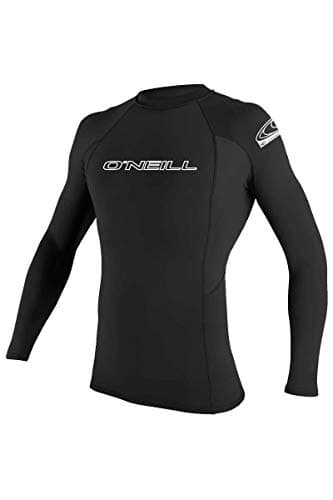
O'Neill Men's Basic Skins 50+ Long Sleeve Rashguard
The default adult rash guard: a 6 oz polyester-spandex surf cut with flatlock seams and a certified UPF 50+ rating.
Specifications
- UPF
- 50+
- Fabric
- 6 oz polyester/spandex
- Fit
- Performance, close
- Seams
- Flatlock, strategic placement
- Sizes
- S-2XL
What works
- A genuine performance fit, which is the whole point — it stays put instead of ballooning and riding up
- Flatlock seams placed where a surfboard would rub, so nothing chafes under the arm on a long day
- Polyester-spandex with 4-way stretch, the blend that holds its shape through a season of sun and water
- Sold through O'Neill and every major retailer, so finding your size in a color you will wear is easy
What doesn’t
- Cut close on purpose — if you wanted something loose to throw on over a suit, this is the wrong shirt
- Crew neck with no zip, so it comes off over your head while wet
- O'Neill sizes this as surf apparel rather than street sizing; check the chart instead of assuming your usual letter
Who it’s for
Any adult who swims rather than wades — the lap swimmer, the tube rider, the parent in the water all afternoon.
Bottom line
The one to buy if you buy one. The women's Basic 50+ is the same shirt on a women's block.
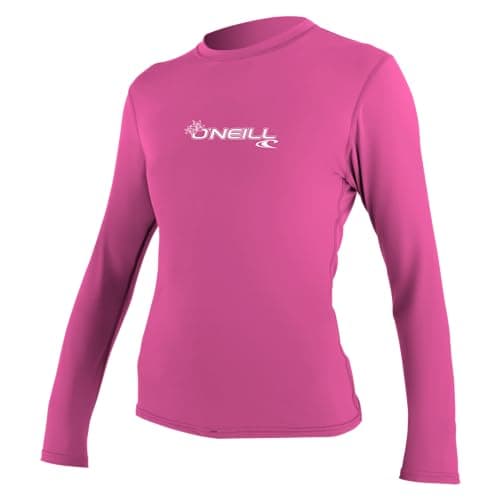
O'Neill Women's Basic 50+ Long Sleeve Rashguard
The women's cut of the same 6 oz polyester-spandex shirt, in XS to 2XL — slim, seam-light and certified UPF 50+.
Specifications
- UPF
- 50+
- Fabric
- 6 oz polyester/spandex
- Fit
- Slim
- Seams
- Overlock stitched
- Sizes
- XS-2XL
What works
- Slim through the body, so it does not balloon and leave the lower back uncovered mid-swim
- Same fabric and rating as the men's Basic Skins, on a cut that actually fits a women's torso
- Starts at XS, which most surf brands do not bother with
- Plain enough to wear over any swimsuit without a clash
What doesn’t
- Reviewers on O'Neill's own listing report it running snug — size up if you are between sizes
- Crew neck, no zip, and peeling it off wet is a two-handed job
- A slim fit skims nothing; for coverage that drapes, the Lands' End swim tee is cut looser
Who it’s for
Women who swim in it rather than sit in it, and anyone who has watched a loose swim shirt ride up all day.
Bottom line
The women's pick for most people. Buy the size the chart says, not the size you expect.
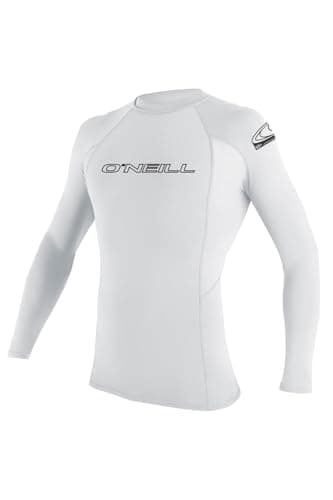
O'Neill Kids' Basic Skins UPF 50+
A close-fitting surf rash guard with minimal seams — the one that does not ride up when a child swims.
Specifications
- UPF
- 50+
- Fit
- Performance, close
- Sleeves
- Long
- Seams
- Minimal, flatlock
What works
- Close fit is the point — a loose swim shirt balloons and rides up, leaving the back exposed
- Flatlock seams do not chafe under the arms on a long day
- Holds UPF 50+ after repeated washing, unlike treated-fabric shirts
- Made by a surf brand, so it is built for repeated saltwater and chlorine
What doesn’t
- Sizing runs slim; check the chart rather than buying by age
- Close fit is harder to pull on over wet skin
Who it’s for
A child who swims and plays hard, where a loose shirt would not stay put.
Bottom line
The default kids' rash guard. Size up one if you want it to last two summers.
Where the difference actually bites
All-day sun on open water. A rated rash guard is a known quantity: UPF 50+ means roughly one fiftieth of UV reaching skin, tested on the fabric. An unrated compression shirt is a guess, and the one place you do not want to guess is a shoulder and upper back exposed from ten until four.
Chafe. Rash guard seams are placed to avoid the rub points; compression shirt seams are placed to anchor support panels. Wet skin plus a seam plus repetition is how a day ends early, and it is the most common complaint from people who wore the wrong one.
Pool chemistry. A few seasons in chlorine will not touch a polyester rash guard and will visibly wreck a high-elastane compression top. If the shirt also gets worn to the gym, you are shortening the life of a more expensive garment for no gain.
Getting it off. A soaked compression shirt is genuinely hard to remove, because compression plus water plus skin is a seal. Rash guards are cut slightly looser for exactly this reason, and zip-front versions exist because even that is not always enough.
When a compression shirt is fine
- A single beach day in the shade, where sun exposure is limited and the shirt is mostly a layer.
- Freshwater only, occasionally. Lake water does not attack elastane the way chlorine does, so an occasional lake swim will not destroy it.
- Under a wetsuit, where it is doing an anti-chafe job and never sees sun.
- Warmth on a cool morning, where a snug synthetic layer under a jacket is exactly what you want.
- You already own it and it is one afternoon. Add sunscreen on the shoulders and move on. This is a gear optimization, not a safety rule.
Which to buy if you are buying one
If the garment will spend any serious time in water or sun, buy the rash guard. It costs about the same as a mid-range compression top, lasts longer in the conditions it was built for, and carries a rating you can rely on rather than an assumption.
Fit is the one thing to get right, and it is where people go wrong in both directions. A rash guard should be close enough not to balloon in the water, and no tighter — the full explanation is in are rash guards supposed to be tight. For men's and women's picks across the price range, see best rash guards for men and best rash guards for women.
Questions
Frequently asked questions
Are rash guards and compression shirts the same?
Can I wear a compression shirt as a rash guard?
Should a rash guard be as tight as a compression shirt?
Do compression shirts protect against the sun?
Which is better for swimming laps?
Read next