Rash Guards · Guide
Are Rash Guards Supposed to Be Tight?
Snug, not restrictive — and the test takes five seconds.
The short answer
Yes, a rash guard is meant to fit snugly against the skin with no loose fabric, because slack material is what chafes and drags in the water. It should not restrict a deep breath or dig at the armholes. If it rides up when you reach overhead, it is too short rather than too loose.

Product photos are the retailer’s own catalogue images, shown from the retailer’s servers and refreshed daily. Any other photo here is a licensed image that illustrates the category, not a photograph of the specific product named.
The short answer
Snug. A rash guard should sit against the skin everywhere with no bagging at the chest, waist or underarm, and it should stay exactly where you put it when you move. That is not the same as tight, and the difference is worth being precise about because both errors cost you something.
Too loose and the fabric moves against your skin instead of with it, which is chafing — the exact thing the garment was invented to prevent. Loose fabric also balloons with water when you swim, which is unpleasant and slow, and it floats away from the skin so the sun protection stops being reliable at the gaps.
Too tight and you get restricted breathing, red marks at the armholes and neck, and a garment nobody volunteers to wear. On a child, too tight means the rash guard becomes a fight at the start of every lake day, which is the real failure mode.
The five-second fit test
- Raise both arms straight overhead. The hem should stay at or below the waistband of your swimsuit. If it climbs and exposes your lower back, the garment is too short — go for a longer cut or a drop-tail hem, not a bigger size.
- Take the deepest breath you can. It should feel completely unrestricted. Any sense of a band across the chest means size up.
- Pinch the fabric at your ribs. You want to be able to lift it slightly off the skin and no more. If you can grab a fistful it is too loose; if you cannot lift it at all it is compression rather than fit.
- Rotate your shoulders forward and back. No digging at the armholes, no fabric pulling across the shoulder blades.
- Check the cuffs. Sleeves should end at the wrist and stay there. Sleeves that creep up the forearm leave the spot people burn most.
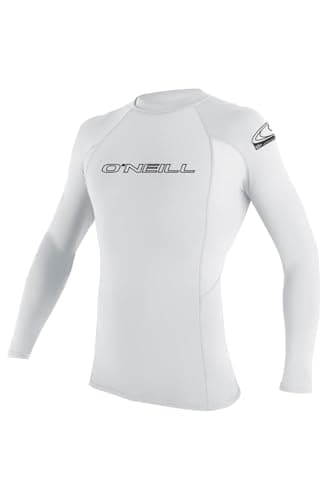
O'Neill Kids' Basic Skins UPF 50+
A close-fitting surf rash guard with minimal seams — the one that does not ride up when a child swims.
Specifications
- UPF
- 50+
- Fit
- Performance, close
- Sleeves
- Long
- Seams
- Minimal, flatlock
What works
- Close fit is the point — a loose swim shirt balloons and rides up, leaving the back exposed
- Flatlock seams do not chafe under the arms on a long day
- Holds UPF 50+ after repeated washing, unlike treated-fabric shirts
- Made by a surf brand, so it is built for repeated saltwater and chlorine
What doesn’t
- Sizing runs slim; check the chart rather than buying by age
- Close fit is harder to pull on over wet skin
Who it’s for
A child who swims and plays hard, where a loose shirt would not stay put.
Bottom line
The default kids' rash guard. Size up one if you want it to last two summers.
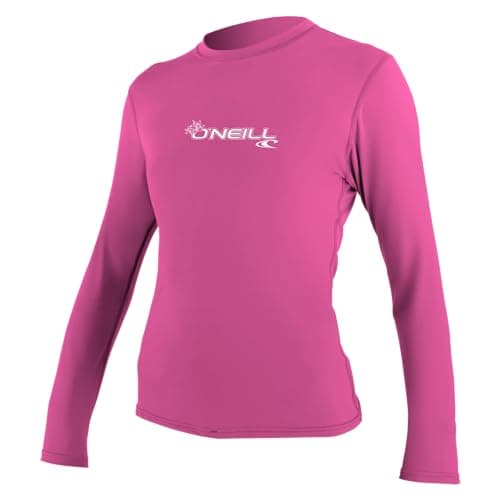
O'Neill Women's Basic 50+ Long Sleeve Rashguard
The women's cut of the same 6 oz polyester-spandex shirt, in XS to 2XL — slim, seam-light and certified UPF 50+.
Specifications
- UPF
- 50+
- Fabric
- 6 oz polyester/spandex
- Fit
- Slim
- Seams
- Overlock stitched
- Sizes
- XS-2XL
What works
- Slim through the body, so it does not balloon and leave the lower back uncovered mid-swim
- Same fabric and rating as the men's Basic Skins, on a cut that actually fits a women's torso
- Starts at XS, which most surf brands do not bother with
- Plain enough to wear over any swimsuit without a clash
What doesn’t
- Reviewers on O'Neill's own listing report it running snug — size up if you are between sizes
- Crew neck, no zip, and peeling it off wet is a two-handed job
- A slim fit skims nothing; for coverage that drapes, the Lands' End swim tee is cut looser
Who it’s for
Women who swim in it rather than sit in it, and anyone who has watched a loose swim shirt ride up all day.
Bottom line
The women's pick for most people. Buy the size the chart says, not the size you expect.
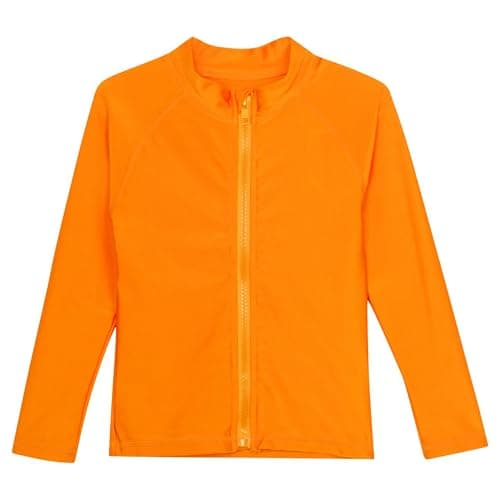
SwimZip Kids' Long Sleeve Rash Guard
A full-length front zip, which is the single feature that makes a wet rash guard removable from a toddler.
Specifications
- UPF
- 50+
- Closure
- Full-length front zip
- Sleeves
- Long
- Sizes
- Baby through youth
What works
- The full zip turns a two-adult wrestling match into a five-second job
- Zip garage at the chin stops the pinch that makes toddlers refuse zipped tops
- Certified UPF 50+ across the size range
- Baby sizes actually exist, which most rash-guard brands skip
What doesn’t
- The zip is a stiff line down the chest, noticeable lying on a float
- Zip is the part that eventually fails
Who it’s for
Babies and toddlers, or any child who fights having a wet top pulled over their head.
Bottom line
Buy the zip version for anyone under about four. The convenience is worth more than the fabric difference.
Does it get looser when it is wet?
Slightly, and this is the detail that catches people out when buying online. A polyester-spandex knit relaxes a little once it is soaked and warm, so a rash guard that feels perfect dry will feel a touch roomier in the water. A rash guard that feels tight dry will feel merely snug wet.
The practical rule: if you are between sizes and buying a performance fit, take the smaller one. If you are between sizes and buying a looser swim tee to wear over a suit, take the larger one. The one thing you should never do is buy a size up for growth — a loose rash guard on a child drags, rides up and gets rejected.
When loose is the right answer
There is a legitimate loose option and it is called a swim tee or a swim shirt. It is the same UPF 50+ fabric in a relaxed cut, meant to be worn over a swimsuit rather than against the skin.
| Snug rash guard | Loose swim tee | |
|---|---|---|
| Swimming and paddling | Yes | Drags and balloons |
| Standing in the water with kids | Fine | More comfortable |
| Hot, still days | Warmer against skin | Air moves; cooler |
| Chafe protection | Yes — the original job | Limited |
| Getting it on and off wet | Harder; a zip helps | Easy |
If the honest use is "supervising from waist-deep water for three hours," the loose version is the better purchase and you will wear it more. The distinction between the names is laid out in rash guard vs swim shirt.
Sizing a child's rash guard
Buy by chest measurement against the brand's own chart, not by age. Age sizing in swimwear is close to useless because the range of real chests inside any one age is enormous. Measure around the fullest part of the chest with the tape snug and level, and compare.
For toddlers, a full-length front zip is worth more than any other feature. Getting a wet long-sleeve top off a tired two-year-old is the whole problem, and a zip removes it. The same logic drives the toddler picks in best toddler rash guards and best baby rash guards.
Why fit changes the sun protection
A UPF 50+ rating is measured on the fabric, and stretching fabric thins it. A rash guard pulled hard over a larger frame than it was cut for has a measurably lower effective rating at the stretched areas — shoulders, chest, upper back — which is exactly where sun lands.
That is the argument against buying small on purpose. Snug keeps the fabric at its intended density; stretched to the limit does not. The numbers behind the rating are in UPF ratings explained.
And the areas the garment does not cover still need sunscreen — face, ears, neck, hands, feet. A rash guard is a sun strategy for the torso and arms, not for the whole body.
Questions
Frequently asked questions
Should a rash guard be tight or loose?
How do I know if my rash guard is too small?
Do rash guards stretch out over time?
Should I size up a rash guard for a child to grow into?
Is a tight rash guard better for sun protection?
Sources
Read next