Rash Guards · Guide
Are Rash Guards Hot to Wear?
Wet, a rash guard cools you. Dry and standing still, it can do the opposite.
The short answer
Wet, a rash guard cools you — evaporation off the fabric pulls heat away faster than bare skin dries. Dry, in still air, a long-sleeve synthetic layer does feel warm. The variables that decide it are fabric weight, color, fit and whether you stay in and out of the water.
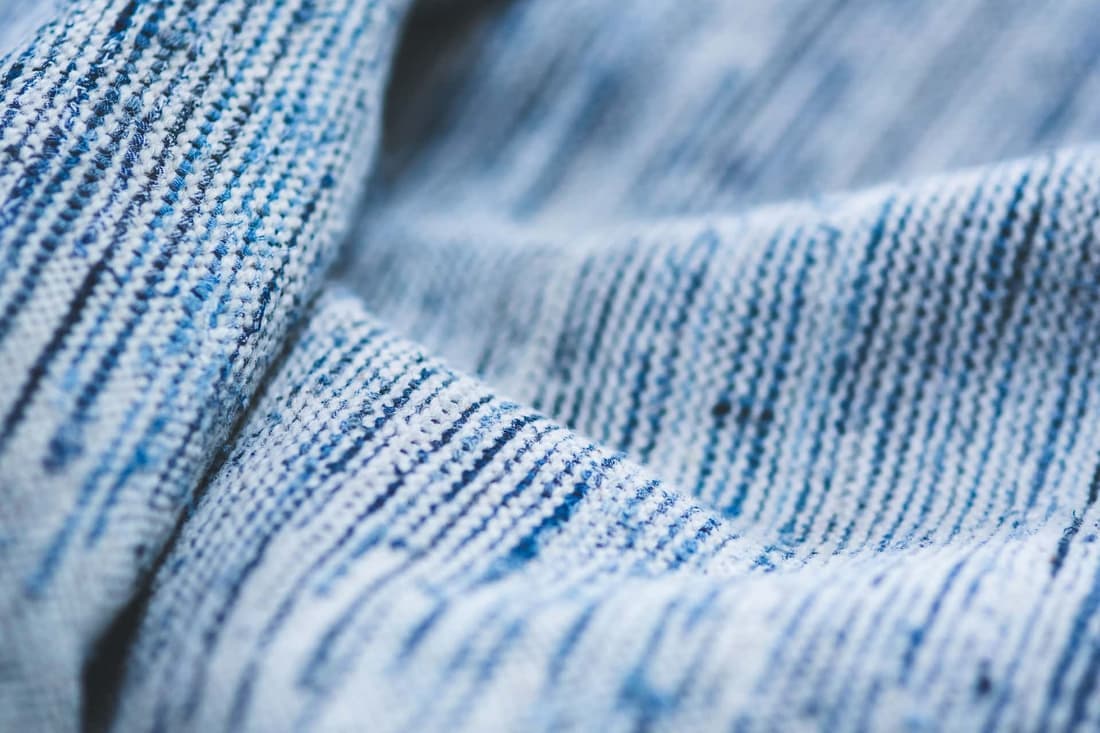
Product photos are the retailer’s own catalogue images, shown from the retailer’s servers and refreshed daily. Any other photo here is a licensed image that illustrates the category, not a photograph of the specific product named.
The honest answer, in two parts
Wet, a rash guard is cooler than bare skin. A thin synthetic layer holds a film of water against you and keeps releasing it to the air. Evaporation is the body's most effective cooling mechanism, and a damp rash guard extends it for far longer than skin that dries in two minutes. This is why surfers and lifeguards wear them in the hottest part of the day.
Dry, in still air, it is warmer than nothing. A long-sleeve knit is insulation, and once it has dried out it traps a layer of warm air against the skin. On a dock with no breeze at two in the afternoon, a dry rash guard feels hot, and people are not imagining it.
So the real question is not whether rash guards are hot — it is whether your day keeps the fabric damp. A lake day with regular swims keeps it damp, and the guard is a cooling garment. A boat day in the sun with one swim at lunchtime does not, and it is a warm one.
Against the alternative, though, the comparison is not bare skin — it is bare skin plus repeated sunscreen, plus whatever sunburn you end up with. A sunburned back radiates heat for two days. That is the trade most people are actually making.
The four variables that decide it
Fabric weight. The single biggest factor. A 6 oz performance knit breathes and dries fast; a thick, dense fabric sold on durability holds heat. Weight is usually listed on good product pages and almost never on cheap ones, which is itself informative.
Color. A black guard in direct sun gets measurably hotter than a light one. Dark colors do absorb more UV as well, which is the counter-argument, but on a hot still day the comfort difference is real. The full trade-off is in best rash guard colors for kids.
Fit. A guard that is too tight restricts the air movement that carries heat away and clings when dry. A guard that is too loose balloons in the water and rides up. Close but not compressive is the target, and it is a comfort decision as much as a performance one.
Ventilation features. A quarter zip you can open on land, a mock neck you can push down, a looser swim-tee cut rather than a surf cut. These matter much more on a hot dry day than any fabric marketing does.
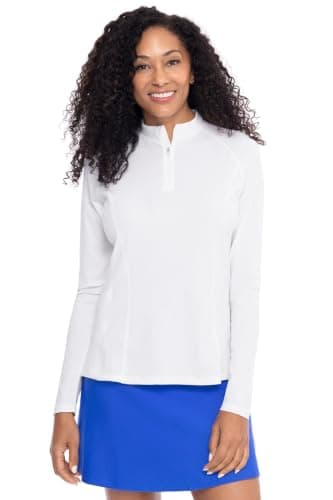
Coolibar Women's Freestyle Long Sleeve Quarter Zip Rash Guard
Coolibar's Aqua Classic knit in a quarter-zip, with a stand collar, a side zip pocket and a drop tail hem.
Specifications
- UPF
- 50+, Skin Cancer Foundation seal
- Fabric
- 84% recycled polyester / 16% elastane
- Closure
- Quarter zip, stand collar
- Extras
- Side zip pocket, drop tail hem
- Length
- 25 in. body (size M)
What works
- A drop tail hem is the direct fix for the failure mode that matters — the lower back coming uncovered
- A quarter zip lets you vent on a hot day without taking the shirt off
- Chlorine- and saltwater-resistant Aqua Classic knit, with the rating in the fabric rather than a finish
- A zip pocket on a swim shirt is genuinely useful for a key or a card
What doesn’t
- The most expensive pick here by a clear margin
- A stand collar plus a zip is more garment than a plain crew, and warmer on a still, hot day
- Sold through Coolibar and a handful of stockists, so trying one on in person is unlikely
Who it’s for
Women who want the knit-based protection and will use the pocket, the vent and the longer hem.
Bottom line
The women's upgrade. If the drop tail and the pocket do not matter to you, the O'Neill does the same sun job.
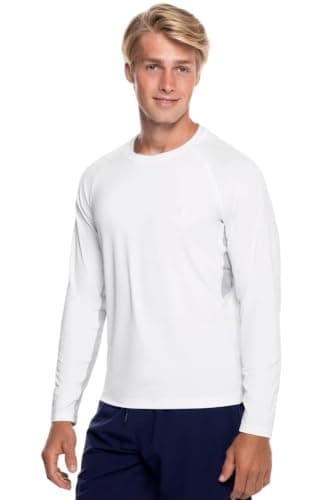
Coolibar Men's Tulum Long Sleeve Surf Rash Guard
UPF 50+ built into the knit rather than applied to it, with a mock neck that covers the spot everyone misses.
Specifications
- UPF
- 50+, Skin Cancer Foundation seal
- Fabric
- Aqua Classic, 100% polyester
- Neck
- Mock
- Sleeves
- Raglan, flatlock seams
- Length
- 28 in. body (size L)
What works
- The rating comes from the fabric construction, so it does not wash out the way a chemical finish does
- Chlorine- and saltwater-resistant, which is unusual at any price and means pool days do not degrade it
- A mock neck covers the back of the neck — the spot sunscreen gets missed on most often
- Raglan sleeves and flatlock seams leave nothing to rub across the shoulders
What doesn’t
- Costs roughly double the mainstream picks, and the extra buys durability rather than a higher rating
- Coolibar's stock thins out as the season runs on; colors and sizes sell through and do not always return
- A mock neck is a preference, not an upgrade — some people find it warm on a hot day
Who it’s for
Fair or reactive skin, a history of burning, or a medical reason to keep UV exposure down.
Bottom line
Worth the premium when you are relying on the garment rather than supplementing with sunscreen.
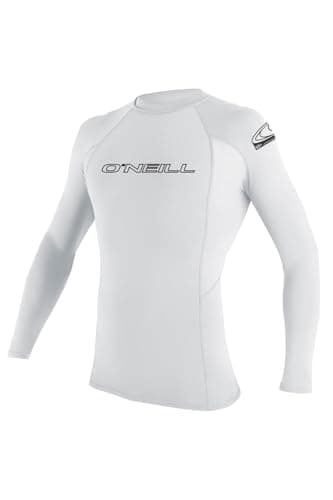
O'Neill Kids' Basic Skins UPF 50+
A close-fitting surf rash guard with minimal seams — the one that does not ride up when a child swims.
Specifications
- UPF
- 50+
- Fit
- Performance, close
- Sleeves
- Long
- Seams
- Minimal, flatlock
What works
- Close fit is the point — a loose swim shirt balloons and rides up, leaving the back exposed
- Flatlock seams do not chafe under the arms on a long day
- Holds UPF 50+ after repeated washing, unlike treated-fabric shirts
- Made by a surf brand, so it is built for repeated saltwater and chlorine
What doesn’t
- Sizing runs slim; check the chart rather than buying by age
- Close fit is harder to pull on over wet skin
Who it’s for
A child who swims and plays hard, where a loose shirt would not stay put.
Bottom line
The default kids' rash guard. Size up one if you want it to last two summers.
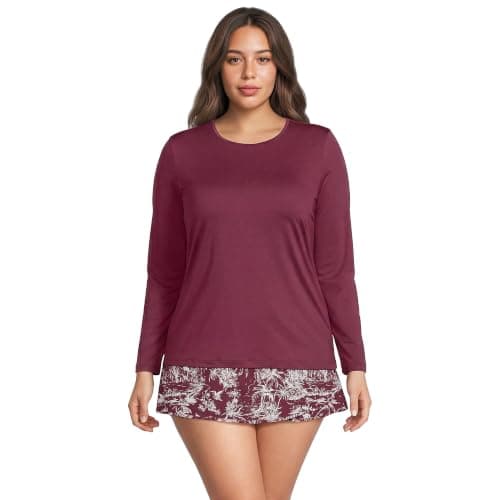
Lands' End Women's SunShade UPF 50 Long Sleeve Rash Guard Swim Tee
The widest size range in the category — regular, petite, plus and long torso — in a LYCRA Xtra Life blend.
Specifications
- UPF
- 50
- Fabric
- LYCRA Xtra Life spandex blend
- Fit
- Swim tee, worn over a suit
- Size ranges
- Regular, petite, plus, long torso
- Colors
- 7
What works
- A long-torso option, which is the one thing that stops a rash guard riding up on a tall frame
- Petite and plus ranges as standard rather than an afterthought
- LYCRA Xtra Life is the spandex built to resist chlorine and sunlight degradation, so the shape lasts
- Cut to pull on over a swimsuit without a fight, wet or dry
What doesn’t
- A swim tee rather than a surf cut, so it is looser and will ride up more than a performance guard while you swim
- No zip and no thumbholes — it is a plain tee shape
- Rated UPF 50 rather than 50+, which is roughly one percentage point of transmitted UV but a difference nonetheless
Who it’s for
Anyone the standard S-M-L block does not fit, and anyone who wants cover rather than compression.
Bottom line
The pick if fit has been the problem. Size by the chart and take the long-torso option if you are tall.
Which guard for a hot day
| Conditions | What to wear | Why |
|---|---|---|
| In and out of the water all day | Any close-fitting UPF 50+ guard | Stays damp, so it cools |
| Hot, still, mostly on land | Light color, quarter zip, loose cut | Vents, and reflects more heat |
| Boat day, lots of sun, few swims | Loose swim tee over a suit | Air moves under it |
| Cool water, breezy | Standard surf-cut guard | A little warmth is welcome |
| Very sun-sensitive skin | Dense UPF 50+ fabric, long sleeve | Protection outranks comfort |
| Small children | Zip-front, light color | Easy on and off, less heat |
Practical ways to stay cooler in one
- Keep it wet. Dunk the sleeves and the back every twenty minutes even if you are not swimming. A damp guard cools; a dry one does not.
- Choose light colors for hot, still days and save dark ones for cooler or breezy conditions.
- Open the zip or push the collar down whenever you are on land and out of direct sun.
- Size for a close fit rather than a tight one. Compression does nothing for you here and makes the garment feel hotter.
- Take it off in the shade. A rash guard is sun protection, and in full shade it is just a layer.
Children and heat
Children run hotter than adults and are worse at noticing it, so a toddler in a dark long-sleeve guard on a hot dock is a genuine thing to watch. The same rules apply, more strictly: lighter fabric, lighter color, and keep them wet.
What a rash guard buys you in exchange is the thing that is actually hard with children — reapplying sunscreen to a wriggling child every two hours. A guard covers the shoulders, upper back and arms permanently, and the remaining sunscreen job is face, neck, hands and legs. For most parents that trade is decisive. The picks by age are in best kids' rash guards and best toddler rash guards.
Questions
Frequently asked questions
Are rash guards hot to wear?
Are rash guards cooler than going shirtless?
Is a black rash guard hotter than a light one?
Should a rash guard be loose to stay cool?
Do kids overheat in rash guards?
Read next