Swim Goggles · Comparison
Swim Goggles for Kids Who Wear Glasses
Goggles do not fit over glasses. These are the three things that actually work.
The short answer
Goggles cannot be worn over glasses — the arms break the gasket seal at the temple. The three working options are prescription goggles sold by diopter, a frame with swappable optical lenses for a changing prescription, or contact lenses under standard goggles, which we would avoid in lake water.
Photos on this page are licensed images that illustrate the category. They are not photographs of the specific products named, and no product image here is supplied by a manufacturer or retailer.
Let us start with the thing being searched for, because the search phrase itself contains a false premise: there is no goggle that fits over glasses. The arms of the glasses cross the gasket line at the temples, and any gasket crossed by a rigid object leaks. Products marketed as fitting over glasses are swim masks, and they work by replacing the glasses, not by accommodating them.
| Prescription goggles | Swappable optical lenses | Contacts under goggles | |
|---|---|---|---|
| How it works | Corrective lenses molded into the goggle, ordered per eye by diopter | Standard frame, diopter lenses you pop in and out | Normal goggles, correction on the eye |
| Correction range | Roughly -1.5 to -8.0 | Roughly -1.5 to -6.0, half steps | Whatever the prescription is |
| Handles astigmatism | No | No | Yes |
| Cost when the prescription changes | A new goggle | A new lens | Nothing |
| Risk of loss | Low | Low | A lens can wash out mid-swim |
| Infection risk in lake water | None | None | Real — contacts trap water against the eye |
| Best for | A stable prescription | A child whose eyes are still changing | Astigmatism, or short pool swims |
Choose prescription goggles if...
- The prescription is stable, or strong enough that the wider -8.0 range matters.
- You want one purchase with nothing to lose or assemble.
- The swimmer is a child who will treat anything removable as losable.
- Correction is spherical — nearsightedness without significant astigmatism.
One practical note: these are sold per lens, so a child with different strengths in each eye is properly corrected. Round to the nearest available step and, if in doubt, round toward slightly less correction — over-correcting underwater is more disorienting than under-correcting.
Choose swappable optical lenses if...
- The child's prescription is still moving, which for most children it is.
- You would rather buy a lens next year than a whole goggle.
- Half-step diopter increments matter — they land closer to a real prescription than full steps.
- You want a deeper, softer gasket for longer comfortable swims.
Be clear on the real cost: frames and lenses are usually sold separately, so the first purchase is more than the frame price suggests. It pays back the first time a prescription changes.
Choose contacts under standard goggles if...
- There is significant astigmatism, which no optical goggle corrects.
- The swim is in a clean, chlorinated pool rather than open water.
- The child is old enough to manage lenses independently.
Our picks
Speedo Vanquisher 2.0 Optical
The standard Vanquisher frame with corrective lenses sold per eye by diopter — the real answer for a swimmer in glasses.
Specifications
- Correction
- -1.5 to -8.0 diopters
- Sold
- Per lens, mix strengths
- Frame
- Vanquisher 2.0, low profile
- Lens
- Anti-fog, UV
What works
- You can order two different strengths, so an unequal prescription is properly corrected
- Same proven frame and bridge system as the standard Vanquisher
- Far cheaper than custom-ground prescription goggles
- No contact lenses in lake water, which is the outcome that actually matters
What doesn’t
- Spherical correction only — it does nothing for astigmatism
- Diopter steps are coarse, so you round to the nearest step
Who it’s for
An older child, teenager or adult who cannot see without glasses and currently swims blind or in contacts.
Bottom line
Goggles do not fit over glasses and never will. This frame, or the Aqua Sphere Eagle Optical, is the actual fix.
Aqua Sphere Eagle Optical
Swappable diopter lenses in a comfortable frame, so a changing prescription costs a lens rather than a goggle.
Specifications
- Correction
- -1.5 to -6.0 diopters
- Lenses
- Interchangeable, half-step increments
- Gasket
- Premium silicone
- Lens
- Anti-fog, scratch-resistant, UVA/UVB
What works
- Pop-and-swap lenses mean a child whose eyes are still changing keeps the frame and buys a lens
- Half-step increments land closer to an actual prescription than full steps
- Softer, deeper gasket than a racing frame, so it suits long relaxed swims
- Scratch-resistant coating on a lens you are paying extra for
What doesn’t
- Frame and lenses are usually sold separately, so the real cost is higher than the frame price suggests
- Correction stops at -6.0, which is not enough for a strong prescription
Who it’s for
A swimmer whose prescription is still moving, or anyone who wants one frame to cover several strengths.
Bottom line
The better long-run buy if the prescription is changing. If it is stable and strong, the Vanquisher Optical goes further.
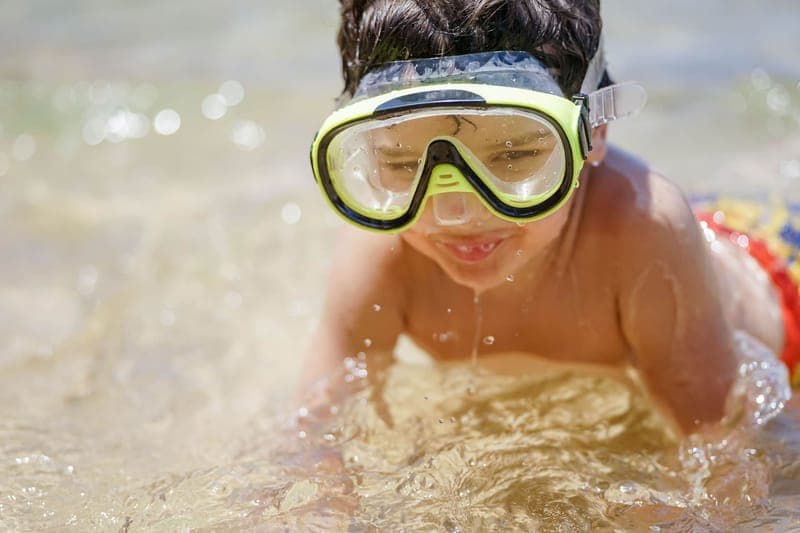
Aqua Sphere Vista
A swim mask, not goggles: it seals around the whole eye area and the nose, so nothing presses on the eye socket.
Specifications
- Type
- Swim mask
- Seal
- Around eyes and nose
- Field of view
- Very wide
- Lens
- Anti-fog, UV
What works
- No pressure on the eye socket at all, which solves the most common reason a child refuses goggles
- Covers the nose, so water does not go up it — a real fear for beginners
- Very large field of view
- Sizing runs wide enough to cover older children as well as adults
What doesn’t
- Bulky and draggy, so it is wrong for anyone swimming laps for time
- You breathe through the mouth only, which takes some children a session to accept
Who it’s for
A child who has rejected two or three pairs of conventional goggles, or who panics about water up the nose.
Bottom line
The escape hatch when nothing else works. Not a training choice — but a child in a mask is a child in the water.
What about swim masks?
A swim mask seals around the whole eye area and the nose, which puts the gasket line well outside where glasses arms would sit. It still does not work over glasses — the arms are inside the seal and press on it — but it does solve a related problem: a child who needs correction, cannot use contacts, and is waiting on prescription goggles can at least see the shape of things through a large-lens mask.
It is also the right answer for a different child entirely: one who refuses goggles because of eye-socket pressure. See best kids' swim goggles for that case.
Questions
Frequently asked questions
Can you wear swim goggles over glasses?
How much do prescription swim goggles cost?
Do prescription goggles correct astigmatism?
What diopter should I order?
Read next