Baby & Toddler · Guide
What Size Swim Diaper Do I Need?
Size by weight, then check the legs. Age on the packet is the least useful number on it.
The short answer
Size a swim diaper by weight, not by age, and then check the leg seal — it should sit flat against the skin with no gap you can slide a finger into. Huggies Little Swimmers run size 3 small at 16-26 lbs, size 4 medium at 24-34 lbs and size 5-6 large at 32 lbs and up.
Product photos are the retailer’s own catalogue images, shown from the retailer’s servers and refreshed daily. Any other photo here is a licensed image that illustrates the category, not a photograph of the specific product named.
Weight, not age
Swim diapers are sized by weight for the same reason regular diapers are: two children of the same age can be ten pounds apart, and ten pounds is more than a whole size band. Age printed on a packet is a rough translation of a weight band, and translating twice is how people end up with the wrong box.
There is a second reason weight matters more here. A swim diaper does not absorb — it contains. Containment depends entirely on the seal at the legs and the waist, so the fit is not merely more comfortable at the right size, it is the only thing making the product work at all.
That is also why sizing up for growth is the wrong instinct. With a regular diaper a slightly big one still absorbs. With a swim diaper a slightly big one has a gap at the leg, and a gap at the leg is a pool closure.
Weigh the child rather than estimating. The difference between 23 lbs and 27 lbs puts you in different sizes with most brands, and parents consistently guess high.
Disposable weight bands
| Size | Label | Weight range |
|---|---|---|
| Size 3 | Small | 16-26 lbs |
| Size 4 | Medium | 24-34 lbs |
| Size 5-6 | Large | 32 lbs and up |
Note the deliberate overlap between bands. Where your child's weight falls inside two sizes, the smaller one is usually right, because containment depends on a snug leg. Pampers Splashers cover a wider overall range, starting lower and running higher, which makes them the option for a small baby or a large toddler at the edges of the Huggies run.
Packaging changes, and the weight range printed on the pack in your hand is the authoritative number rather than anything on a website. Check it before you buy a multipack you cannot return.
Reusables work differently
Reusable swim diapers come two ways. Sized reusables cover one band, much like a disposable, and fit that band well. Adjustable reusables use rows of snaps on the front and side to cover a far wider range — commonly around 8 to 36 lbs on a single garment.
The adjustable kind is why reusables make financial sense: one purchase spans the whole pre-trained period rather than three. The trade is that a diaper engineered to fit a range fits any single point in that range slightly less precisely than a sized one does.
Practical advice either way: own at least two. One in the wash or hanging to dry means the other is available, and a family swimming twice a week with one diaper will end up buying disposables anyway. The full cost comparison is in reusable vs disposable swim diapers.
Beau & Belle Littles Nageuret Reusable
An adjustable-snap reusable that covers roughly 8 to 36 lbs, so one diaper lasts the whole non-trained period.
Specifications
- Type
- Reusable, adjustable
- Weight range
- Approx. 8-36 lbs
- Closure
- Snap rows plus side snaps
- Layers
- 2, mesh inner
What works
- Snap rows mean one diaper spans infancy to toddlerhood instead of two or three purchases
- Side snaps let you remove it without pulling it down a leg, which matters after an accident
- Slim enough to fit under a swimsuit without bulking the waist
- Dries quickly between sessions
What doesn’t
- Adjustable snaps fit a range well and any single size less perfectly than a sized diaper
- Only two layers, so containment is tighter than the i play but less forgiving
Who it’s for
Families who want one diaper to cover the whole pre-trained period, or who are buying before a baby arrives.
Bottom line
The best value across the whole period. If you only need one size right now, the i play fits better.
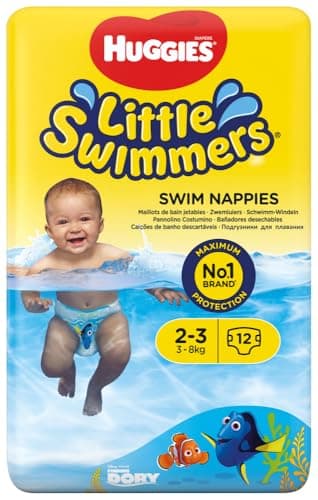
Huggies Little Swimmers
The disposable standard, with a double leak guard and a stretchy waist — and available in every supermarket.
Specifications
- Type
- Disposable
- Sizes
- Small to large (approx. 16-34+ lbs)
- Guards
- Double leak guard
- Removal
- Pull-on with tear sides on some sizes
What works
- Genuinely the most available swim diaper — you can buy them mid-trip anywhere
- Double leak guard is the best containment in the disposable tier
- No rinsing, no washing, no wet bag in the car
- Fine for a one-off pool party or a holiday week
What doesn’t
- Costs add up fast — a weekly swimmer spends well over a hundred dollars a season
- Bulks up when wet, so the waistband gaps under a swimsuit
Who it’s for
Occasional swimmers, travel, and anyone without laundry access.
Bottom line
Right for occasional use, expensive as a habit. Swimming weekly? Buy two reusables instead.
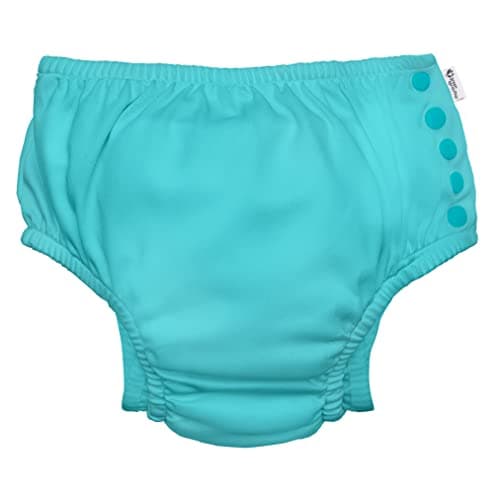
i play. by green sprouts Reusable Swim Diaper
The reusable standard: a snug three-layer diaper with a UPF 50+ outer that meets public-pool rules.
Specifications
- Type
- Reusable
- Layers
- 3, with absorbent inner
- UPF
- 50+ outer
- Sizes
- 6 months to 5T
What works
- Snug leg elastic is what public pools actually check for, and this passes
- Pays for itself in about a month of weekly swimming
- Sizes run up to 5T, well past where disposables stop being practical
- Machine washable and survives a full season
What doesn’t
- Has to be rinsed immediately after use or it smells
- Absorbs nothing meaningful, so it is containment only — it does not hold urine
Who it’s for
A baby or toddler swimming weekly or more, where disposables become a recurring cost.
Bottom line
The reusable to buy. Own two so one is always dry; a single one is not enough for back-to-back sessions.
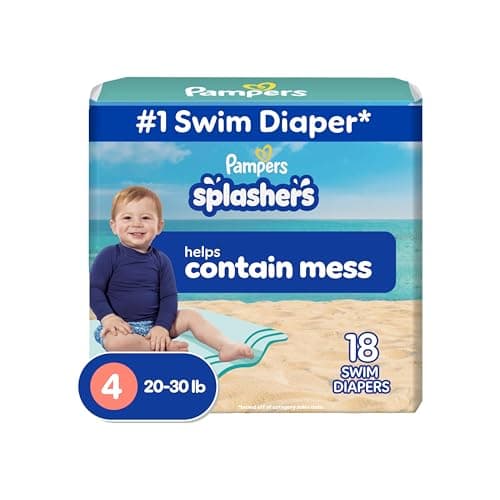
Pampers Splashers
Disposable containment comparable to Huggies, with tear-away sides that matter more than they sound.
Specifications
- Type
- Disposable
- Sizes
- Approx. 13-41+ lbs
- Sides
- Tear-away
- Guards
- Dual leak-guard barriers
What works
- Tear-away sides mean a soiled diaper comes off without going down the legs
- Containment is on par with Huggies in practice
- Slimmer fit when wet than most disposables
- Widely stocked
What doesn’t
- Same recurring cost problem as every disposable
- Tear-away sides occasionally give way early on an active toddler
Who it’s for
Toddlers likely to have an accident, where removal method genuinely matters.
Bottom line
Pick between these and Huggies on fit and price — containment is equivalent. Tear-away sides are the real differentiator.
The leg seal is the actual size test
- Put the diaper on dry and look at the legs. The elastic should lie flat against the skin all the way around the thigh, with no bunching and no visible gap.
- Run a finger around the leg opening. You should feel resistance, not space. If a finger slides in easily, the size is too big or the cut is wrong for this child's legs.
- Check for red marks after ten minutes. Deep indentations mean too small, which chafes and is why toddlers start refusing the diaper.
- Check the waist sits at or just below the navel without rolling down. A rolled waistband drags the leg elastic out of position.
- Test in shallow water before the first proper swim. A diaper that holds dry and gapes wet is the wrong fit, and better discovered at the shoreline than in a public pool.
Chunky thighs are the most common reason a correctly weighted diaper still fails. If the waist fits and the legs gap, move to an adjustable reusable, which sets waist and rise independently of the leg cut, rather than going up a size and making the gap worse.
Common sizing questions, answered plainly
| Situation | What to buy | Why |
|---|---|---|
| Between two disposable sizes | The smaller size | Containment needs a snug leg |
| Chunky thighs, slim waist | Adjustable reusable | Waist and legs set independently |
| Newborn to about 8 lbs | Smallest adjustable reusable | Disposable bands start higher |
| Swimming weekly or more | Two adjustable reusables | One purchase spans the whole period |
| Holiday or one-off pool party | Disposables in the right band | No washing, no wet bag |
| Potty training in progress | Reusable, side-snap opening | Comes off without going down a leg |
Does a swim diaper go under a swimsuit?
Yes, and the swimsuit should not change the size you buy. A swim diaper fits against the skin and the suit goes over it. A reusable is slim enough not to bulk the waist; a wet disposable is not, which is one of the quieter reasons families move to reusables.
What a swim diaper does not go over is a regular diaper, and that is the single most common mistake in this category — a regular diaper swells to several times its dry size in water and breaks the seal entirely. That is explained in do swim diapers go over regular diapers.
Questions
Frequently asked questions
What size swim diaper do I need?
What size swim diaper for a 1 year old?
Should you size up in swim diapers?
What size swim diaper for a 3 year old?
Do reusable swim diapers come in sizes?
Sources
Read next